Spain and Argentina Battle to a Scoreless Draw in Regulation Time During the 2026 FIFA World Cup Final in East Rutherford

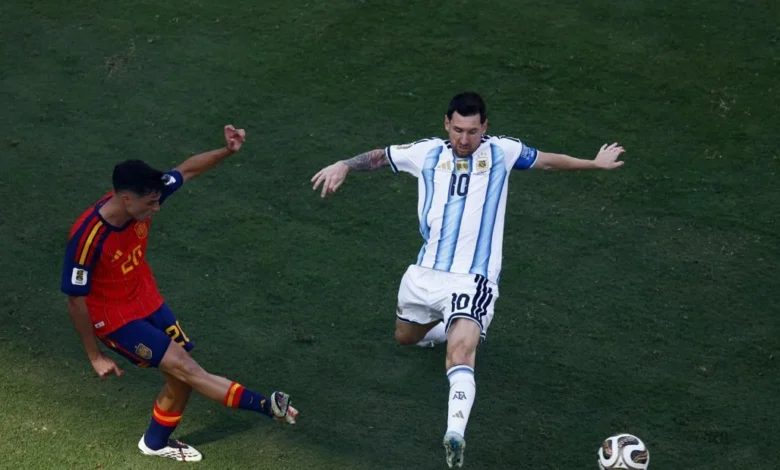
The 2026 FIFA World Cup final has reached a dramatic impasse as Spain and Argentina concluded 90 minutes of regulation time without a goal, forcing the most prestigious match in global football into a grueling 30 minutes of extra time. On a humid evening at the New Jersey Stadium in East Rutherford, the clash of titans showcased a profound contrast in styles: Spain’s relentless, rhythmic possession against Argentina’s resilient, physical, and disciplined defensive structure. Despite a flurry of late chances and a high-stakes red card in the dying moments of injury time, the scoreline remains 0-0, leaving the fate of the world title hanging in the balance.
The Tactical Chess Match in East Rutherford
From the opening whistle, Spain established their intent to dictate the tempo. Under the guidance of their technical staff, La Roja utilized a high defensive line and quick transitions to pin Argentina into their own half. The Spanish midfield, anchored by Rodri and Fabian Ruiz, circulated the ball with surgical precision, seeking to stretch the Argentine backline. Argentina, however, appeared prepared for this onslaught. Reverting to a compact 4-4-2 formation when out of possession, the Albiceleste focused on closing internal passing lanes and forcing Spain to play through the wide areas.
The physicality of the match was evident from the outset. Argentina, known for their "garra" or fighting spirit, did not hesitate to engage in heavy challenges to disrupt Spain’s flow. This tactical approach led to several stoppages as Spanish players frequently found themselves on the turf following robust tackles. The officiating team was kept busy as the intensity of a World Cup final fueled aggressive duels across every blade of grass.
First Half: Spanish Dominance and Argentine Resilience
Spain nearly broke the deadlock as early as the fifth minute. Lamine Yamal, the teenage sensation who has been the breakout star of the tournament, showcased his vision by playing a deft one-two with Dani Olmo. Exploiting a rare gap in the Argentine defense, Yamal unleashed a powerful strike aimed at the lower corner. However, Emiliano "Dibu" Martinez, Argentina’s hero from the 2022 campaign, proved why he is considered a big-game specialist by reacting quickly to smother the attempt.
Following the early scare, the match settled into a lower tempo. Spain maintained the lion’s share of possession, but Argentina’s defensive block, led by Cristian Romero and Lisandro Martinez, remained impenetrable. It wasn’t until the 38th minute that the crowd was brought to its feet again. Spain orchestrated a fluid move down the left flank, eventually finding Mikel Oyarzabal at the edge of the penalty area. Oyarzabal opted for a first-time left-footed strike, but the shot lacked the necessary placement to beat Martinez, who gathered the ball comfortably.
The closing stages of the first half were marked by rising tensions and a significant injury blow for the defending champions. In the 40th minute, Lisandro Martinez received the game’s first yellow card for a cynical foul on Oyarzabal. Just three minutes later, disaster struck for the Argentine camp as Lisandro Martinez was forced to leave the field due to a right thigh injury. The loss of a starting center-back in the first half of a World Cup final is a catastrophic scenario, forcing Lionel Scaloni to introduce the veteran Nicolas Otamendi earlier than planned.
Second Half: The Siege of the Argentine Goal
The second half mirrored the first in terms of territorial dominance, but the stakes felt significantly higher. Spain continued to probe, while Argentina looked to find an opening on the counter-attack, though Lionel Messi and Julian Alvarez found themselves increasingly isolated.
In the 64th minute, Dani Olmo found himself unmarked in a dangerous position just outside the box. However, his effort was uncharacteristically weak, allowing Emiliano Martinez to make an easy save. Three minutes later, Ferran Torres, who had just entered the pitch, nearly made an immediate impact. Lamine Yamal delivered a pinpoint cross that found Torres’ head, but once again, Martinez was positioned perfectly to deny the goal.
Recognizing the need for fresh energy, the Spanish bench introduced Nico Williams and Mikel Merino in the 75th minute. This double substitution injected pace into the Spanish attack, leading to a frantic final fifteen minutes. Pedri, also a second-half substitute, tested Martinez in the 77th minute with a low drive. Two minutes later, young defender Pau Cubarsi ventured forward and fired a shot from a narrow angle that forced a spectacular fingertip save from Martinez, resulting in a corner.
The pressure remained relentless. In the 80th minute, Aymeric Laporte rose highest to meet a Pedri cross, but his header lacked the power to beat the ever-vigilant Argentine goalkeeper. As the clock ticked toward 90 minutes, Spain’s Nico Williams forced another save in the 93rd minute, as the Spanish bench and fans alike began to wonder if Martinez was truly unbeatable.
Late Drama: Red Card and the Final Whistle
The match took a dramatic turn in the fourth minute of stoppage time. Enzo Fernandez, already under immense pressure in the midfield battle, committed a reckless challenge on Pau Cubarsi. The referee did not hesitate, brandishing a second yellow card followed by a red. Argentina was reduced to ten men at the most critical juncture of the match.
With seconds remaining, Spain was awarded a free kick in a dangerous position. Lamine Yamal stepped up, curling a magnificent effort over the wall. The ball seemed destined for the top corner, but Emiliano Martinez produced perhaps the save of the tournament, flying through the air to tip the ball away. The referee blew the whistle shortly after, signaling the end of 90 minutes and the beginning of a high-stakes extra-time period.
Statistical Overview of Regulation Time
The statistics from the first 90 minutes underscore Spain’s dominance in terms of volume, while highlighting Argentina’s efficiency in survival.
- Possession: Spain 68% – 32% Argentina
- Total Shots: Spain 16 – 4 Argentina
- Shots on Target: Spain 9 – 1 Argentina
- Corners: Spain 7 – 2 Argentina
- Fouls Committed: Argentina 14 – 8 Spain
- Saves: Emiliano Martinez (Argentina) 9 – Unai Simon (Spain) 1
Background and Context: A Final for the Ages
The 2026 FIFA World Cup, hosted across North America, has been a tournament of unprecedented scale. This final represents the culmination of a month-long journey that saw 48 teams compete for the first time in history. For Spain, this final is a chance to return to the pinnacle of world football for the first time since their 2010 triumph in South Africa. Their path to the final has been defined by a youth movement, with players like Lamine Yamal and Pau Cubarsi representing a new generation of "La Roja."
For Argentina, the stakes are equally historic. Having won the 2022 World Cup in Qatar and the 2024 Copa America, the Albiceleste are seeking to cement their status as one of the greatest dynasties in sporting history. This match is widely believed to be the final World Cup appearance for Lionel Messi, adding an emotional weight to every minute played.
Expert Analysis and Implications
Football analysts suggest that the red card for Enzo Fernandez significantly shifts the momentum in favor of Spain for the extra-time period. Playing with ten men for 30 minutes against a side that thrives on ball retention and lateral movement is an exhausting prospect.
"Spain has the numerical advantage and the technical superiority, but Argentina has Emiliano Martinez and a collective will that is difficult to break," noted a former international manager during the halftime analysis. "The injury to Lisandro Martinez earlier in the game already taxed their defensive depth. Now, without Enzo in the middle, Scaloni has to decide whether to park the bus and play for penalties or risk a counter-attack."
The physical toll of the match cannot be overstated. With the temperature in East Rutherford remaining high, fatigue will play a major role in the final 30 minutes. Spain’s depth on the bench, which has already seen the likes of Nico Williams and Pedri enter the fray, may be the deciding factor. Conversely, Argentina’s reliance on the brilliance of Martinez and the leadership of Messi will be tested to the absolute limit.
Conclusion of Regulation
As the teams prepare for the first 15-minute period of extra time, the atmosphere in the New Jersey Stadium is electric. The world watches as ten-man Argentina attempts to hold off a relentless Spanish side. Whether the match is decided by a moment of individual brilliance, a tactical error, or the clinical lottery of a penalty shootout, the 2026 World Cup Final has already lived up to its billing as a historic encounter between two of the world’s most storied footballing nations.
Lineups at the end of 90 minutes:
Spain: Unai Simon; Marc Cucurella, Aymeric Laporte, Pau Cubarsi, Pedro Porro; Fabian Ruiz (Pedri 62′), Rodri; Alex Baena (Nico Williams 75′), Dani Olmo (Mikel Merino 75′), Lamine Yamal; Mikel Oyarzabal (Ferran Torres 62′).
Argentina: Emiliano Martinez; Nicolas Tagliafico, Lisandro Martinez (Nicolas Otamendi 43′), Cristian Romero (Facundo Medina 70′), Gonzalo Montiel (Nahuel Molina 58′); Nico Gonzalez (Leandro Paredes 46′), Enzo Fernandez (Red Card 94′), Alexis Mac Allister, Rodrigo De Paul (Giuliano Simeone 70′); Julian Alvarez, Lionel Messi.