Palapa Ring Tengah Undersea Cable Segment Melonguane-Morotai Targeted for Restoration by August 11, 2026, Following Seismic Activity

The Indonesian government, through the Telecommunications and Information Accessibility Agency (BAKTI) of the Ministry of Communication and Digital (Komdigi), is accelerating the restoration of the Palapa Ring Tengah undersea cable network, specifically the Melonguane-Morotai segment, which sustained damage due to tectonic activity. The official target for the full restoration of services is set for August 11, 2026.
Darien Aldiano, the Acting Director of Infrastructure at BAKTI Komdigi, clarified that the damage is not a complete severance of the network but rather a partial break in the undersea fiber optic cables. This proactive approach to repair is a critical preventive measure aimed at averting more widespread disruptions to telecommunication services across the northern Sulawesi archipelago.
"Based on technical monitoring results, the anomaly in this undersea cable route occurred following tectonic activity, specifically a magnitude 5.7 earthquake on May 26, 2026, and several subsequent strong tremors felt in the Melonguane-Morotai segment," Darien Aldiano stated in a press release on July 23, 2026. The detected damage is located at a depth of approximately 3,400 meters, roughly 95 kilometers from the Morotai Terminal Station (TS). The extreme depth of the damage necessitates the deployment of specialized vessels equipped for deep-sea cable splicing operations, a complex and technically demanding undertaking.
Background: The Palapa Ring Project and its Significance
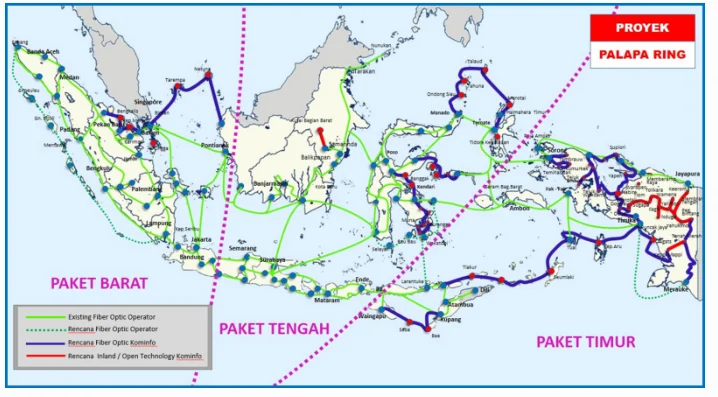
The Palapa Ring project, initiated by the Indonesian government, represents a monumental undertaking to establish a comprehensive and equitable national telecommunications network. Its primary objective is to bridge the digital divide by providing reliable internet access to all regions of Indonesia, including remote and underserved areas. The Palapa Ring consists of a vast network of fiber optic cables that encircle the Indonesian archipelago, connecting its many islands and ensuring that even the most distant communities can benefit from the digital revolution. The project is divided into three main segments: Palapa Ring Barat (West), Palapa Ring Tengah (Central), and Palapa Ring Timur (East). The Palapa Ring Tengah segment, which connects various islands in the northern Sulawesi region, plays a crucial role in the digital connectivity of these strategically important archipelagos. The successful operation of this segment is vital for economic development, public services, and social connectivity.
Chronology of the Incident and Response
The incident began to unfold on May 26, 2026, when a magnitude 5.7 earthquake struck the region. This seismic event, followed by several aftershocks, caused significant stress on the undersea infrastructure. Initial monitoring by BAKTI detected anomalies along the Palapa Ring Tengah cable route.
- May 26, 2026: A magnitude 5.7 earthquake occurs in the northern Sulawesi region, followed by multiple tremors.
- Post-May 26, 2026: BAKTI’s technical teams begin monitoring the Palapa Ring Tengah cable segment, specifically the Melonguane-Morotai link, for any signs of disruption.
- Early July 2026: Technical monitoring confirms damage to the undersea fiber optic cables at a significant depth. The nature of the damage is identified as a partial break.
- July 23, 2026: BAKTI Komdigi officially announces the damage and the commencement of accelerated restoration efforts. The target for service restoration is set for August 11, 2026.
- July 28, 2026: The specialized cable repair vessel is scheduled to depart from Bitung for Morotai, following the completion of all administrative procedures and maritime permits.
- August 2026 (Estimated 12 days): A critical period of service interruption is anticipated as the technical repair process involves severing and splicing the cable.
- August 11, 2026: The targeted date for the full operational readiness of the Palapa Ring Tengah segment Melonguane-Morotai.
Impacted Regions and Mitigation Strategies
The damage to the Melonguane-Morotai segment has directly impacted telecommunication services in three key regencies within North Sulawesi Province: Kepulauan Sangihe, Kepulauan Talaud, and Kepulauan Siau Tagulandang Biaro (Sitaro). These regencies are characterized by their island geography, making undersea cables the primary conduit for robust internet connectivity.
"We extend our apologies for the inconvenience experienced by the affected communities in Kepulauan Sangihe, Talaud, and Sitaro," stated Darien Aldiano. He further assured the public, "We ensure that our entire team is working to the best of their ability in the field to expedite the recovery of this vital infrastructure, aiming to realize quality connectivity throughout Indonesia."

During the restoration period, BAKTI is implementing a crucial mitigation strategy by optimizing existing internet access points that rely on the SATRIA-1 satellite. A total of 286 such service points are operational within the affected regions. These include 106 locations in Kepulauan Sangihe, 48 in Kepulauan Sitaro, and 132 in Kepulauan Talaud. To enhance their effectiveness, the bandwidth capacity of these satellite-based access points is being upgraded to levels ranging from 50 Mbps, 100 Mbps, to 150 Mbps, tailored to the specific needs of each location. These internet access points are strategically situated in public facilities such as government offices, schools, community health centers (puskesmas), hospitals, and critical defense and security installations, ensuring that essential services remain accessible.
Technical Challenges and Operational Details
The restoration process presents significant technical hurdles. The damage occurring at a depth of 3,400 meters requires advanced technology and specialized expertise. The repair vessel must be capable of operating in deep-sea conditions, accurately locating the damaged section, and performing precise splicing of the fiber optic cables. This process is meticulous and time-consuming, demanding a high degree of accuracy to ensure the integrity and long-term functionality of the repaired cable.
The estimated 12-day period of service interruption is a critical phase where the existing connection will be temporarily severed to allow for the physical repair work. This proactive approach, while causing a temporary outage, is designed to prevent further degradation of the cable and ensure a stable and reliable connection once the repairs are completed.
Collaboration and Stakeholder Involvement
The successful and timely restoration of the Palapa Ring Tengah cable segment is a collaborative effort involving multiple stakeholders. BAKTI is working closely with the Directorate General of Digital Infrastructure of Komdigi, PT Len Telekomunikasi Indonesia, PT Surveyor Indonesia, various telecommunication operators, and other key parties. This coordinated approach is essential for navigating the complex logistical, administrative, and technical aspects of the repair operation. The finalization of all administrative requirements and maritime permits for the repair vessel’s journey from Bitung to Morotai, scheduled for July 28, 2026, underscores the intricate planning involved.
Broader Implications and Analysis
The incident highlights the inherent vulnerability of critical digital infrastructure, particularly undersea cables, to natural phenomena like seismic activity. While the Palapa Ring project represents a significant advancement in Indonesia’s digital connectivity, the reliance on a single undersea cable segment for multiple regions underscores the importance of redundancy and resilience in the network architecture.
The proactive mitigation strategy utilizing SATRIA-1 satellite services demonstrates BAKTI’s commitment to maintaining essential connectivity during disruptions. The optimization of bandwidth for these satellite points is a pragmatic solution that helps to alleviate the immediate impact on public services and communication. However, the bandwidth limitations of satellite technology compared to fiber optic cables mean that full service restoration will be crucial for optimal digital experiences.
The target restoration date of August 11, 2026, while seemingly distant, reflects the complex and time-sensitive nature of deep-sea cable repair. The government’s commitment to expediting this process is a testament to the critical role of digital connectivity in modern society, impacting everything from economic activities and education to healthcare and national security.
As Indonesia continues to expand its digital infrastructure, lessons learned from incidents like this will likely inform future planning, potentially leading to the development of more robust and resilient network designs, including the exploration of alternative routes and backup systems. The ultimate goal remains to ensure that no community is left behind in the digital age, and the successful restoration of the Palapa Ring Tengah cable is a vital step in achieving that objective. The focus now shifts to the meticulous execution of the repair plan and the swift return of seamless digital connectivity to the affected island communities.