Massive Walkout Greets Benjamin Netanyahu at UN General Assembly as Diplomatic Isolation Deepens

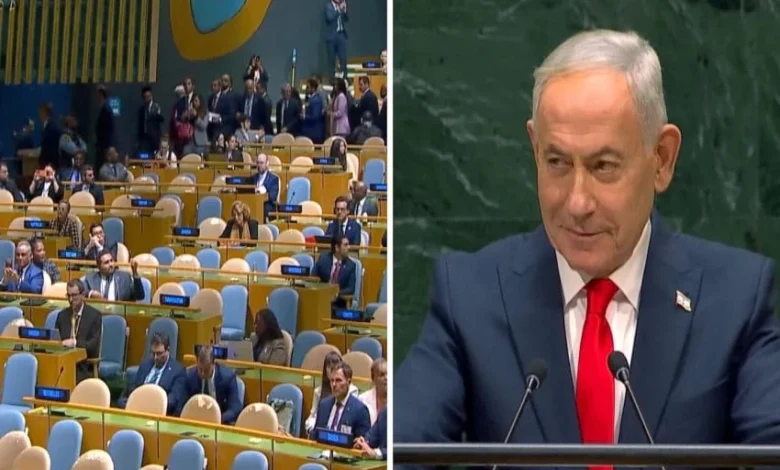
The 79th session of the United Nations General Assembly in New York witnessed a stark display of diplomatic friction on Thursday, September 24, 2026, as dozens of international delegates staged a mass walkout from the assembly hall the moment Israeli Prime Minister Benjamin Netanyahu approached the podium. The protest, which left large swathes of the chamber vacant, serves as a potent symbol of the accelerating international isolation facing the Israeli administration amidst the ongoing humanitarian crisis in the Gaza Strip.
The atmosphere in the United Nations headquarters was palpably tense well before the Prime Minister’s address. As Netanyahu ascended the dais to deliver his speech, scores of diplomats from various member states stood in unison and exited the hall, a rare and highly visible rebuke in the context of high-level multilateral diplomacy. The walkout was not merely a spontaneous outburst but appeared to be a coordinated gesture of disapproval from nations deeply critical of Israel’s military conduct in the Palestinian territories.
A Backdrop of Protest and International Scrutiny
The scenes inside the General Assembly hall mirrored the unrest occurring outside the UN complex. Throughout the week, New York City has been the site of large-scale demonstrations organized by a diverse coalition of groups, including pro-Palestinian activists, Jewish anti-Zionist organizations, and local American advocacy groups. These protesters have consistently labeled the Israeli military campaign in Gaza as a genocide, calling for the immediate cessation of hostilities and the arrest of Israeli leadership.
Among the demonstrators were members of various Orthodox Jewish groups who held placards identifying Netanyahu as a war criminal. This segment of the protest highlights a growing divide within the global Jewish community regarding the policies of the Israeli government. The protesters argued that the current military strategy has failed to achieve security for either Israelis or Palestinians, instead resulting in a catastrophic loss of civilian life and the systematic destruction of infrastructure in Gaza.
The ICC Status and Legal Implications
A critical factor underpinning the current international climate is the status of Benjamin Netanyahu as a person of interest for the International Criminal Court (ICC). Since 2024, the ICC has maintained a high-profile investigation into alleged war crimes and crimes against humanity committed during the conflict that erupted in October 2023.
While the legal processes of the ICC are complex and slow-moving, the stigma of being a potential subject of international arrest warrants has fundamentally altered the diplomatic landscape for the Israeli Prime Minister. His attendance at the UN General Assembly was seen by some analysts as an attempt to project strength and defiance on the world stage, yet the empty seats in the auditorium suggested that the message was received differently by the international community. The walkout effectively signaled that for many nations, the standard diplomatic courtesies traditionally afforded to heads of state are increasingly being withheld in light of the ongoing allegations of systemic human rights abuses.
Netanyahu’s Retort: Defiance in the Face of Criticism
Visibly agitated by the mass departure of delegates, Prime Minister Netanyahu utilized his time on the podium to adopt a confrontational tone. Rather than focusing solely on his prepared remarks regarding regional security or the Iranian threat, he directly addressed the dissenters.
"You try to silence me, but you cannot silence the truth," Netanyahu declared. He labeled those who participated in the walkout as "moral cowards," a phrase that resonated through the largely empty chamber. He extended his rhetoric to critique specific political figures, including New York City Council member Zohran Mamdani. Netanyahu took exception to Mamdani’s public characterization of him as an "architect of a horrific genocide," a label that has gained traction among some progressive circles in the United States.
Netanyahu also cast a wide net in his condemnation, attacking Western European leaders who he claimed had capitulated to "antisemitic mobs," and accusing Qatar and Turkey of disseminating misinformation regarding Israel’s strategic objectives and humanitarian record in Gaza. His speech was characterized by an uncompromising stance, emphasizing that Israel would continue to act in its own self-defense regardless of international consensus or mounting diplomatic pressure.
The Role of Domestic Politics and Local Tensions
The focus on Zohran Mamdani during the UN speech highlights the interconnectedness of global affairs and local American politics. Mamdani, who has been vocal in his opposition to the war, had previously suggested that he would seek to have the Prime Minister detained for war crimes upon his arrival in New York. While Mamdani later clarified that he recognized the lack of municipal legal authority to execute such an arrest, the rhetoric underscored the deep-seated anger felt by many activists.
The Prime Minister’s decision to address these local criticisms on the floor of the UN General Assembly was viewed by political observers as an attempt to consolidate his domestic base in Israel, where he faces similar internal pressures. By framing himself as a target of international elites and "antisemitic" forces, Netanyahu aims to rally public support and deflect from the policy failures that have plagued his administration since the start of the Gaza conflict.
Chronology of the 2026 UNGA Crisis
The events of September 24 did not occur in a vacuum. To understand the gravity of the walkout, one must look at the timeline of the preceding events:
- October 2023: Conflict erupts in Gaza, setting the stage for long-term regional instability and the beginning of intense international scrutiny.
- Early 2024: The International Criminal Court formalizes its investigations into potential war crimes, placing the Israeli leadership under unprecedented international legal pressure.
- September 2026 (Pre-UNGA): Large-scale protests are planned in New York City months in advance, signaling to world leaders that the presence of the Israeli delegation would be highly contentious.
- September 24, 2026 (Morning): Multiple protests occur near the United Nations headquarters, involving thousands of participants.
- September 24, 2026 (Afternoon): As Netanyahu approaches the podium, a significant percentage of the General Assembly delegates exit the room. Israeli media, including Channel 12 and Yedioth Ahronoth, broadcast images of empty chairs, confirming the scale of the protest.
Broader Implications for Global Diplomacy
The mass walkout at the United Nations is a bellwether for the shifting dynamics of international relations. Historically, the UN General Assembly has been a venue for civil, if often performative, diplomatic engagement. The decision by dozens of nations to collectively boycott a speech by a sitting Prime Minister suggests that the traditional norms of international diplomacy are fracturing.
For Israel, the implications are profound. The country’s diplomatic corps faces an increasingly difficult task in maintaining alliances with Western nations, particularly as public opinion in those countries shifts against the current Israeli government’s policies. The isolation witnessed at the UN is not merely symbolic; it reflects a genuine policy divergence between Israel and a large segment of the global community.
Moreover, the incident raises questions about the future efficacy of the United Nations as a mediator in the Middle East. If the assembly becomes a space where dialogue is replaced by mass walkouts and verbal confrontation, the potential for a negotiated resolution to the Gaza conflict appears increasingly remote.
Data and Humanitarian Context
According to recent reports from international observers and human rights organizations, the situation in Gaza remains dire, which serves as the primary driver for the diplomatic backlash. With millions displaced and the infrastructure of the enclave largely decimated, the humanitarian cost of the war has dominated the discourse at the UN.
Statistics provided by independent monitoring groups suggest that the mortality rates and the destruction of essential services—such as hospitals, schools, and water treatment facilities—have reached levels that are difficult to reconcile with international humanitarian law. This data has been repeatedly cited by member states in the General Assembly as justification for their vocal opposition to the Israeli government’s actions.
Conclusion: A Fractured World Order
The events of September 24, 2026, will likely be remembered as a pivotal moment in the history of the United Nations. By turning his back on the diplomatic consensus, Prime Minister Netanyahu has leaned into a policy of isolationism that may offer short-term domestic benefits but carries long-term risks for Israel’s international standing.
As the world watches, the divide between the Israeli administration and the international community continues to widen. The empty seats at the General Assembly were not just a protest against one individual; they were a collective expression of a global desire for a fundamental change in the approach to one of the world’s most enduring and tragic conflicts. Whether this act of defiance leads to a diplomatic breakthrough or further entrenchment remains to be seen, but the message from the international community was unequivocal: the status quo is no longer tenable.