
Wildfire Near Spain Costa del Sol Resort Forces Mass Confinement and Leaves Three Injured

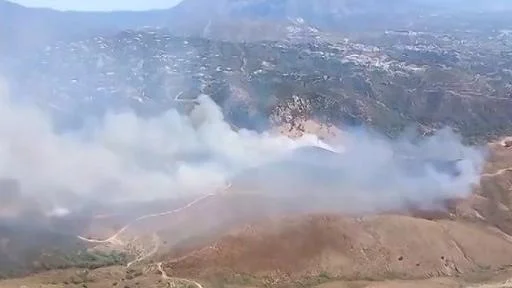
A rapidly spreading wildfire erupted on Sunday in the hilly terrain surrounding Benahavís, an affluent residential village located just outside Spain’s renowned Costa del Sol resort region. The blaze, fueled by severe weather conditions including erratic winds and extreme terrain, forced authorities to issue emergency stay-at-home orders affecting thousands of residents, primarily expatriates and wealthy homeowners.
The fire, which broke out in the late afternoon, quickly escalated into a major civil protection emergency. Towering columns of smoke and violent orange flames were visible from the upscale Mediterranean resort city of Marbella, drawing immediate concern from both locals and tourists in the densely populated coastal tourist hub. Regional emergency services in Andalusia confirmed that three individuals sustained injuries during the incident, with one person hospitalized for severe burns.
The emergency response involved a massive mobilization of firefighting assets, underscoring the growing vulnerability of the Iberian Peninsula to late-season wildfire outbreaks exacerbated by prolonged climate anomalies.
Chronology of the Emergency
The crisis began on Sunday afternoon in the rugged, forested hillsides situated just outside Benahavís, a picturesque Andalusian village characterized by traditional whitewashed houses and narrow, winding streets. According to reports from the Andalusia emergency services coordination center, the fire was catalyzed by strong gusts of wind reaching speeds of up to 50 kilometers per hour. These winds, combined with the steep and inaccessible topography of the local hills, created what officials described as conditions for a "very rapid spread" of the fire front.
By late afternoon, the blaze had advanced dangerously close to luxury residential complexes and high-end villa communities favored by British and other international expatriates. Realizing the imminent danger, regional authorities acted swiftly. At approximately 5:00 p.m. local time, civil protection agencies triggered emergency alert protocols, broadcasting automated warning messages via mobile phones to approximately 9,500 residents in Benahavís and the surrounding luxury urbanizations. The alerts were intentionally issued in both Spanish and English to ensure the safety of the sizable foreign community residing in the area.
As the flames crept closer to residential perimeters, approximately 50 residents were urgently evacuated from a vulnerable housing complex directly threatened by the advancing smoke and embers. Concurrently, ground crews and aerial units engaged in a desperate containment battle. Firefighters established defensive lines around residential properties, while water-dropping aircraft performed continuous sorties despite heavy smoke and turbulent wind conditions. By late Sunday night, aggressive containment measures managed to halt the forward momentum of the primary fire front, preventing catastrophic structural damage, although mop-up operations and hot-spot surveillance extended well into Monday.
Casualties and Official Responses
Antonio Sanz, a high-ranking official within the Andalusia regional government and head of emergency management, provided detailed updates regarding the human toll of the disaster. Speaking to reporters on Sunday evening, Sanz confirmed that three people had sustained injuries as a direct result of the wildfire.
The most serious injury involved a local resident who suffered significant burns while attempting to independently combat the approaching flames before professional emergency crews arrived on the scene. This individual was rushed to the regional hospital for specialized burn care. According to subsequent medical bulletins provided by Sanz, the patient’s condition is stable and expected to improve progressively.
The second casualty was a professional firefighter who suffered a fractured wrist during the arduous containment operations on the rugged terrain. The third injured party received medical treatment on-site for mild smoke inhalation.
Despite the alarming proximity of the flames to multi-million-dollar villas, structural losses were miraculously averted. "No residential buildings or permanent structures have been structurally compromised or destroyed," Sanz declared during a press briefing. He praised the swift coordination between municipal police, civil guard units, and regional firefighters, whose rapid deployment averted a far deadlier humanitarian and architectural catastrophe.
Massive Deployment of Personnel and Aerial Assets
The scale of the firefighting operation reflects the immense gravity of the threat. Andalusia’s emergency services deployed a formidable multi-agency response team to counter the Benahavís blaze. More than 200 professional firefighters, drawn from various regional and national forestry brigades (BRIF), worked tirelessly along the steep fire lines through the night.
The ground offensive was heavily reinforced by an aerial armada consisting of approximately 20 specialized aircraft. This fleet included heavy-lift amphibious Canadair planes capable of scooping water directly from the Mediterranean Sea, as well as maneuverable light coordination helicopters that provided real-time thermal imaging and tactical direction to ground crews.
The strategic deployment of aviation assets proved decisive in breaking the intensity of the crown fires burning through dense brush and pine forests, preventing the inferno from leaping further toward the heavily populated coastal strip of Marbella and Estepona.
Meteorological Context and Climate Background
While historically wildfire seasons in Southern Europe were strictly confined to the peak summer months of June through August, changing climatic patterns have drastically elongated the window of extreme fire risk. Spain remains firmly on the front lines of global climate change, experiencing unprecedented meteorological extremes that continue to challenge civil defense infrastructure late into the calendar year.
According to data released by Spain’s State Meteorological Agency (AEMET), the summer of 2026 shattered historical climate records, cementing its status as the hottest summer recorded since comprehensive nationwide record-keeping began in 1961. The prolonged marine heatwaves in the Mediterranean basin, combined with cumulative multi-year droughts, have turned the Andalusian countryside into a tinderbox.
The severity of the heat was underscored just days prior to the Benahavís incident. On September 2, meteorological stations in El Granado, located in southwestern Andalusia, recorded a staggering peak temperature of 45.7 degrees Celsius (114.3 degrees Fahrenheit). Such extreme thermal readings, occurring well outside the traditional mid-summer peak, drastically reduce fuel moisture content in vegetation, creating conditions where even a minor spark can trigger an uncontrollable conflagration.
Broader Environmental and Economic Implications
The wildfire in Benahavís is not an isolated incident but part of a wider, deeply concerning national environmental crisis. Statistical data compiled by the European Forest Fire Information System (EFFIS) reveals that cumulative wildfire devastation in Spain has already surpassed 296,000 hectares of land this year alone. This figure places 2006 among the most destructive fire seasons in modern Spanish history, severely impacting rural ecosystems, agricultural output, and biodiversity reserves.
From an economic perspective, incidents occurring in high-end tourist destinations like the Costa del Sol carry immediate repercussions. The region is a cornerstone of Spain’s lucrative tourism economy, attracting millions of affluent international travelers, retirees, and property investors annually. The sight of towering columns of smoke near Marbella and luxury enclaves inevitably raises concerns among prospective tourists and real estate investors regarding climate resilience, insurance costs, and regional safety.
Urban planners, environmental scientists, and local municipal councils are facing mounting pressure to reassess preventative land management policies. Experts emphasize the urgent need to expand buffer zones around residential developments situated in wildland-urban interfaces (WUI), increase controlled grazing programs to reduce underbrush accumulation, and invest more heavily in localized early-warning sensor networks.
As climate projections suggest that Southern Europe will continue to experience warmer temperatures and more erratic precipitation patterns, the containment of late-season wildfires like the one in Benahavís will likely become a recurring challenge for Spanish emergency management authorities in the years ahead.