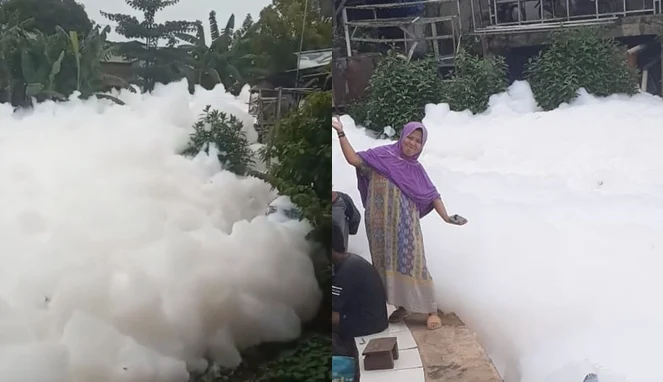
A startling viral video has brought to light a severe environmental crisis unfolding in Depok, West Java, Indonesia, where the Kali Baru river in Tugu Village, Cimanggis District, has been inundated by an astonishing amount of foam. The footage, which rapidly spread across social media platforms starting Monday afternoon, November 27, 2023, shows the river completely obscured by a dense, white blanket of foam, reaching heights that dwarf nearby homes. The sheer volume of the foam has raised alarms among residents and netizens alike, prompting urgent calls for government intervention.
The Visual Shock: A River Lost to Foam
The viral video captures a disturbing scene: the Kali Baru river, a vital waterway in the Depok region, is no longer visible. Instead, a colossal mound of white foam, thick and voluminous, has entirely replaced the water’s surface. In some parts of the footage, the foam has breached the riverbanks, extending to the verges of residential properties, reportedly reaching the doorstep of at least five homes. The person recording the video can be heard exclaiming about "waste pollution in the river in Depok," underscoring the immediate and apparent source of the environmental degradation.
The visual impact of the video was so extreme that many initial viewers mistook the scene for something entirely different. Comments on social media platforms reveal that some users believed the footage depicted clouds, while others speculated it was a landscape covered in snow. This widespread misinterpretation highlights the unprecedented nature of the pollution event and the shock it generated, underscoring the urgent need for clarity and official action. Beyond the visual spectacle, the phenomenon has spurred a torrent of concerned messages, with many netizens imploring the local government to address the pollution promptly.
Eyewitness Accounts and the Ephemeral Nature of the Foam
Residents living near Kali Baru have described the foam’s appearance as a gradual but relentless process. According to reports, the foam did not materialize instantaneously but rather emerged subtly before rapidly escalating in volume and thickness. Compounding the visual distress is a pungent odor, distinctly unpleasant and unlike the mild scent typically associated with detergents. This strong smell further negates any notion that the foam is a harmless byproduct of cleaning agents.
Adding a layer of mystery to the event, witnesses reported that the extensive foam, which had dominated the river’s landscape for a significant period, mysteriously disappeared by the evening of the same day it gained widespread attention. This ephemeral nature of the foam raises further questions about the nature of the pollutants and their interaction with the river’s ecosystem. The rapid dissipation, while seemingly a relief, could also indicate a continuous influx of pollutants that react with water and air in a dynamic, albeit destructive, manner.
Official Investigation Underway: Tracing the Source of the Pollution
In response to the escalating public concern and the alarming visual evidence, the Depok City Environment and Hygiene Agency (DLHK Kota Depok) has launched an immediate investigation to identify the origin of the polluting waste. Preliminary hypotheses suggest that the thick foam is a consequence of domestic wastewater discharge, potentially containing high concentrations of soaps and detergents, accumulating within the river system.
The agency’s preliminary assessment indicates that the surge in foam accumulation and its rise to the surface are likely exacerbated by an increase in the river’s water debit. This surge is attributed to the current transitional period between the dry and rainy seasons, a time when rainfall can stir up accumulated pollutants and increase water flow. DLHK Kota Depok has announced plans to conduct thorough inspections of industrial facilities and residential areas situated along the river’s course to pinpoint the exact sources of the waste responsible for the severe foam pollution.
The Broader Implications of River Pollution
The incident in Depok serves as a stark reminder of the severe and multifaceted consequences of river pollution, particularly from industrial and domestic waste. Such contamination poses significant threats to public health, creating breeding grounds for waterborne diseases that can spread rapidly within communities reliant on these water sources. The ecological impact is equally devastating, threatening the survival of aquatic life and disrupting delicate riverine ecosystems.
Beyond environmental and health concerns, river pollution has tangible economic repercussions. The degradation of water quality directly impacts the availability of clean water for daily use, a fundamental necessity for all life. Furthermore, agricultural sectors that depend on river water for irrigation face significant challenges, potentially leading to reduced crop yields and economic losses for farmers. The long-term sustainability of communities and local economies is intrinsically linked to the health of their natural water resources.
A Call for Proactive Environmental Management
The viral video and the subsequent investigation highlight the critical need for enhanced environmental monitoring and enforcement in urban areas like Depok. While the immediate focus is on identifying and mitigating the current pollution source, a more comprehensive strategy is required to prevent future occurrences. This includes:
- Stricter Industrial Regulations: Implementing and rigorously enforcing regulations on industrial wastewater discharge, ensuring that factories treat their effluent effectively before releasing it into the environment.
- Improved Waste Management: Enhancing domestic waste management systems to prevent household waste, including detergents and chemicals, from entering waterways through inadequate sewage systems or direct dumping.
- Public Awareness Campaigns: Educating the public about the impact of their daily activities on water quality and promoting responsible waste disposal practices.
- River Restoration and Monitoring: Investing in long-term river restoration projects and establishing robust monitoring systems to track water quality and detect pollution events early.
The incident at Kali Baru is not merely a localized environmental issue; it is a symptomatic representation of broader challenges faced by many urban centers in developing nations. The visual evidence of the foam-laden river serves as a potent symbol of the urgent need for collective action, responsible governance, and a renewed commitment to protecting vital natural resources. The response from DLHK Kota Depok is a crucial first step, but sustained efforts and community engagement will be paramount in restoring the health of Depok’s rivers and safeguarding the well-being of its residents.
The investigation by DLHK Kota Depok is expected to provide more detailed findings regarding the specific pollutants and their sources in the coming days. As the city grapples with this environmental emergency, the global community watches, highlighting the shared responsibility in addressing the pervasive issue of water pollution and its far-reaching consequences. The hope is that this alarming incident will catalyze a more robust and proactive approach to environmental stewardship in Depok and beyond.