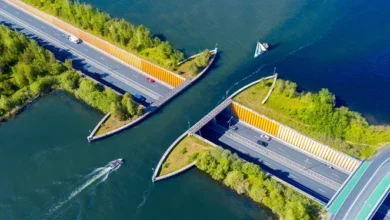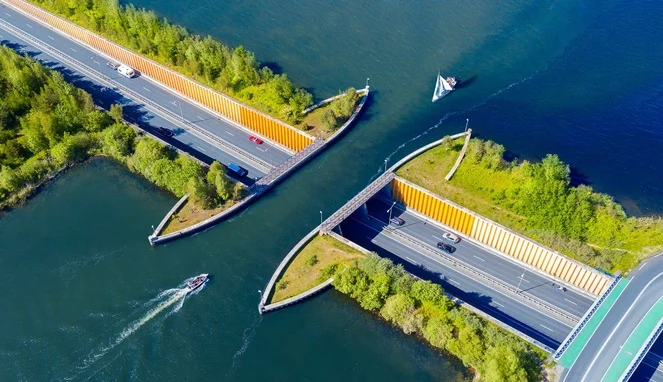
The Veluwemeer Aqueduct, an architectural marvel situated in the Netherlands, represents a groundbreaking solution to the perennial challenge of integrating transportation networks across varied terrains and water bodies. This unique structure, located in Harderwijk, East Netherlands, does not merely bridge two landmasses over water; it ingeniously creates a navigable waterway directly above a road tunnel, seamlessly merging aquatic and terrestrial transit.
A Symphony of Engineering: Design and Functionality
At its core, the Veluwemeer Aqueduct is an aqueduct, a conduit designed to transport water. However, its design transcends conventional aqueducts by incorporating a fully functional road tunnel beneath its water-filled channel. This duality allows for the simultaneous passage of waterborne vessels and road traffic, a feat of engineering that has captivated engineers and travelers alike since its completion. The aqueduct portion spans approximately 25 meters in length and 19 meters in width, with the water channel reaching a depth of roughly 3 meters. This allows for the passage of smaller boats and other watercraft, enhancing the region’s connectivity for recreational and commercial purposes.
The ingenious aspect of the Veluwemeer Aqueduct lies in its integration with a submerged road tunnel. This tunnel, stretching about 17 meters and positioned at the water’s surface level, provides a vital link between the city of Harderwijk and the province of Flevoland. Flevoland itself is a remarkable testament to Dutch ingenuity, being one of the world’s largest artificial islands, reclaimed from the sea. The construction of the aqueduct and tunnel was thus essential to connect this landmass efficiently to the mainland. To ensure the integrity of the water channel above, robust steel sheet piles line its sides, preventing any leakage into the road tunnel below. This meticulous design ensures that both water and road traffic can operate without interference.
Addressing Transportation Demands: A Cost-Effective Solution
The impetus behind the construction of the Veluwemeer Aqueduct was the escalating need to manage and optimize traffic flow in the region. The area is characterized by a dynamic interplay between land and water, with the Ijssel River and Lake Veluwemeer being significant navigational routes. Traditional solutions, such as building a high-level bridge, would have presented several challenges. Such a bridge would have required significant vertical clearance to allow for the passage of boats, potentially leading to steep inclines for road traffic and a substantial visual impact on the landscape.
The aqueduct-tunnel hybrid offered a more elegant and efficient solution. By placing the road traffic beneath the water channel, the need for an exceptionally high bridge was eliminated. This not only preserved the scenic beauty of the area but also facilitated smoother and more direct road access. The project, completed and opened to the public in 2002, reportedly cost approximately USD 61 million. While a significant investment, this figure was considered economically viable when compared to the projected costs and logistical complexities of constructing a conventional high-rise bridge. The dual-purpose nature of the structure allowed for a more integrated and less intrusive infrastructure development.
A Landmark of Dutch Ingenuity and Tourism
Since its inauguration, the Veluwemeer Aqueduct has emerged as a significant landmark in the Netherlands, celebrated for its innovative design and practical application. It serves as a crucial artery for daily commuters, with an average of 8,000 vehicles utilizing the submerged tunnel each day. Simultaneously, it maintains the navigability of the waterways, supporting recreational boating and other water-based activities.
The picturesque setting of the aqueduct also contributes to its appeal. The sight of water flowing above a road, with boats gliding serenely overhead while cars pass beneath, creates a unique visual spectacle. This distinctiveness has transformed the Veluwemeer Aqueduct into a minor tourist attraction, drawing visitors who are keen to witness this engineering marvel firsthand. The surrounding area, including Lake Veluwemeer, is also a popular recreational zone and a nature reserve, further enhancing the appeal of the location. The juxtaposition of advanced engineering with natural beauty makes it a compelling destination for those interested in architecture, infrastructure, and the Dutch landscape.
Broader Implications and Future Perspectives
The success of the Veluwemeer Aqueduct offers valuable insights into sustainable and integrated infrastructure development. It demonstrates that innovative thinking can overcome geographical constraints and create solutions that are both functional and aesthetically pleasing. The project highlights the importance of considering multiple modes of transportation and their interdependencies when planning large-scale infrastructure.
The implications of such projects extend beyond immediate transportation needs. They can foster economic growth by improving connectivity, support recreational industries, and enhance the overall quality of life for residents. Furthermore, the Veluwemeer Aqueduct serves as an inspiration for future engineering endeavors, particularly in regions facing similar challenges of integrating diverse transportation networks. As global populations grow and urbanization intensifies, the need for creative and efficient infrastructure solutions will only increase. The Veluwemeer Aqueduct stands as a testament to what can be achieved through bold design, meticulous planning, and a commitment to overcoming complex engineering hurdles.

A Deeper Dive into the Veluwemeer Aqueduct’s Context
The construction of the Veluwemeer Aqueduct cannot be fully appreciated without understanding the broader context of Dutch water management and land reclamation. The Netherlands has a centuries-long history of battling the sea, with a significant portion of its land lying below sea level. This constant struggle has fostered a unique culture of engineering prowess, particularly in hydraulics and civil engineering. Projects like the Delta Works, a massive system of dams, sluices, and storm surge barriers, are prime examples of the nation’s expertise in managing water.
The reclamation of Flevoland, the province connected by the Veluwemeer Aqueduct, is a more recent and ambitious undertaking. Initiated in the mid-20th century, the creation of this vast landmass involved draining large areas of the former Zuiderzee, a saltwater inlet of the North Sea. This ambitious project added thousands of square kilometers of usable land for agriculture, housing, and infrastructure. However, the creation of such a significant landmass also necessitated the development of robust transportation links to the rest of the country. The Veluwemeer Aqueduct, therefore, is not just an isolated structure but an integral part of a larger national strategy to manage water, create land, and ensure efficient connectivity.
The Role of Innovation in Dutch Infrastructure
The Dutch approach to infrastructure development is characterized by a continuous drive for innovation and efficiency. Faced with limited land and a complex hydrological environment, Dutch engineers have consistently pushed the boundaries of what is possible. The Veluwemeer Aqueduct exemplifies this spirit, showcasing a willingness to explore unconventional solutions that integrate multiple functions into a single structure. This approach is often driven by a pragmatic assessment of costs, environmental impact, and long-term utility.
The decision to build an aqueduct over a road tunnel, rather than a traditional bridge, was a strategic one. It minimized the visual intrusion on the landscape, reduced the land required for approaches, and provided a more direct route for both water and road traffic. This type of integrated design is becoming increasingly important as urban areas become more densely populated and the competition for space intensifies.
A Timeline of Development and Impact
The concept and planning for the Veluwemeer Aqueduct likely spanned several years, reflecting the complexity of such a large-scale project. Construction commenced in the late 1990s, with the project culminating in its public opening in 2002. This relatively swift construction period, for a project of its magnitude, speaks to the advanced planning and execution capabilities of the Dutch construction industry.
Since its opening, the aqueduct has consistently served its intended purpose, facilitating smooth traffic flow and maintaining water connectivity. The estimated 8,000 vehicles per day passing through the tunnel represent a significant volume of traffic, underscoring the necessity of this infrastructure. The aqueduct’s contribution to the regional economy is also considerable, by enabling efficient movement of goods and people. Furthermore, its role in supporting recreational activities on Lake Veluwemeer adds another layer to its socio-economic importance.
Expert Opinions and Acknowledgement
While specific public statements from engineers or government officials involved in the project might not be readily available in the original source, the very existence and continued functionality of the Veluwemeer Aqueduct serve as a testament to the expertise and foresight of its creators. The project has been widely recognized within engineering circles as a notable achievement in hydraulic and civil engineering. Its ability to seamlessly blend two distinct transportation modes – water and road – within a single, elegant structure is frequently cited as an example of innovative problem-solving. The cost-effectiveness of the design, when compared to alternative solutions, has also been a point of admiration, demonstrating a pragmatic approach to infrastructure investment.
Broader Impact and Global Relevance
The Veluwemeer Aqueduct’s impact extends beyond its immediate geographical location. It serves as a compelling case study for other nations grappling with similar infrastructure challenges. In coastal regions, areas with extensive river systems, or densely populated urban centers, the principles demonstrated by the aqueduct – integration, multi-functionality, and aesthetic consideration – are highly relevant.
As the world faces increasing pressure on its infrastructure due to population growth and climate change, innovative solutions like the Veluwemeer Aqueduct offer a glimpse into the future of urban planning and transportation. The ability to maximize the utility of limited space and to harmonize different forms of movement is crucial for sustainable development. The Dutch mastery of water management and their continuous pursuit of engineering excellence, as exemplified by this aqueduct, provide valuable lessons for the global community. The Veluwemeer Aqueduct is not just a bridge; it is a symbol of human ingenuity and a testament to the power of innovative design in shaping our built environment for the better.