
The Eerie Sound of Earth’s Magnetic Past Revealed Through Advanced Scientific Sonification

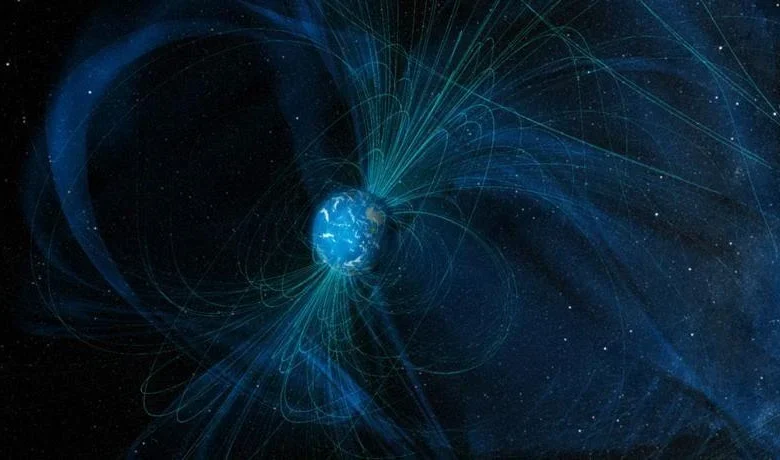
For eons, the Earth’s magnetic field has served as an invisible, silent guardian, shielding the planet from the harsh bombardment of solar winds and cosmic radiation. However, this protective barrier is not static; it is a dynamic, shifting force driven by the turbulent movement of molten iron in the planet’s outer core. Scientists from the Technical University of Denmark (DTU) and the German Research Centre for Geosciences (GFZ) have recently achieved a remarkable feat: they have transformed the chaotic data of a geomagnetic reversal into an audible experience. By utilizing information collected by the European Space Agency’s (ESA) Swarm satellite constellation and geological records, researchers have reconstructed the sound of the Laschamps excursion, a dramatic period roughly 41,000 years ago when Earth’s magnetic poles weakened significantly and wandered.
The resulting audio is a haunting soundscape—a collection of groaning, cracking, and rumbling noises that evoke the instability of a planet stripped of its primary defense mechanism. While the sound is a synthetic representation, it provides a visceral medium for understanding the profound physical shifts that Earth undergoes on geological timescales.
Decoding the Invisible: The Science of Sonification
The magnetic field of the Earth cannot be heard by the human ear, nor can it be seen with the naked eye. It is an electromagnetic phenomenon generated approximately 3,000 kilometers beneath the surface. To bridge the gap between abstract geophysical data and human perception, the research team employed a technique known as sonification. This process involves mapping numerical data—such as magnetic intensity, orientation, and fluctuation—into acoustic parameters.
According to the ESA, the methodology is akin to composing a musical score. By utilizing historical data preserved in volcanic rocks and deep-sea sediment, researchers reconstructed the magnetic state of the planet during the late Pleistocene. To make these invisible forces tangible, the team layered the synthesized data with natural, organic sounds, such as the splintering of timber and the grinding of stones. The final product is an alien, yet strangely familiar, auditory journey into the past, offering a bridge between the cold data of paleomagnetism and the visceral reality of a changing planet.
The Laschamps Excursion: A Chronology of Instability
The Laschamps excursion stands as one of the most significant geomagnetic events of the late Quaternary period. Occurring approximately 41,000 years ago, this event saw the Earth’s magnetic field strength collapse to a mere 5% of its current intensity. This period of extreme vulnerability lasted for roughly 250 years, during which the magnetic poles essentially wandered, losing their stable north-south alignment. Following this initial collapse, the field remained in an irregular, non-dipolar state for approximately 440 years before eventually migrating back toward the orientation we recognize today.
Evidence for this event is etched into the geochemical record. By analyzing the concentration of beryllium-10 isotopes in ice cores and sediment layers, scientists have been able to trace the timeline with high precision. Beryllium-10 is formed when high-energy cosmic rays strike the Earth’s upper atmosphere. When the magnetic shield is at full strength, it deflects these particles; however, during the Laschamps excursion, the weakened field allowed a greater flux of cosmic rays to penetrate the atmosphere, leaving behind a spike in beryllium-10 levels that remains detectable to this day. This provides a definitive empirical record that the planet’s radiation shield was, for all intents and purposes, largely compromised.
The Mechanism of the Magnetic Shield
To understand why this event occurred, one must look toward the Earth’s core. The magnetic field is sustained by the geodynamo, a self-sustaining process of convection and rotation involving the liquid outer core. As molten iron and nickel circulate, they create electrical currents that generate the global magnetic field. This field is not a perfect sphere; it is a complex, shifting entity that is constantly being buffeted by solar winds and internal convective changes.
The periodic reversal of magnetic poles is a natural, albeit sporadic, feature of Earth’s history. Geological data suggests that over the last 83 million years, the magnetic poles have swapped orientations at least 183 times. The frequency of these reversals is highly unpredictable, with some occurring every few thousand years and others separated by millions of years. The Laschamps excursion is categorized as an "excursion" rather than a full reversal because, although the poles moved dramatically, the field eventually returned to its previous orientation rather than permanently flipping.
Scientific Implications and Public Perception
While the sound of the Laschamps excursion is undeniably unsettling, researchers emphasize that it should not be viewed as a harbinger of an imminent catastrophe. The Earth’s magnetic field is currently undergoing subtle shifts—most notably the ongoing migration of the Magnetic North Pole toward Siberia and the existence of the South Atlantic Anomaly, a region of significantly lower magnetic field strength. However, geophysicists consistently state that these fluctuations are well within the bounds of normal, long-term planetary behavior.
The primary value of the Laschamps sonification project is educational and analytical. By converting complex datasets into sensory input, scientists can identify patterns in the data that might be overlooked in traditional numerical formats. Furthermore, it serves as a powerful public engagement tool, helping to communicate the dynamic nature of our planet to a wider audience. As Chris Turney, a leading Earth scientist, noted during the study’s analysis, the realization that our protective shield can drop so drastically provides a sobering perspective on the fragile equilibrium that sustains life on the surface.
Broader Impact on Global Research
The collaboration between the Technical University of Denmark and the GFZ underscores the importance of interdisciplinary research in understanding Earth’s history. By integrating satellite-based contemporary measurements with paleomagnetic data from terrestrial sources, scientists are creating a more holistic model of the geodynamo. This is essential for improving our ability to forecast long-term trends in the magnetic field, which has practical implications for satellite technology and global navigation systems.
Modern infrastructure relies heavily on the stability of the magnetosphere. Satellites in Low Earth Orbit (LEO) are particularly susceptible to solar radiation, and any significant weakening of the magnetic field could lead to increased operational risks. While the next major magnetic shift may not happen for thousands of years, the data gathered from events like the Laschamps excursion allows for the development of more resilient technological architectures.
Conclusion: Listening to the Earth’s Heartbeat
The sonification of the Laschamps excursion serves as a profound reminder that the Earth is a living, changing entity. While the ground beneath our feet feels solid and the magnetic field appears eternal, they are merely products of the violent, energetic processes occurring deep within the planet. The "creaking" of the magnetic field 41,000 years ago is more than just an interesting audio experiment; it is a testament to the Earth’s resilience and its history of constant flux.
As science continues to peel back the layers of our planet’s past, projects like this highlight the intersection of art and empirical observation. By translating the silent physics of the core into the audible language of the surface, researchers have provided humanity with a new way to listen to the heartbeat of our world. It is a voice that is at once ancient, terrifying, and profoundly revealing—a reminder that we live on a planet that is constantly evolving, shifting, and defending itself against the vast, chaotic forces of the cosmos. As we look toward the future of geophysical research, the lessons learned from the Laschamps excursion will undoubtedly continue to inform our understanding of how our planet functions and how we might better prepare for the long-term changes that lie ahead.