Surabaya, a city synonymous with the spirit of Indonesian independence, houses within its urban fabric a structure that serves as a profound monument to the volatile transition from colonial rule to sovereignty. The Internatio Building, located in the historic Jembatan Merah (Red Bridge) district, stands as a silent sentinel to one of the most consequential events in modern Indonesian history: the death of British Brigadier General A.W.S. Mallaby during the Battle of Surabaya in 1945. Beyond its role in the revolutionary struggle, this architectural landmark embodies the complex tapestry of colonial commerce, urban evolution, and the resilience of a nation forging its own identity.
The Architectural Legacy and Economic Genesis
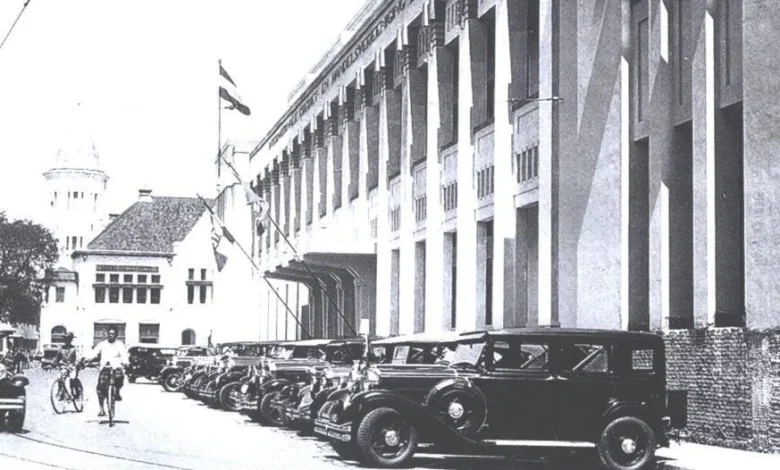
Constructed between 1927 and 1931, the Internatio Building—originally known as the Internationale Crediten Handelvereeniging—was the brainchild of the renowned architect Frans Johan Louwrens Ghijsels. A master of the "Nieuwe Indische Bouwstijl" (New Indies Architectural Style), Ghijsels was instrumental in shaping the aesthetic of colonial Indonesia, with other notable works including the Jakarta Kota Station and the Panti Rapih Hospital in Yogyakarta.
Situated at the intersection of Heerenstraat and Willemsplein, the building was strategically positioned to anchor the commercial heart of Surabaya. During the Dutch colonial era, the Jembatan Merah area was the nerve center for international trade, investment, and bureaucratic administration in East Java. The Internatio Building functioned as a hub for financial and trading activities, reflecting the prosperity of the Dutch mercantile system. The structure’s design—characterized by its clean lines, structural integrity, and integration with the tropical climate—served not only as a place of business but as a symbol of the institutional power that the Dutch wielded over the regional economy.
The Crucible of Revolution: October 1945
The trajectory of the Internatio Building shifted dramatically following the proclamation of Indonesian independence on August 17, 1945. As the global dust of World War II settled, the Allied forces, under the mandate of the Southeast Asia Command, arrived in Surabaya on October 25, 1945. Their objective was to disarm Japanese troops and restore order, but they were met with a population fiercely determined to defend their newly declared autonomy.
The British 49th Indian Infantry Brigade, led by Brigadier General A.W.S. Mallaby, occupied the Internatio Building, turning the former center of trade into a fortified military outpost. This occupation was an immediate affront to the local militia, known as the pemuda, who viewed the presence of foreign troops as a precursor to the return of Dutch colonial rule.
The tension escalated into an urban siege. For days, the Internatio Building became the focal point of a standoff between the British forces, holed up inside, and thousands of Indonesian fighters surrounding the perimeter. The building was transformed from a site of commerce into a tactical bottleneck where diplomacy and violence collided.
The Death of General Mallaby: A Turning Point
The climax of this standoff occurred on October 30, 1945. A ceasefire had been tentatively negotiated to prevent a full-scale confrontation. President Sukarno, Vice President Mohammad Hatta, and Minister Amir Sjarifuddin had traveled to Surabaya to de-escalate the volatile situation.
As part of the effort to uphold the ceasefire, Brigadier General Mallaby entered the area near the Internatio Building. Amidst the chaos and the breakdown of communications, a skirmish broke out. During the ensuing melee, Mallaby was killed—an event that would become the catalyst for the catastrophic full-scale British offensive on November 10, 1945.
Historical analysis suggests that Mallaby’s death served as a tipping point that rendered diplomatic resolutions nearly impossible. The British command, outraged by the loss of their high-ranking officer, demanded unconditional surrender, which the Indonesian forces rejected. This led to the deployment of the 5th Indian Division and the subsequent aerial and naval bombardment of Surabaya, marking the start of the most intense battle of the Indonesian National Revolution.
The Role of Diplomacy: The Contribution of Doel Arnowo
While the violence at the Internatio Building often dominates historical narratives, the role of local leaders in attempting to mitigate the bloodshed remains a crucial, though often understated, aspect of the history. Among these figures was Doel Arnowo, who served as the Chairman of the Indonesian National Committee (KNI) for the Surabaya Residency.
Arnowo was instrumental in facilitating the contact bureau, a liaison body intended to maintain communication between the Indonesian authorities and the British military. He worked tirelessly to convey the terms of the ceasefire and to prevent unnecessary loss of life among the civilian population. His collaboration with Governor R.M.T.A. Soerjo and his consultations with President Sukarno highlight that the struggle for independence was not purely militaristic; it was a sophisticated, multi-front effort involving negotiation, public messaging, and administrative management.
Following the revolutionary period, Arnowo’s influence continued as he served as the Mayor of Surabaya in 1950. His tenure was characterized by a focus on urban reconstruction, the revival of traditional markets, and the development of city infrastructure—a testament to the transition from a wartime leader to a city builder.
The Internatio Building in the Modern Era
Today, the Internatio Building stands within the revitalized Kota Lama (Old Town) district of Surabaya. The area surrounding the building, once a bustling terminal for public transport, has been transformed into a public space known as Taman Jayengrono. This park, adjacent to the historical sites of the Jembatan Merah and the Taman Sejarah, reflects the city’s commitment to urban renewal while preserving its historical identity.
Current management of the building is overseen by PT Tjipta Niaga (formerly PT Aneka Niaga), which utilizes the facility for commercial and printing operations. Despite these modern functional changes, the structure remains a heritage site, protected by the local government of Surabaya.
Historical Analysis: Implications of the Site
The legacy of the Internatio Building provides a unique lens through which to view the Indonesian revolution. It serves as a reminder of the fragility of peace when post-colonial power vacuums occur. The site is a physical manifestation of:
- Urban Resilience: The building has survived the transition from colonial asset to military bunker, and eventually to a preserved cultural landmark, mirroring the journey of Surabaya itself.
- The Complexity of Conflict: The death of Mallaby underscores how localized incidents—often driven by miscommunication and deep-seated mistrust—can trigger global-scale political shifts.
- Heritage Preservation: The efforts by the Surabaya city government (Disbudporapar) to maintain the building signify a shift in the national consciousness, where colonial-era architecture is no longer viewed solely as a symbol of oppression, but as a vital component of the city’s historical narrative.
Conclusion
The Internatio Building is far more than a colonial relic or a silent witness to a general’s death. It is an enduring piece of the Indonesian story. It documents the transition from the mercantilism of the 20th century to the birth of a nation, and it continues to educate new generations about the sacrifices made in the pursuit of sovereignty. As Surabaya continues to evolve as a modern metropolis, the Internatio Building remains a foundational pillar, ensuring that the memory of the struggle at Jembatan Merah is never erased from the city’s collective conscience.
Through its preservation, the city of Surabaya honors not only the combatants of 1945 but also the diplomats and administrators who sought to bridge the gap between two worlds, creating a legacy that resonates within the modern, vibrant landscape of East Java.