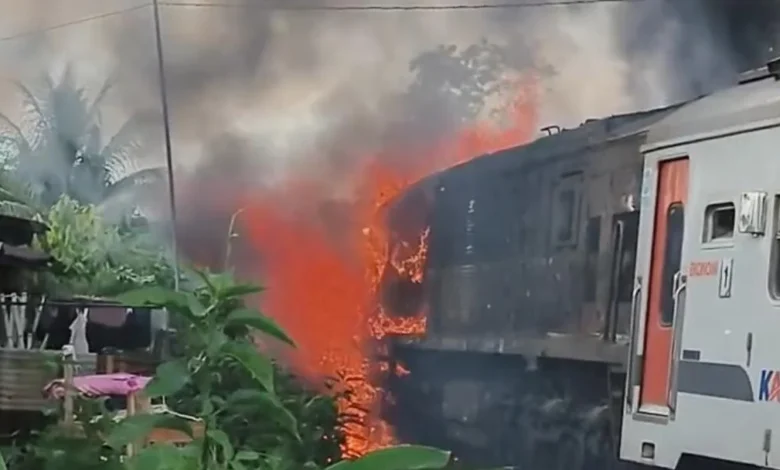
The tragic collision between the Siantar Ekspres train, traveling the Pematangsiantar-Medan route, and a Sinar Tani minibus has reignited a fierce national debate regarding rail safety standards in Indonesia. The incident, which occurred on Friday, November 20, 2026, in the Sinaksak area, Simalungun Regency, resulted in the death of the minibus driver and left three railway staff members suffering from severe burns. The collision caused both the locomotive and the minibus to erupt into flames, highlighting the extreme dangers posed by unprotected level crossings. As authorities begin their investigation, the question of legal liability—and the broader systemic failures—has taken center stage.
Chronology and Immediate Aftermath
The incident unfolded on a Friday afternoon when a Sinar Tani minibus attempted to traverse a level crossing in Kelurahan Sinaksak, Kecamatan Tapian Dolok. Local reports indicate that the crossing is categorized as an "unauthorized" or "unprotected" crossing, lacking both automated barriers and human sentries. As the train approached, the minibus entered the tracks, leading to a high-impact collision. The force of the crash caused an immediate fire, engulfing the front of the train and the minibus.
While 264 passengers aboard the Siantar Ekspres were fortunately unharmed, the train’s operational crew bore the brunt of the physical impact. Three crew members were hospitalized with significant burn injuries sustained while attempting to manage the post-collision situation. The death of the minibus driver has raised immediate questions regarding the adherence to traffic protocols at rail intersections, while the injury of the KAI (Kereta Api Indonesia) staff members has triggered a review of occupational safety procedures for train operators in emergency scenarios.
Legal Liability and Regulatory Framework
Determining accountability in rail-road collisions is a complex legal exercise. According to Joni Martinus, a railway expert and head of the Railway Division of the Indonesian Transportation Society (MTI) for the South Sumatra region, the legal framework is clearly defined by Law Number 22 of 2009 concerning Traffic and Road Transportation.
Under Article 114 of this law, drivers are strictly mandated to stop when a train signal sounds, when crossing barriers begin to descend, or when other warning signs are present. Furthermore, drivers are required to prioritize trains, which by law possess the "right of way" at any level crossing. Joni emphasizes that if a driver bypasses these safety protocols, they are fundamentally in breach of the law.
"In the eyes of the law, the primary responsibility for the collision rests with the driver of the minibus if it is proven that they failed to yield or attempted to cross while a train was approaching," Joni explained. Under these conditions, PT KAI is generally absolved of liability for the driver’s death, provided that the investigation confirms the train was operating according to standard procedures and that no negligence occurred on the part of the railway operator.
Occupational Safety and Passenger Protection
While the minibus driver’s liability is a matter of traffic law, the protection of railway staff and passengers falls under different regulatory requirements. PT KAI, as an employer, is mandated to provide comprehensive medical coverage and financial support to the three injured staff members. This includes not only immediate trauma care for their burns but also long-term rehabilitation and compensation for occupational hazards encountered during the course of their duties.
Regarding passengers, Law Number 23 of 2007 on Railways dictates that the operator is responsible for the safety of those onboard from the moment they board until they disembark. This includes coverage for medical expenses for the injured, compensation for the families of any deceased passengers, and restitution for damaged or lost personal property. In this specific incident, the successful evacuation of the 264 passengers serves as a testament to existing safety protocols, though the trauma experienced by those on board cannot be overlooked.
The Crisis of Unprotected Level Crossings
The Sinaksak accident is not an isolated incident but rather a symptom of a systemic "time bomb" within the national transportation infrastructure. The prevalence of unofficial, or "wild," level crossings remains one of the most significant threats to public safety in Indonesia. These crossings are often created by local communities to shorten travel distances between villages or agricultural fields, yet they lack the vital infrastructure—such as warning lights, bells, or physical barriers—to warn motorists of approaching high-speed rail.
The data over the past four years presents a grim reality. In 2022, there were 245 reported accidents at unprotected crossings, resulting in 110 fatalities. The year 2023 saw an increase to 274 incidents, with 94 deaths. In 2024, there were 213 incidents resulting in 123 deaths, and by 2025, the toll stood at 171 accidents with 106 lives lost. These numbers suggest that while some years show a slight decline in incidents, the fatality rate remains persistently high, indicating that when a collision does occur at these crossings, it is almost invariably catastrophic.
Proposed Solutions and Policy Shifts
Addressing the issue of level crossings requires a multi-faceted approach involving local government, the Directorate General of Railways (DJKA), and PT KAI. Experts like Joni Martinus propose three primary pillars for improvement:
- Infrastructural Intervention: The most direct solution is the elimination of dangerous crossings. This involves either permanently closing unauthorized crossings or, where the crossing is essential for traffic flow, upgrading them with modern automated barriers and alarm systems. In high-traffic areas, the construction of underpasses or flyovers is the gold standard for safety, though such projects require significant capital investment and complex land acquisition processes.
- Strict Legal Enforcement: There must be zero tolerance for motorists who ignore traffic signals at rail crossings. Law enforcement agencies should utilize CCTV and automated ticketing systems to penalize those who disregard safety warnings, thereby fostering a culture of compliance.
- Cultural and Educational Campaigns: Infrastructure alone is insufficient if the public does not respect the inherent danger of train tracks. Mass education campaigns are necessary to instill the "stop, look, listen" habit among drivers. Public awareness must emphasize that a train cannot stop on a dime, and the responsibility for avoiding a collision lies heavily on the shoulders of the road user.
A Call to Action
The tragedy in Sinaksak serves as a sobering reminder that every life lost at a level crossing represents a failure of the current system. Authorities must move beyond reactive measures and implement proactive audits of all crossings across North Sumatra and the wider archipelago. The "wild" crossings are not merely convenient shortcuts; they are structural vulnerabilities that expose both the public and railway workers to unnecessary risk.
Moving forward, the government must prioritize the allocation of the national budget toward the closure of these dangerous points. As Joni Martinus poignantly noted, "The crossing in Sinaksak is a time bomb that has been ignored for too long. If we do not act now, we are essentially waiting for the next victim. We must stop waiting for another tragedy to occur before we decide to implement basic safety measures."
In the final analysis, the responsibility for rail safety is shared. While the legal burden often falls on the motorist who fails to yield, the moral and administrative burden rests with the state to provide a safe, regulated, and reliable transportation network. Without a concerted, inter-agency effort to audit, upgrade, or eliminate dangerous crossings, the cycle of accidents will continue to claim lives, leaving families devastated and railway operators facing the recurring trauma of preventable incidents. The investigation into the Siantar Ekspres accident must serve as a catalyst for a comprehensive national overhaul of level crossing safety standards.
Related posts: