ASRock Expands Its Mini PC Lineup with the Official Launch of the NUC BOX 300 Series Powered by Intel Wildcat Lake Processors

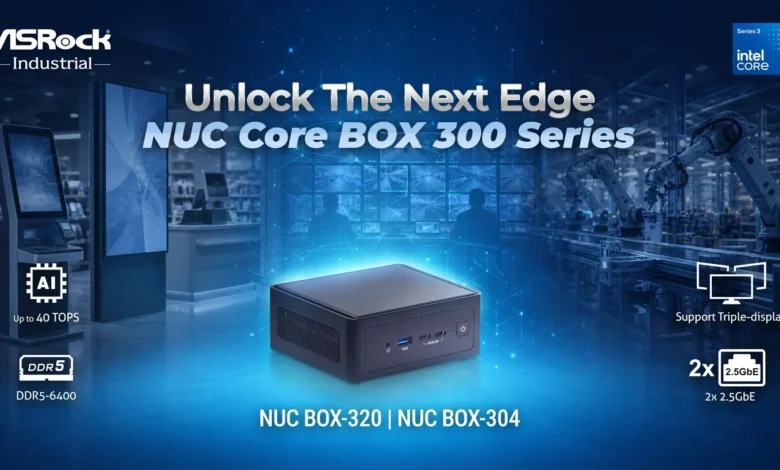
ASRock, a leading global manufacturer of motherboards, graphics cards, and small-form-factor computing solutions, has officially announced the expansion of its compact desktop portfolio with the introduction of the NUC BOX 300 Series. Representing the latest generation of ultra-compact form-factor (UCFF) systems, the new lineup comprises two primary models: the performance-oriented NUC BOX-320 and the streamlined NUC BOX-304. Built around Intel’s newly minted Core 300 series processors based on the advanced Wildcat Lake architecture, these mini PCs are designed to deliver a potent blend of energy efficiency, modern connectivity, and robust processing power. Despite sporting a minuscule chassis measuring just 0.63 liters in volume, the series breaks conventional performance boundaries for entry-to-mid-range small form factor systems by supporting high-speed DDR5 memory, dual 2.5-gigabit Ethernet networking, and versatile multi-display configurations.
The unveiling of the NUC BOX 300 Series underscores ASRock’s ongoing commitment to meeting the growing demand for space-saving yet capable computing hardware. As modern workplaces, educational institutions, and smart-home environments increasingly prioritize desk space optimization without sacrificing computational throughput, manufacturers have intensified their focus on miniaturized hardware. By adopting Intel’s Wildcat Lake platform, ASRock aims to capture a significant share of the commercial, industrial, and consumer desktop replacement markets, offering a compelling alternative to traditional, bulky desktop towers.
Detailed Specifications and Hardware Architecture
At the heart of the newly minted NUC BOX 300 Series are Intel’s latest Core 300 processors, engineered on the Wildcat Lake architecture. This platform is specifically tailored to balance power efficiency with responsive multi-threaded execution, making it ideal for compact environments where thermal dissipation and power consumption are critical engineering constraints.
The flagship model in this initial rollout, the NUC BOX-320, is powered by the Intel Core 5 320 processor. This CPU features a hybrid core architecture consisting of two Performance-cores (P-cores) and four Efficient-cores (E-cores), combining for a total of six cores designed to handle moderately heavy workloads, multitasking, and media consumption smoothly. Below it sits the NUC BOX-304, driven by the Intel Core 3 304 processor, which scales back the configuration slightly to one P-core and four E-cores, optimizing the system for lighter office automation, digital signage, and basic productivity tasks.
Memory capabilities in the NUC BOX 300 Series are remarkably robust for systems of this physical footprint. Both models feature a single SODIMM slot capable of supporting up to 64GB of high-speed DDR5-6400 memory. The inclusion of DDR5 architecture ensures higher bandwidth and lower latency, which directly benefits data-intensive applications, virtualization tasks, and overall system responsiveness.
Storage expansion is handled via a multi-tiered approach to accommodate varied user requirements. The systems include a compact M.2 2242 slot running on PCIe Gen 4 x1 speeds alongside a standard-sized M.2 2280 slot utilizing PCIe Gen 4 x2 lanes. This dual-storage layout allows users to pair a fast operating system boot drive with a high-capacity secondary solid-state drive. Furthermore, wireless networking is facilitated by a dedicated M.2 2230 slot pre-populated with an Intel wireless card providing Wi-Fi 6E and Bluetooth 5.3 connectivity, ensuring seamless integration into modern wireless network infrastructures.

Connectivity and Physical Design
One of the standout engineering achievements of the ASRock NUC BOX 300 Series is its comprehensive input/output (I/O) array, which defies the physical limitations of its ultra-compact chassis. Measuring a mere 117.5 x 110 x 49 mm and enclosing a volume of just 0.63 liters with a total weight hovering around 1 kilogram, the devices are engineered for maximum discretion. They can be tucked behind monitors, mounted beneath desks, or integrated into kiosk systems using the included VESA mounting hardware.
Despite these diminutive dimensions, ASRock has managed to pack a formidable array of physical ports onto the chassis. For visual output, the units feature dual HDMI 2.1 ports complemented by two USB Type-C ports with full support for DisplayPort 1.4a alternate mode. This configuration enables the systems to drive up to four simultaneous displays at high resolutions, making them exceptionally well-suited for multi-monitor workstations, digital signage networks, and financial trading desks.
Wired networking is another major strong point. The NUC BOX 300 Series comes equipped with dual 2.5GbE Ethernet ports powered by high-performance Intel controllers. This dual-LAN setup is particularly attractive for enterprise deployments, small-office/home-office (SOHO) servers, software routers, network-attached storage (NAS) clients, and environments requiring robust network redundancy or link aggregation. Additional peripheral connectivity is provided by three standard USB Type-A ports and a universal 3.5mm audio jack for headphones or microphones.
Background Context and Technological Evolution
The release of the NUC BOX 300 Series reflects a broader industry trend where the "Next Unit of Computing" (NUC) concept—originally pioneered by Intel—has been successfully adopted and innovated upon by tier-one motherboard manufacturers like ASRock. Following Intel’s decision to shift its internal NUC product roadmap, third-party partners stepped in to fill the market void, continuously pushing the envelope in small form factor engineering.
The introduction of the Wildcat Lake processor family represents the latest phase in Intel’s continuous refinement of low-power architecture. By leveraging advanced manufacturing nodes and refining the balance between Performance and Efficient cores, Intel and its hardware partners are able to deliver desktop-grade responsiveness within power envelopes traditionally reserved for mobile devices. ASRock’s implementation of high-frequency DDR5-6400 memory within this ecosystem highlights how rapidly enterprise-grade memory standards are trickling down into the ultra-compact desktop sector.
Market Implications and Industry Analysis

From an industry perspective, the launch of the ASRock NUC BOX 300 Series carries several notable implications for both enterprise IT deployment and consumer desktop trends.
First, the integration of dual 2.5GbE ports signals that high-speed local area networking is becoming a baseline requirement rather than a premium feature. As Wi-Fi 7 begins to emerge and multi-gigabit fiber internet connections proliferate in homes and businesses, having resilient wired networking options ensures that mini PCs can function efficiently as edge devices, secure gateway nodes, or high-speed client terminals.
Second, the versatility offered by the combination of HDMI 2.1 and DisplayPort-capable USB-C ports addresses the evolving needs of professional workspaces. Modern offices are increasingly transitioning to single-cable dock solutions and ultra-wide or high-refresh-rate multi-monitor arrays. The ability of the NUC BOX 300 Series to effortlessly manage quad-display configurations enhances its viability in control rooms, medical facilities, and creative environments where screen real estate is paramount.
However, market analysts note that success in the competitive mini PC sector heavily depends on aggressive pricing strategies and regional availability. As of press time, ASRock has not disclosed official pricing or specific global rollout schedules for the NUC BOX-320 and NUC BOX-304. The absence of MSRP figures leaves open questions regarding how competitively these models will position themselves against established rivals from brands such as ASUS, Minisforum, Beelink, and Geekom, many of which also vie for dominance in the entry-to-mid-range compact PC segment.
Future Outlook and Availability
As ASRock prepares to ship the NUC BOX 300 Series to global distributors, industry observers anticipate that initial adoption will be strongest in the commercial and industrial sectors—particularly in fields requiring reliable, headless operation, digital signage management, and space-constrained office environments. Consumer reception will largely depend on the final retail pricing structure and whether the performance delta between the Core 5-equipped BOX-320 and the Core 3-equipped BOX-304 justifies their respective market positions.
For now, ASRock’s latest offering demonstrates that the boundaries of small-form-factor computing continue to expand. By squeezing advanced processing architecture, high-bandwidth memory, and enterprise-grade networking into a device that can fit in the palm of a hand, the NUC BOX 300 Series stands as a testament to modern engineering efficiency, pointing toward a future where traditional, bulky desktop towers are increasingly relegated to specialized high-performance workstations.
Related posts: