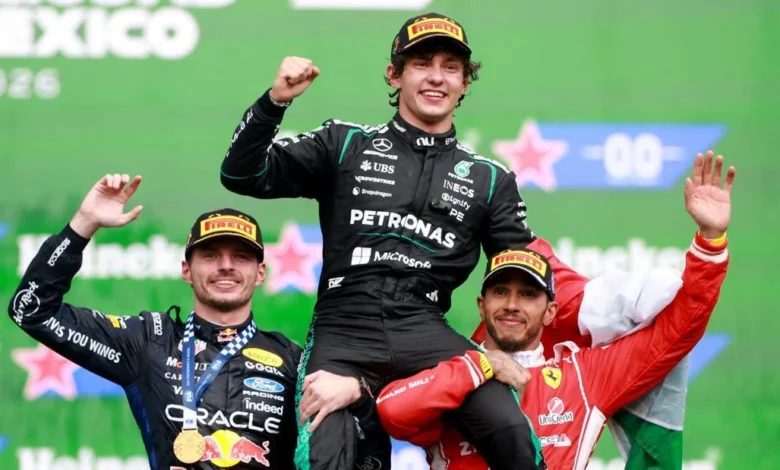
The landscape of Formula 1 has been irrevocably altered following the conclusion of the 2026 Mexican Grand Prix, where Andrea Kimi Antonelli secured his status as a sporting icon. At the age of 20 years and 68 days, the Mercedes-AMG Petronas pilot officially claimed the Formula 1 World Drivers’ Championship, establishing a new benchmark as the youngest titleholder in the history of the sport. His third-place finish at the Autódromo Hermanos Rodríguez in Mexico City was the final piece of a championship puzzle that had been meticulously constructed throughout a high-stakes 2026 season.
The coronation of Antonelli marks a significant shift in the sport’s hierarchy. By eclipsing the record previously held by Sebastian Vettel—who secured his first of four titles with Red Bull Racing in 2010 at the age of 23 years and 134 days—the young Italian has effectively ended an era dominated by veterans and heralded the arrival of a new, exceptionally talented generation. Beyond the record books, the achievement carries historical weight; Antonelli is the first Italian to claim the F1 world crown since the legendary Alberto Ascari achieved the feat in 1953, a drought spanning over seven decades.
A Historic Sunday in Mexico City
The Mexican Grand Prix served as the theater for this historic milestone. The race was characterized by the high-altitude challenges and technical intensity synonymous with the Mexico City track. Antonelli entered the weekend with a commanding points lead, knowing that a podium finish would mathematically secure his inaugural title with four rounds still remaining in the calendar.
The race itself was far from a straightforward procession. The event saw multiple interruptions, including a red-flag period triggered by a significant accident involving Valtteri Bottas, and a late-race deployment of the Safety Car following an incident involving Arvid Lindblad. Throughout the chaos, Antonelli displayed a maturity well beyond his years. Managing his tires and fuel load under immense pressure, he maintained his composure to cross the finish line in third, trailing race winner Max Verstappen and the runner-up, Lewis Hamilton. As the checkered flag waved, the gravity of the moment became clear: the Mercedes prodigy had reached the summit of motorsport in only his second full season.
The Digital Celebration: Google’s Interactive Tribute
In a testament to the global impact of this achievement, tech giant Google took the unusual step of integrating a celebratory digital experience into its search engine. Users worldwide who searched for "Kimi Antonelli" were greeted with an interactive, animated display. Upon execution, the search results page would overlay an animation of a Formula 1 car traversing the screen, followed by an ascending golden trophy accompanied by the banner, "Youngest Ever World Champion."
This digital tribute underscores the crossover appeal of Formula 1’s current era. By gamifying the news of his victory, Google acknowledged that Antonelli’s win was not merely a niche sporting result but a viral cultural phenomenon. The integration also provided instant access to real-time standings and the specific context of the Mexican Grand Prix, ensuring that casual observers could immediately grasp the significance of the event. While the availability of the feature fluctuated based on regional search parameters and device compatibility, it served as a powerful tool for fan engagement and historical documentation.
A Symbolic Changing of the Guard
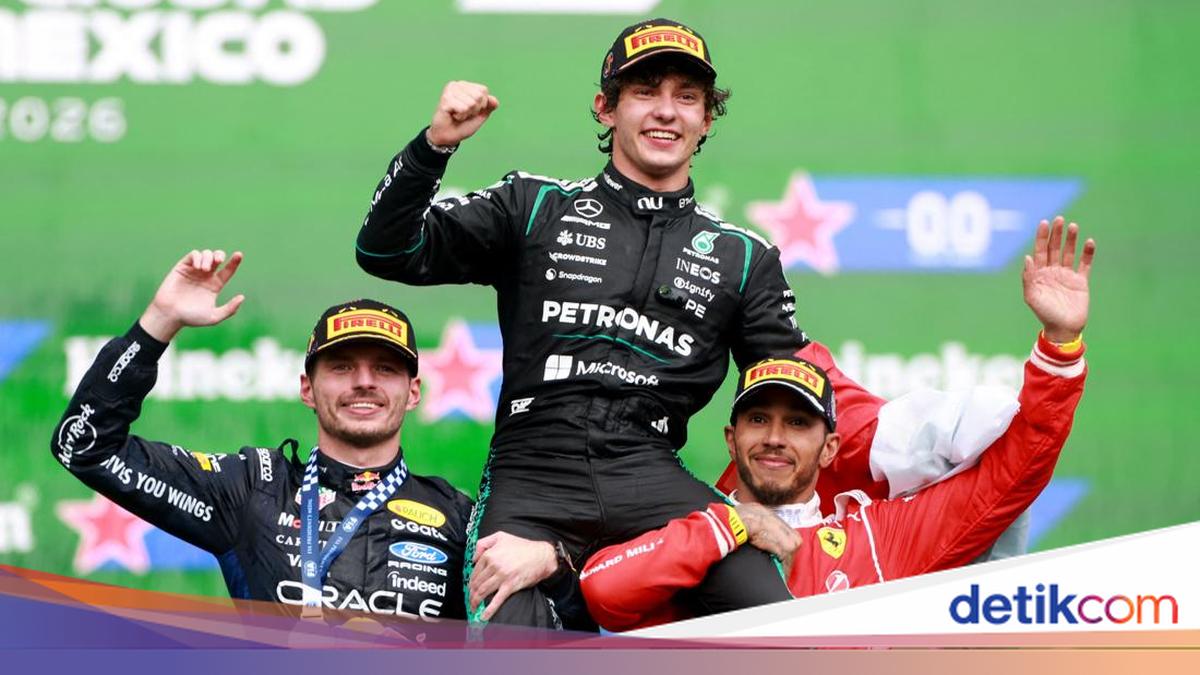
The podium ceremony at the Autódromo Hermanos Rodríguez provided one of the most poignant images of the 2026 season. Lewis Hamilton, the seven-time world champion now driving for Ferrari, demonstrated profound sportsmanship. In a move that resonated with millions of viewers, Hamilton and Max Verstappen—two of the most formidable competitors in the history of the sport—physically lifted Antonelli onto their shoulders during the celebrations.
This gesture was laden with symbolism. Hamilton, who had vacated his Mercedes seat to allow for Antonelli’s entry into the team in 2025, acted as a mentor figure, seemingly passing the torch of elite dominance to the young Italian. The sight of Hamilton, Verstappen, and Antonelli—representing three distinct generations of championship pedigree—standing together encapsulated the transition of power currently underway in Formula 1. For Antonelli, the support from such high-caliber rivals validated his journey through the ranks, from karting to the junior formulae, and finally to the pinnacle of open-wheel racing.
Chronology of a Meteoric Rise
The path to this championship began long before the 2026 season opener. Antonelli’s progression through the FIA feeder series was marked by consistent dominance, which prompted Mercedes to fast-track his development.
- Pre-2025: Antonelli dominates junior categories, signaling his readiness for F1.
- 2025 Season: Antonelli debuts with Mercedes, replacing Lewis Hamilton. He shows flashes of brilliance, learning the complexities of the hybrid power units and race strategy.
- Early 2026: A series of consistent podiums and race wins in the first half of the season establishes Antonelli as the primary challenger to the established order.
- Mid-2026: Antonelli’s gap to the field expands as he masters the updated aerodynamic regulations, putting him in a position to clinch the title early.
- November 2, 2026: The Mexican Grand Prix confirms his championship, cementing his place in history at 20 years and 68 days old.
Technical and Statistical Context
Statistically, Antonelli’s season has been a masterclass in consistency. While modern F1 cars are significantly more complex than those driven by the record holders of previous decades, the physical and mental demands on a 20-year-old are arguably higher due to the intensity of the simulator work, media commitments, and the extreme precision required by modern engineering teams.
His ability to secure the championship with four races remaining is a rare feat in the current era of high competition. It reflects not only his individual talent but also the efficiency of the Mercedes engineering department. The team’s ability to provide a car that was both fast and reliable under diverse track conditions was essential. The 2026 regulations, which focused on further reducing downforce to promote closer racing, rewarded drivers with high adaptability—a trait Antonelli has showcased repeatedly.
Official Statements and Industry Reaction
"I am still struggling to process the magnitude of what has happened," Antonelli stated in the post-race press conference. "To be standing here, having achieved the dream that every child in a go-kart has, is overwhelming. This is a team effort. The dedication from Mercedes, the support from my family, and the lessons learned from my peers like Lewis have all contributed to this moment."
Industry experts have been quick to praise the young champion. Former team principals and analysts noted that Antonelli’s composure under the pressure of a title-deciding race was the defining characteristic of his season. Unlike many young drivers who experience mid-season slumps, Antonelli maintained a high performance floor, rarely making unforced errors even when faced with aggressive wheel-to-wheel combat against veterans like Verstappen.
The Broader Implications for Formula 1
The crowning of Antonelli is expected to have long-term consequences for the sport’s landscape. First, it validates the efficacy of the modern "Academy" systems. Teams are increasingly willing to gamble on teenage talent, knowing that the preparation provided in the junior tiers is sufficient to handle the demands of F1. This will likely lead to an even younger average age on the grid in the coming years.
Second, the result intensifies the rivalry between Mercedes and Ferrari. With Hamilton now at Ferrari and Antonelli leading the charge for the Silver Arrows, the strategic battles between these two historic marques will likely dominate the 2027 and 2028 seasons. The fact that the champion was celebrated by his rivals suggests a healthy competitive environment, but behind the scenes, the engineering arms race will only accelerate as teams attempt to close the gap to the new champion.
Finally, the cultural impact of an Italian champion cannot be overstated. Italy has a storied history with Ferrari, and while Antonelli drives for a German-based team, his nationality has sparked a renewed fervor for the sport in his home country. The "Antonelli Effect" is expected to lead to increased investment in Italian motorsport infrastructure and a surge in domestic viewership, potentially bolstering the prospects of the Italian Grand Prix at Monza in the long term.
Looking Ahead
As the dust settles on the 2026 Mexican Grand Prix, the focus of the Formula 1 community shifts toward the final four races of the season. While the Drivers’ Championship has been decided, the Constructors’ Championship remains a tight contest, and the battle for the runner-up positions in the drivers’ standings continues.
Andrea Kimi Antonelli has already begun his tenure as the champion, but the true test of his legacy will be how he approaches the challenges of defending his title in 2027. The history of F1 is littered with "one-hit wonders" who failed to sustain their momentum after early success. However, given his technical proficiency, the backing of the Mercedes organization, and the maturity he demonstrated during this record-breaking campaign, analysts believe that Antonelli is poised to be a defining figure in the sport for the next decade.
For now, the focus remains on the historic nature of his achievement. In a sport defined by numbers, milliseconds, and mechanical limits, Antonelli has redefined the limit of age, proving that when talent meets opportunity, the impossible becomes inevitable. The 2026 season will forever be remembered as the year the youth movement finally conquered the pinnacle, led by a 20-year-old from Italy who changed the face of Formula 1 forever.