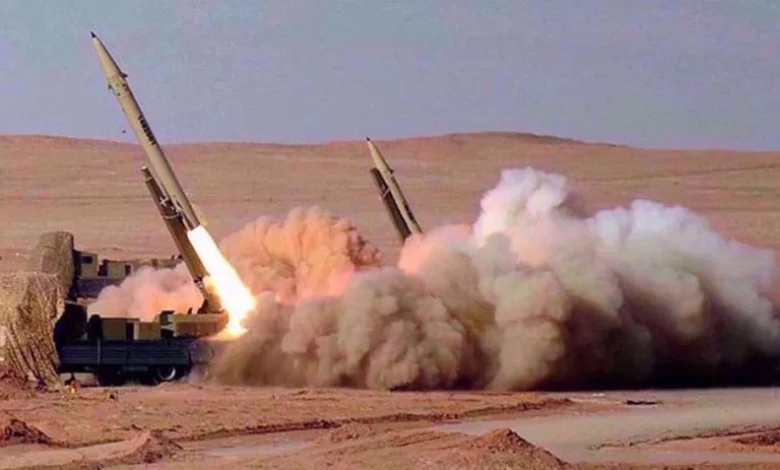
The geopolitical landscape in the Middle East has entered a phase of heightened volatility following a significant policy shift from the Islamic Republic of Iran regarding its ballistic missile program. Tehran has officially announced the removal of its self-imposed 2,000-kilometer (1,200-mile) range limit on ballistic missiles, a strategic pivot that effectively places European military installations—particularly those hosting United States forces—within the potential target envelope of the Iranian military. This declaration, articulated by Brigadier General Hossein Mohebbi of the Islamic Revolutionary Guard Corps (IRGC), marks a departure from years of diplomatic posturing and suggests a more aggressive posture in response to escalating regional tensions involving Israel and the United States.
Strategic Shift: Removing the 2,000-Kilometer Barrier
For years, the Iranian military leadership had maintained a policy that restricted the range of its indigenous ballistic missiles to 2,000 kilometers. This threshold was largely viewed by international observers as a deliberate signal of restraint, intended to avoid direct confrontation with NATO member states and European powers. However, the recent statements from Brigadier General Mohebbi signal that this self-imposed ceiling is no longer operational.
During a press conference held this past Saturday, Mohebbi clarified that the decision to remove these range constraints is part of an ongoing evolution in Iran’s defense doctrine. While the military official did not disclose specific technical details regarding new long-range missile platforms, he emphasized that the Iranian armed forces are now focused on demonstrating these enhanced capabilities in practice. This development comes amid persistent concerns from Western intelligence agencies, including reports from the Associated Press, which suggest that while Iran may not currently possess a publicly acknowledged intercontinental ballistic missile (ICBM) in its active inventory, the country possesses the underlying technological infrastructure to develop such weapons systems.
Chronology of Escalation: From Strategic Patience to Active Deterrence
The current tensions are the culmination of a decade-long cycle of regional skirmishes, sanctions, and proxy conflicts. To understand the gravity of the recent announcement, one must look at the recent timeline of events:
- 2019-2021: Iran accelerated its space launch program, which Western nations, including the United States, France, and Germany, repeatedly warned could serve as a cover for developing ballistic missile technology, particularly dual-use satellite launch vehicles that share components with long-range ballistic missiles.
- April 2024: Following a direct strike on an Iranian diplomatic facility in Damascus, Syria, Iran launched an unprecedented drone and missile barrage directly from its own territory toward Israel. This event marked the first time Tehran had bypassed its proxy networks to strike an adversary directly.
- Late 2024: Following subsequent exchanges of fire, including significant Israeli retaliatory operations, Iranian officials began to pivot their rhetoric. The focus shifted from regional deterrence to a broader, intercontinental threat assessment, culminating in the recent declaration regarding the removal of missile range limits.
- Present Day: The IRGC has explicitly linked the expansion of its strike range to the presence of U.S. military infrastructure in Europe, arguing that these bases serve as the logistics and operational backbone for U.S. and Israeli military activity in the Middle East.
The Technical Reality: Can Iran Reach Europe?
The technical feasibility of an Iranian strike on Europe remains a subject of intense debate among defense analysts. Historically, Iran’s missile arsenal has been dominated by the Shahab-3, Qiam-1, and the more modern Fattah-series missiles. The Fattah-2, described by Iranian state media as a hypersonic glide vehicle, has been a centerpiece of recent military parades. Hypersonic technology, if successfully integrated into long-range delivery systems, presents a significant challenge to existing European missile defense architectures, such as the Aegis Ashore systems stationed in Poland and Romania.
While the 2,000-kilometer limit was previously honored, Iran’s development of the Soumar and Hoveyzeh cruise missiles, as well as the Khorramshahr-4 ballistic missile, indicates a concerted effort to extend reach. The Khorramshahr-4, which reportedly carries a 1,500-kilogram warhead, has a demonstrated range that pushes close to the limits of the previous restrictions, suggesting that the "removal" of the limit is, in many ways, an acknowledgment of existing technological progress.
IRGC Doctrine: The Promise of Battlefield Surprises
Beyond the technical specifications of their hardware, the psychological dimension of the IRGC’s message is equally critical. Brigadier General Mohebbi warned that Iran is prepared to unleash "surprises on the battlefield" should a new round of conflict erupt. This terminology is often used by Iranian military planners to refer to unconventional warfare tactics, including massive swarm drone attacks, cyber-warfare capabilities aimed at critical infrastructure, and the mobilization of regional non-state allies.
Ezzatollah Zarghami, a prominent member of the Iranian government’s Cyber Space Council, echoed these sentiments in a recent interview. He noted that the nature of threats facing the Islamic Republic has shifted, necessitating a "redefinition" of defense policies. This suggests that Iran is moving toward a doctrine of "active defense," where the distinction between local regional conflicts and global military engagement is increasingly blurred. By threatening European bases, Iran is attempting to raise the diplomatic cost for European nations that support U.S. military movements in the Middle East.
Global Reactions and Implications for NATO
The announcement has triggered alarm bells across Western capitals. NATO, which maintains a collective defense agreement under Article 5, views any threat to the territory of its member states as a matter of extreme gravity. While U.S. military bases in Europe are primarily tasked with supporting NATO missions, the potential for these sites to be targeted in a non-NATO related conflict—specifically one involving Iran and the U.S. in the Middle East—complicates the strategic calculus for European leaders.
Analysts point out three major implications of this policy shift:
- Increased Pressure on Missile Defense: The move forces the United States and its European allies to accelerate the deployment of advanced interceptor systems, such as the THAAD (Terminal High Altitude Area Defense) and upgraded Patriot batteries, across a wider geographical area than previously planned.
- Diplomatic Polarization: The threat to European soil is likely to force European governments to take a more assertive stance in negotiations regarding the Iranian nuclear and missile programs. This may lead to a tightening of sanctions or, conversely, a push for renewed diplomatic dialogue to prevent a catastrophic miscalculation.
- Deterrence Stability: The concept of "mutually assured destruction" is being tested in a new, multipolar context. If Iran succeeds in fielding a truly capable ICBM, the regional deterrence model that has characterized the Middle East for decades will undergo a fundamental transformation, likely leading to a regional arms race as neighboring states seek to match Iran’s increased reach.
Analysis: A Strategy of Asymmetric Deterrence
The strategic logic behind Iran’s announcement appears to be rooted in "asymmetric deterrence." By signaling that no target is beyond reach, Tehran is attempting to force its adversaries to account for a globalized threat landscape. In the eyes of the IRGC, the removal of the 2,000-km limit is a tool to ensure that the United States cannot conduct military operations from distant, "safe" locations without risk to its own personnel and infrastructure elsewhere in the world.
However, this policy also carries significant risks for Iran. By explicitly threatening European soil, Iran risks further isolating itself from the international community and potentially triggering a unified European military response. Furthermore, such rhetoric often invites a pre-emptive posture from the United States, which may choose to increase its forward-deployed surveillance and strike capabilities in response to the perceived escalation.
As the situation continues to unfold, the international community remains on high alert. The transition from regional power projection to a perceived intercontinental threat represents a dangerous inflection point. Whether this is a genuine shift in military capability or a calculated act of psychological warfare, the geopolitical consequences are immediate: the barrier between regional disputes and global security crises has become significantly thinner. Future developments will likely depend on the success of back-channel diplomatic efforts and the ability of global powers to manage the escalatory cycle before it reaches a point of no return. For now, the world watches as Iran attempts to redefine the geography of its defense, and by extension, the reach of its influence.