Exploring the Hallyu Wave: Top Travel Destinations in South Korea That Bring K-Dramas to Life


South Korea has firmly established itself as one of the premier global tourism hotspots, drawing millions of international travelers each year, with a particularly significant influx of visitors from Southeast Asia, including Indonesia. This surge in tourism is largely attributed to the unprecedented global phenomenon of the "Hallyu" or the Korean Wave. The widespread popularity of South Korean television dramas, films, and music has transformed ordinary city streets, cultural districts, and modern architectural marvels into iconic landmarks. For travelers eager to step directly into the frames of their favorite cinematic moments, South Korea offers a diverse array of destinations that seamlessly blend contemporary urban culture with rich artistic traditions. Beyond breathtaking natural landscapes, the country’s urban centers provide an immersive backdrop that mirrors the sophisticated and dynamic settings popularized by modern media.
The Rise of Hallyu Tourism and Economic Impact
The intersection of popular culture and international travel has become a major economic driver for South Korea. Over the past decade, the Korean Tourism Organization (KTO) has capitalized on the explosive growth of K-dramas, partnering with entertainment agencies and production studios to promote filming locations as primary tourist destinations. According to tourism data released by the South Korean government, international arrivals have historically seen double-digit percentage increases following the global broadcast of hit television series.
This trend has prompted local municipalities to invest heavily in urban revitalization projects, transforming commercial districts, historical alleys, and public spaces into pedestrian-friendly zones equipped with English-language signage, global payment systems, and tourist information centers. Industry analysts note that Hallyu tourists tend to stay longer and spend more on average compared to traditional sightseers, as their itineraries often include shopping for cosmetics, dining at trendy cafes featured in shows, and purchasing official merchandise. Consequently, destinations that once served strictly local or functional purposes have been re-engineered to accommodate international visitors without losing their authentic local character.
Geonbae Street: Experiencing the Vibrant Metropolis
For travelers seeking to immerse themselves in the high-energy lifestyle of South Korea’s capital, Geonbae offers an authentic slice of contemporary metropolitan life. Characterized by narrow corridors flanked by an eclectic mix of contemporary bars, pubs, and intimate dining establishments, this vibrant street district captures the essence of Seoul’s bustling nightlife. The area is visually striking, illuminated by vibrant neon signage that casts a cinematic glow over the pavement—a setting frequently utilized in urban dramas depicting after-work gatherings and romantic encounters among young professionals.
Geonbae remains active throughout the day, transitioning from a relaxed atmosphere in the early evening to a high-octane social hub after dark. Local tourism authorities emphasize that districts like Geonbae play a crucial role in showcasing South Korea’s modern social culture. Visitors are encouraged to engage with local patrons and sample various traditional and fusion bar snacks, locally known as anju, which are integral to the country’s modern dining culture. Urban planning experts observe that such districts reflect South Korea’s rapid post-war modernization and the evolution of its urban architecture, where traditional residential patterns have given way to vertical entertainment complexes.

Daehakro: The Cultural and Artistic Heartbeat of Seoul
Moving from the commercial nightlife of the metropolis to the epicenter of South Korean performing arts, Daehakro stands as a testament to the nation’s rich theatrical heritage. Spanning approximately 1.6 kilometers, Daehakro—whose name literally translates to "University Street"—occupies the former site of Seoul National University’s main campus before it relocated to Gwanak-gu in the 1970s. Following the university’s relocation, the district was intentionally zoned by the government to foster artistic expression, evolving into South Korea’s equivalent of London’s West End or New York City’s Broadway.
Daehakro is densely populated with dozens of independent theaters, musical halls, art galleries, and experimental performance spaces. On any given weekend, the pedestrian-friendly avenue comes alive with street performers, indie musicians, and promoters handing out flyers for upcoming theatrical productions. The architectural landscape of Daehakro is a unique hybrid of mid-20th-century institutional buildings and modern avant-garde theater facades.
Cultural economists and city officials have frequently cited Daehakro as a successful model of urban adaptive reuse, where an educational institution was transformed into a self-sustaining cultural ecosystem. For international visitors, the district offers a rare glimpse into South Korea’s thriving independent art scene, far removed from the commercialized pop music industry. Subtitled performances and non-verbal musical shows are increasingly offered to accommodate the growing demographic of foreign tourists interested in partaking in local arts and culture.
Starfield Library: Architectural Grandeur and Literary Haven
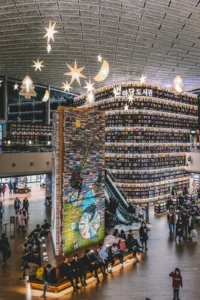
In stark contrast to the historic streets of Daehakro and the lively bars of Geonbae, the Starfield Library represents the pinnacle of modern architectural innovation integrated into public commercial spaces. Situated in the heart of the COEX Mall in Gangnam, Seoul, this expansive public cultural space opened in 2017 and has since become one of the most photographed interior locations in East Asia.
Spanning over 2,800 square meters, the library features towering, 13-meter-tall bookshelves that curve gracefully toward a glass atrium ceiling, allowing natural sunlight to flood the interior during the day and offering a view of the night sky after dark. The facility houses over 50,000 books, magazines, and digital catalogs, covering a comprehensive range of subjects including literature, humanities, travel, and international publications. Unlike traditional, quiet research libraries, the Starfield Library is designed as an open public lounge where visitors can read, converse, and attend cultural events, poetry readings, and lectures by prominent authors.
The integration of a massive public library within a high-end shopping complex reflects Seoul’s broader urban design philosophy of creating multi-functional public spaces that prioritize community engagement over pure commercialism. Real estate and urban development analysts have praised the project for increasing foot traffic to the surrounding shopping and convention center complexes while providing a tranquil intellectual oasis within one of the world’s most densely populated business districts. For travelers, the Starfield Library offers both an awe-inspiring visual spectacle and a quiet respite from the bustling city streets.

Broader Economic and Social Implications of South Korean Tourism
The steady growth of international tourism centered around cultural landmarks and media-inspired locations carries significant implications for South Korea’s diplomatic and economic standing. Known internationally as "soft power," the global appeal of Korean media and travel destinations has bolstered the nation’s brand value, encouraging cross-cultural exchange and boosting bilateral trade in consumer goods, cosmetics, and food products.
Government agencies, including the Ministry of Culture, Sports and Tourism, have continually updated their strategic frameworks to ensure sustainable tourism management. With popular districts experiencing high concentrations of visitors, urban planners are increasingly focusing on crowd-control measures, eco-friendly public transportation integration, and the preservation of residential quietude in mixed-use neighborhoods. Furthermore, the diversification of tourist itineraries beyond standard historical palaces to include contemporary districts like Geonbae, Daehakro, and the Starfield Library ensures that the economic benefits of tourism are distributed more evenly across various sectors of the urban economy.
Conclusion and Traveler Recommendations
South Korea’s unique ability to preserve its historical roots while aggressively pioneering modern architectural and cultural landmarks makes it a compelling destination for diverse types of travelers. Whether one is seeking the electric energy of metropolitan nightlife on Geonbae Street, the artistic depth of theatrical performances in Daehakro, or the architectural marvels of the Starfield Library, the capital city provides a multifaceted travel experience.
Travel industry professionals advise prospective visitors to plan their itineraries based on personal interests, noting that Seoul’s efficient, English-accessible subway and public transportation network allows for seamless navigation between these distinct neighborhoods. By venturing beyond standard guidebooks and exploring districts popularized by contemporary media, travelers can gain a holistic understanding of modern South Korean society, its artistic ambitions, and its vibrant urban culture.