Susan Sarandon and Hannah Einbinder Arrested in New York Amid Protests Targeting Israeli Prime Minister Benjamin Netanyahu at the UN General Assembly

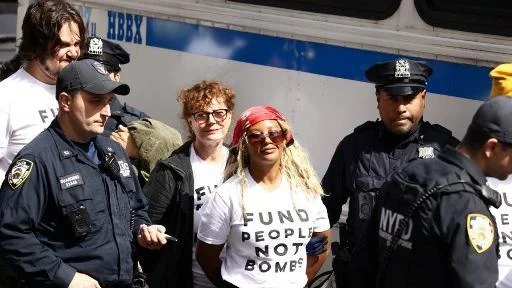
Hollywood veteran Susan Sarandon and rising comedy star Hannah Einbinder found themselves at the center of intense political drama in New York City, where both actresses were taken into police custody during a large-scale demonstration condemning Israeli Prime Minister Benjamin Netanyahu. The high-profile arrests occurred on Thursday, September 24, 2026, as geopolitical tensions boiled over onto the streets of Manhattan while world leaders gathered for the high-level debates of the United Nations General Assembly.
The demonstration, organized by the progressive Jewish advocacy group Jewish Voice for Peace, sought to draw global attention to the ongoing humanitarian crisis in Gaza and voice fierce opposition to Netanyahu’s leadership and military strategies. As sirens echoed through the metropolitan streets, law enforcement officers from the New York City Police Department intervened to disperse the gathering after organizers and participants allegedly refused to comply with municipal directives regarding public assembly and traffic flow.
Eyewitness accounts and video footage captured by international media agencies, including Agence France-Presse, document the moment NYPD officers placed handcuffs on Sarandon, the Academy Award-winning actress renowned for her roles in cinematic classics such as Thelma & Louise and Dead Man Walking. She was subsequently led away from the bustling intersection where the protest had convened. Shortly thereafter, multiple media outlets, including The New York Post, confirmed that Einbinder—widely recognized for her breakout role in the critically acclaimed television series Hacks—had also been detained by authorities and removed from the active protest zone.
The demonstration was characterized by an array of vocal chants and visual displays. Protesters hoisted prominent banners bearing slogans such as "Stop Arming Israel" and "End the Genocide," demanding an immediate halt to foreign military assistance and calling for a permanent ceasefire in the Middle East. The collision between free speech, civil disobedience, and municipal order underscored the deep polarization surrounding the Israeli-Palestinian conflict, which has continually spilled over from diplomatic chambers into the public squares of major Western cities.
Chronology of the Demonstration and Police Intervention
The events leading up to the arrests unfolded rapidly on a Thursday afternoon in Midtown Manhattan. According to official statements released by the New York City Police Department, the demonstration had not been cleared through standard municipal permitting processes, classifying it as an unannounced assembly.
Shortly after the gathering began, participants converged on a major Manhattan intersection, effectively halting vehicular traffic and disrupting local transit routes. A spokesperson for the NYPD detailed the sequence of events, noting that personnel from the department’s Community Affairs Bureau were dispatched to the scene to manage the disruption and engage with the crowd.
"Members of the NYPD Community Affairs Bureau provided multiple warnings, informing the participants to leave the location," the NYPD spokesperson stated. Despite these verbal warnings and direct requests to clear the roadway, protesters maintained their position, continuing to block the intersection. "They continued to block the intersection. Several individuals who failed to comply with those lawful orders were taken into custody."
While the police department declined to release a comprehensive breakdown of the total number of individuals arrested during the operation, the detention of two prominent figures immediately elevated the media profile of the local demonstration, transforming a localized act of civil disobedience into an international news story. The arrested individuals were processed according to standard municipal procedures for disorderly conduct and blocking pedestrian or vehicular traffic before being subsequently released.
Diplomatic Fallout Inside the United Nations General Assembly
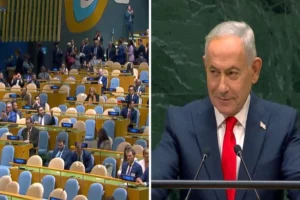
While the streets outside witnessed clashes between demonstrators and law enforcement, a parallel confrontation unfolded inside the grand halls of the United Nations headquarters. As Prime Minister Benjamin Netanyahu stepped up to the podium to address the General Assembly, the atmosphere shifted abruptly.
In an unprecedented display of diplomatic defiance, dozens of official delegates and state envoys from various nations stood up in unison and walked out of the General Assembly hall just as Netanyahu began his address. The mass walkout highlighted the severe diplomatic isolation Israel faces in several multilateral forums as the conflict in Gaza and Lebanon continues to draw international condemnation.
During his speech, Netanyahu launched a fierce defense of his government’s military campaigns and directly attacked countries that had recently shifted their diplomatic posture regarding Palestinian statehood. He specifically singled out European powers, including the United Kingdom and France, lambasting them for taking diplomatic steps toward recognizing a Palestinian state in recent months.
"They accuse Israel, little Israel, of colonialism," Netanyahu proclaimed from the UN podium. "And who accuses us? Among them are people in Great Britain and France. Good God, they are the ones who invented the term."
The verbal assault inside the UN, combined with the street protests outside featuring figures like Sarandon and Einbinder, vividly illustrated the dual-front nature of the ongoing crisis: one fought on the battlefield and in diplomatic corridors, and the other waged in the court of public opinion, cultural institutions, and media spaces.
Susan Sarandon’s Longstanding Activism and Industry Backlash
For Susan Sarandon, Thursday’s arrest is far from an isolated incident. The 79-year-old actress has a decades-long history of political activism, spanning anti-war movements, labor rights, environmental campaigns, and criminal justice reform. In the wake of the October 7, 2023 escalation and the subsequent war in Gaza, Sarandon has been an unyielding critic of Israeli military policy and a vocal advocate for Palestinian rights.
Her outspokenness, however, has carried significant professional consequences. Earlier this month, while attending the prestigious Venice Film Festival, Sarandon candidly addressed reporters regarding the economic and professional fallout she has experienced within the American entertainment industry due to her political stances.
"I’ve still lost some movies recently because agencies have told people not to hire me," Sarandon revealed during interviews in Venice. "But that’s the power structure."
Sarandon reflected on the evolving landscape of public sentiment versus corporate and institutional resistance. While she believes a tangible shift has occurred in how everyday citizens perceive the humanitarian situation in Gaza, she noted that powerful factions within the Hollywood studio system remain steadfast in their opposition to her views.
"I think there’s been a shift in terms of the understanding of the situation and the general public, but there are still very strong positions in my industry held by Zionists and they haven’t loosened their feelings toward me," she explained. Despite the professional hurdles, blacklisting, and loss of commercial opportunities, Sarandon expressed peace with her choices, adding, "I found my family, I found my people, and I’m fine."
Beyond her filmography—which includes iconic cinematic touchstones such as The Rocky Horror Picture Show, The Witches of Eastwick, and Dead Man Walking, for which she won the Academy Award for Best Actress—Sarandon’s legacy is increasingly defined by her willingness to risk her career and personal liberty for causes she champions. Her co-arrestee, Hannah Einbinder, represents a younger generation of entertainment professionals willing to leverage their visibility to draw attention to humanitarian and political issues. Einbinder, celebrated for her sharp wit and Emmy-nominated performances in HBO’s Hacks, has likewise utilized her social media platforms and public appearances to advocate for Palestinian human rights and humanitarian relief.
Broader Implications for Cultural Figures and Political Discourse
The arrests of Susan Sarandon and Hannah Einbinder, coinciding with Netanyahu’s address at the United Nations, reflect a broader sociological and political phenomenon: the increasing convergence of pop culture, celebrity activism, and intense geopolitical conflict.
In recent years, artists, musicians, and actors have faced mounting pressure from fans, activist groups, and industry executives to take public stances on major international crises. Conversely, public figures who choose to speak out often face severe professional repercussions, ranging from the cancellation of contracts and public relations backlashes to formal blacklisting by talent agencies and production studios. Analysts note that the willingness of high-profile actors to face arrest during protests signifies a profound shift, where personal moral imperatives are prioritized over career preservation in traditional commercial markets.
Furthermore, the simultaneous occurrence of the street demonstrations and the diplomatic walkout inside the UN General Assembly underscores the multifaceted pressure campaign facing Israeli leadership on the international stage. As public protests persist in major global capitals—from New York and London to Tokyo and Berlin—governments and international bodies find themselves under mounting pressure to reevaluate their foreign policies, arms shipments, and diplomatic alliances.
As the legal proceedings surrounding the Manhattan demonstrations move forward, and as the diplomatic standoff at the United Nations continues to reverberate across international media, the intersection of art, politics, and civil disobedience remains a volatile and defining feature of contemporary global society. The willingness of cultural icons to step off the silver screen and onto the asphalt ensures that the human costs of the Middle East conflict will remain at the forefront of public consciousness, regardless of corporate pressures or institutional resistance.