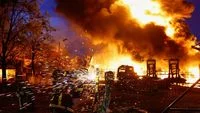
The conflict between Russia and Ukraine witnessed a violent intensification this weekend, as a wave of cross-border strikes resulted in significant civilian casualties and the destruction of critical infrastructure in both Kharkiv, Ukraine, and Belgorod, Russia. On the evening of October 24, 2026, a Russian missile strike targeted a major commercial hub in the city of Kharkiv, igniting a massive fire at a household goods supermarket and prompting an urgent emergency response. Simultaneously, Ukrainian drone operations struck deep into Russian territory, specifically targeting the border city of Belgorod, where authorities reported two fatalities and at least 13 injuries. These back-to-back incidents underscore the persistent volatility of the frontline and the growing reliance on long-range munitions to disrupt logistical and civilian centers.
Chronology of the October 24 Escalation
The sequence of events began on Friday evening, local time, when multiple air raid sirens echoed across the Kharkiv region, a frequent target for Russian aerial bombardment due to its proximity to the border. According to preliminary reports from local emergency services, a Russian guided missile—a weapon frequently utilized to bypass regional air defenses—impacted a shopping center that served as a central supply point for local residents.
The impact triggered a series of secondary explosions, likely caused by flammable household goods and pressurized containers stored within the facility. Emergency services, including firefighting crews and medical personnel, arrived on the scene within minutes. Images from the aftermath showed the skeletal remains of the structure, with thick black smoke billowing into the night sky as firefighters navigated through smoldering rubble to search for survivors.
Hours later, the theater of conflict shifted to the Russian side of the border. In the early hours of Saturday, October 25, the Belgorod region, which has become a primary target for Ukrainian counter-battery and drone strikes, came under heavy fire. Regional Governor Vyacheslav Gladkov confirmed that a series of drone strikes hit civilian residential areas. The tactical shift toward targeting regional urban centers in Russia suggests a calculated strategy by Ukrainian forces to extend the front line, forcing Russian command to divert air defense resources from the active battlefield to protect its own hinterland.
The Humanitarian Toll and Infrastructure Damage
The humanitarian cost of the weekend’s events is significant. In Kharkiv, the attack on the supermarket—a civilian facility—has once again raised questions regarding the distinction between military and non-military targets under international humanitarian law. While the Russian Ministry of Defense maintains that its strikes are directed solely at military-industrial complexes, the reality on the ground in Kharkiv often reflects a different narrative. The city has been under constant pressure for months, with power grids, residential apartment blocks, and commercial centers facing repeated strikes that have left the population in a state of perpetual anxiety.
In Belgorod, the casualty count—two dead and 13 wounded—highlights the increasing vulnerability of Russian border communities. For months, the Kremlin has attempted to project an image of normalcy in its internal territories; however, the persistent drone strikes and artillery shelling in Belgorod, Kursk, and Bryansk have eroded this perception. The 13 individuals injured in the Belgorod strike were transported to local medical facilities, with several reported to be in critical condition.
Contextualizing the Current Phase of the War
To understand the severity of these strikes, one must look at the broader strategic context of the war in late 2026. After more than two and a half years of high-intensity conflict, both nations have moved into a phase characterized by attritional warfare and the exploitation of technological asymmetries.
Ukraine has increasingly relied on locally produced, long-range "kamikaze" drones to compensate for the limitations imposed by Western allies on the use of supplied long-range missiles against Russian territory. By striking targets like fuel depots, ammunition dumps, and command centers in Belgorod, Kyiv aims to degrade the operational capabilities of the Russian forces stationed in the northern sectors.
Conversely, Russia’s strategy in Kharkiv involves a dual approach: heavy aerial bombardment designed to render the city uninhabitable and force a mass evacuation, combined with incremental ground pushes. Kharkiv, being the second-largest city in Ukraine, acts as a vital industrial and logistical hub. Its neutralization would be a major strategic victory for the Kremlin, though the city has demonstrated remarkable resilience despite constant attacks.
Official Responses and Diplomatic Stagnation
The official response from both capitals remains predictably rigid. The Ukrainian government, led by the President’s office, condemned the Kharkiv attack as a "blatant act of terror against the Ukrainian people," asserting that the destruction of a supermarket serves no military purpose other than to terrorize the civilian population. Kyiv continues to call for enhanced air defense systems, specifically the Patriot and NASAMS batteries, to provide a more robust "shield" over its eastern and southern cities.
On the other side, the Russian Foreign Ministry and local authorities in Belgorod have framed the drone attacks as "unprovoked acts of aggression" against innocent civilians. Russian state media has utilized these events to justify further escalation, framing the ongoing "Special Military Operation" as a necessary measure for the protection of Russian sovereignty. There has been no indication of a diplomatic thaw or interest in ceasefire negotiations from either side; rather, the rhetoric has shifted toward long-term mobilization and the expansion of domestic military production.
Tactical Implications and Strategic Shifts
The strike on the Kharkiv supermarket is not an isolated event but rather indicative of the current tactical environment. Military analysts point to the "precision-strike competition" as the dominant feature of the late-2026 campaign. As both sides improve their drone guidance systems and electronic warfare capabilities, the ability to strike behind the lines has become a primary driver of the war’s trajectory.
- Air Defense Saturation: The Russian strike in Kharkiv suggests that their forces are attempting to saturate Ukrainian air defense networks by using a mix of ballistic missiles and lower-cost drones to identify gaps in coverage.
- Asymmetric Retaliation: The strike on Belgorod is a clear signal that Ukraine intends to maintain parity in the psychological war. By bringing the conflict to the Russian public, Kyiv is attempting to force the Russian government to account for the war’s costs to its own citizens.
- Logistical Disruption: The targeting of commercial infrastructure, while devastating to civilians, also disrupts the local economy and supply chains, which are critical for sustaining the war effort in frontline cities.
Future Outlook and Global Concerns
As winter approaches in late 2026, the international community remains deeply concerned about the potential for further humanitarian crises. The destruction of heating, electricity, and food supply infrastructure in cities like Kharkiv creates a dual-threat environment: the immediate danger of shelling and the long-term risk of exposure and malnutrition during the sub-zero months.
Western nations, currently grappling with their own domestic political challenges, are under renewed pressure to provide financial and military aid to ensure that Ukraine can maintain its defensive posture. However, the appetite for sustained, high-level support is being tested by the longevity of the conflict and the potential for a wider, more unpredictable regional escalation.
The events of October 24 and 25 serve as a stark reminder that the war in Europe is not moving toward a resolution, but is instead settling into a deeper, more entrenched cycle of violence. As the rubble is cleared in Kharkiv and funeral preparations begin in Belgorod, the international community watches with apprehension, knowing that the absence of a diplomatic roadmap means the next round of strikes is likely already being planned. The resilience of the civilian populations on both sides remains the most tragic variable in this equation, as they continue to bear the brunt of geopolitical ambitions and tactical maneuvers that have fundamentally altered the European security landscape for the foreseeable future.
In summary, the weekend’s escalation is a microcosm of the entire conflict: a brutal exchange of firepower that prioritizes immediate tactical impact over civilian safety, leaving the path to peace increasingly obscured by the smoke of burning cities and the debris of destroyed homes. The coming weeks will likely see an intensification of these cross-border attacks, as both sides seek to gain leverage before the environmental conditions of winter dictate a change in the pace of operations.