Unraveling the Engineering Marvel of the Veluwemeer Aqueduct: How The Netherlands Defied Conventional Infrastructure

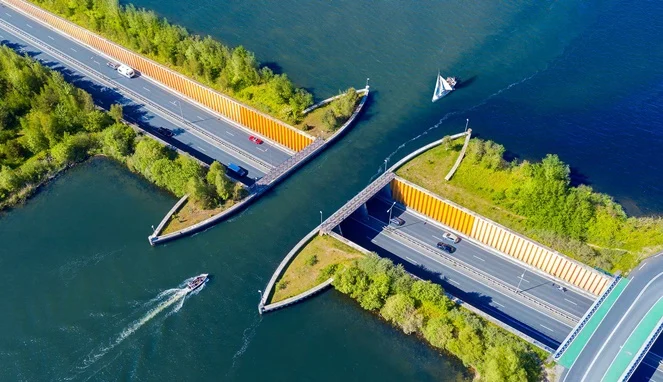
Bridges have historically served as the fundamental arteries of human civilization, designed to bridge physical divides, connect sprawling road networks, and facilitate the seamless movement of pedestrians and motorists alike. Conventionally, engineering paradigms dictate that bridges are built to span across bodies of water, carrying vehicular or pedestrian traffic high above the surface while ships navigate the currents below. However, in the heart of the Netherlands, a country renowned for its centuries-old mastery over water management and hydraulic engineering, a radical departure from traditional design has captivated global attention. The Veluwemeer Aqueduct, located near the historic town of Harderwijk in the eastern part of the nation, completely inverts this age-old concept. When viewed from an aerial perspective, the structure creates the optical illusion of a roadway slicing directly through an open body of water, allowing cars to drive seamlessly underneath ships and sailboats. Opened to the public in 2002, this architectural wonder has since evolved from a purely functional civil engineering project into an iconic global landmark, symbolizing the innovative spirit of Dutch infrastructure and offering a masterclass in modern spatial design.
The Genesis and Strategic Planning of a Waterway Highway
The conception of the Veluwemeer Aqueduct was not born out of a desire to create a novelty tourist attraction, but rather out of an urgent regional necessity. During the late 20th century, the regional transportation planners in the Netherlands faced a mounting logistical challenge. The region needed a high-capacity transit corridor to connect the mainland town of Harderwijk with Flevoland—the largest artificial island in the world, reclaimed entirely from the former Zuiderzee. At the same time, the route intersected with the Veluwemeer, a major recreational lake, and the IJssel River, both of which sustained heavy maritime traffic, ranging from leisure yachts to commercial vessels.
Traditional civil engineering options presented significant drawbacks. Constructing a conventional high-level suspension bridge to carry highway traffic over the water would have required massive approach ramps, incurred astronomical construction costs, and created a visually intrusive structure that would disrupt the serene flat landscape of the Dutch countryside. Conversely, building a traditional drawbridge would have caused chronic traffic bottlenecks on land every time a commercial barge or sailing vessel needed to pass.
Faced with these competing demands, Dutch hydraulic engineers proposed a counter-intuitive yet remarkably efficient solution: a navigable aqueduct. By routing the vehicular traffic through a submerged concrete tunnel and carrying a shallow layer of water directly over the roadway, the project successfully reconciled the demands of land and water transit without forcing either mode of transport to wait for the other. Construction on the project commenced as part of a broader regional development initiative, culminating in its official opening in 2002. The total expenditure for the project reached approximately $61 million USD—a figure that urban planners and economists later confirmed was significantly more cost-effective than building and maintaining a complex, high-clearance suspension bridge system capable of handling equivalent traffic loads.
Architectural Anatomy and Engineering Specifications
The structural mechanics of the Veluwemeer Aqueduct showcase the pinnacle of modern civil and hydraulic engineering. Spanning a total length of 25 meters and stretching 19 meters wide, the aqueduct maintains a remarkably shallow water depth of just 3 meters. This deliberate design choice is critical; by keeping the water shallow, the total weight of the water mass pressing down on the subterranean tunnel roof is minimized, thereby reducing structural stress and lowering material costs.

The water-bearing structure is supported by robust steel sheet piles and reinforced concrete foundations, engineered to withstand the continuous hydrostatic pressure of the surrounding lake. Specialized containment walls and barrier systems line the edges of the water channel to ensure that water never spills over the sides into the sunken roadway below.
Directly underneath this aquatic thoroughfare lies a 17-meter-long waterproof concrete tunnel that accommodates the N302 roadway. To ensure safety and accessibility for all commuters, the tunnel is flanked by dedicated pedestrian walkways and segregated bicycle lanes, separated from vehicular traffic by sturdy safety barriers. Today, this subterranean corridor handles an average daily volume of approximately 8,000 vehicles, ranging from daily commuters to commercial freight haulers, while an uninterrupted stream of waterborne vessels glides smoothly overhead.
Economic and Environmental Implications
The implementation of the Veluwemeer Aqueduct has yielded profound economic and environmental benefits for the region. From an infrastructural standpoint, the elimination of intersection delays between maritime and terrestrial traffic has resulted in substantial reductions in regional carbon emissions and fuel consumption. Vehicles no longer idle at drawbridges, and marine vessels experience zero wait times, optimizing both supply chain efficiency and recreational navigation.
Furthermore, the integration of the aqueduct into the local ecosystem was executed with stringent environmental safeguards. The Veluwemeer functions not only as a recreational hub for boating, swimming, and windsurfing enthusiasts, but also as a vital cultural and natural reserve supporting diverse aquatic flora and fauna. The careful management of water levels around the aqueduct ensures that local wetland habitats remain undisturbed, proving that large-scale infrastructure projects can coexist harmoniously with fragile ecosystems.
Global Recognition and Legacy as a Dutch Icon
In the two decades since its inauguration, the Veluwemeer Aqueduct has transcended its utilitarian origins to become a celebrated global symbol of Dutch ingenuity. Civil engineering students, urban planners, and architecture enthusiasts from around the world frequently visit Harderwijk to study the hydraulic dynamics of the structure. It stands as a testament to the Netherlands’ historical ethos of "living with water," transforming what has traditionally been a natural barrier into a seamless continuum of land and water transit.
As global urban centers face increasing congestion, rising sea levels, and the complex challenge of managing multi-modal transportation networks within limited geographic spaces, the Veluwemeer Aqueduct offers a compelling blueprint for the future. By refusing to choose between land and water, Dutch engineers have demonstrated that visionary design can harmonize conflicting human needs, cementing the aqueduct’s legacy as one of the most remarkable feats of modern infrastructure.