Kareena Kapoor Khan Captivates Audiences During Diwali Celebrations with Historic Royal Heirloom Necklace Featuring Ayatul Kursi

The festive season in the Indian subcontinent consistently delivers a dazzling array of high-fashion moments, traditional pageantry, and cultural celebrations, particularly during Diwali, the Hindu festival of lights. Celebrities and public figures often utilize this period to showcase exquisite sartorial choices crafted by renowned designers, blending contemporary trends with rich heritage textiles. Among the most anticipated appearances each year are those of Bollywood royalty Kareena Kapoor Khan and her husband, Saif Ali Khan. During the recent Diwali celebrations, the celebrity couple once again dominated news cycles and social media platforms, capturing public fascination not merely through their high-end fashion, but through a deeply symbolic display of generational history.
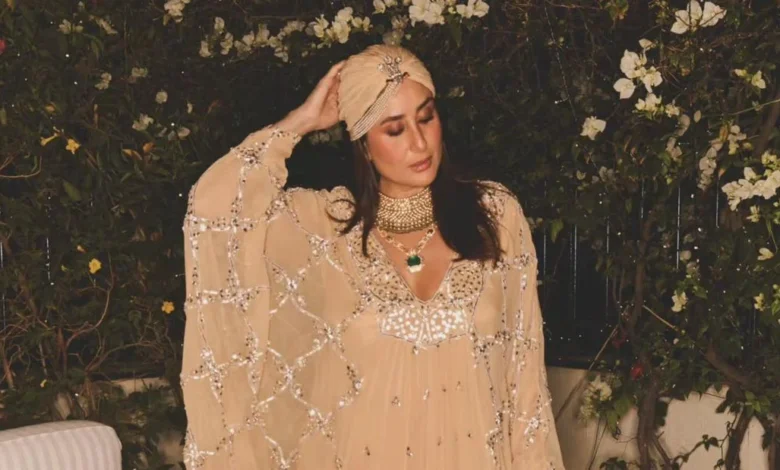
Kareena Kapoor Khan stepped out for the festive gatherings alongside Saif Ali Khan and their two children, Taimur and Jeh, presenting an aesthetic that many fashion critics and commentators described as evocative of imperial Indian royalty. While initial media reports focused heavily on the visual splendor of her ensemble—featuring a meticulously tailored kaftan and a coordinating turban designed by Punit Balana—subsequent disclosures from celebrity stylist Rhea Kapoor illuminated a much deeper narrative. Beyond the surface glamour, the acclaimed actress integrated significant pieces of historical and familial heritage into her modern festive attire, centering around an extraordinary emerald pendant inscribed with an Islamic verse and an antique turban ornament dating back two centuries.
Main Facts: The Ensemble and the Historic Inheritance
The centerpiece of Kareena Kapoor Khan’s Diwali ensemble, which quickly went viral across multiple digital platforms, was a piece of jewelry laden with both material value and ancestral significance. According to fashion and styling disclosures provided by Rhea Kapoor, the actress wore a stunning 30-carat emerald pendant meticulously carved with the Ayatul Kursi, the esteemed 255th verse of Surah Al-Baqarah from the Holy Quran.
This rare piece of jewelry possesses a storied provenance. The pendant originally belonged to the Begum of Bhopal and was formally passed down to Kareena Kapoor Khan following her marriage to Saif Ali Khan. The connection to the Bhopal royal lineage highlights a fascinating intersection of cinema, history, and nobility. Saif Ali Khan is the son of the late legendary actress Sharmila Tagore and the late Mansoor Ali Khan Pataudi, the former Nawab of Pataudi. However, through his maternal ancestry, Saif is directly linked to the royal house of Bhopal. His grandmother, Sajida Sultan, was the daughter of Hamidullah Khan, the last ruling Nawab of Bhopal.
Furthermore, Kareena’s styling incorporated another remarkable artifact from the Pataudi-Bhopal archives. She accented her turban with a kalgi—a traditional ornamental brooch traditionally worn on turbans by Indian nobility—that is approximately 200 years old. Notably, this exact kalgi was worn by Saif Ali Khan on his wedding day when he married Kareena in October 2012.
Complementing his wife’s historically rich look, Saif Ali Khan wore a classic, flawlessly tailored all-black kurta set, paired with polished black shoes and a cleanly shaven face accented by a distinguished mustache. Meanwhile, their young sons, Taimur and Jeh, added a touch of vibrant color to the family portrait, wearing silk kurtas in contrasting jewel tones that harmonized with the overall royal aesthetic of the family gathering.
Chronology of the Event and Styling Revelations
The unfolding of this sartorial story followed a structured timeline typical of modern high-profile celebrity events in the digital age.
On the evening of the primary Diwali celebrations, Kareena Kapoor Khan and Saif Ali Khan were photographed arriving at high-profile gatherings in Mumbai, accompanied by their children. Photographers and fashion journalists immediately captured the couple’s striking appearance, noting the unusual inclusion of turbans and structured garments that broke away from conventional festive wear norms. Within hours of the photographs being uploaded to social media, the images circulated widely, trending across platforms like Instagram, X (formerly Twitter), and various entertainment portals. Initial commentary centered on the bold styling choices, praising the couple for redefining modern festive fashion.
The narrative shifted from contemporary fashion to historical curation a day later, when celebrity stylist Rhea Kapoor shared detailed breakdown posts on social media. By publishing close-up imagery and explanatory captions, Rhea unveiled the intricate details behind the look. She formally identified the 30-carat carved emerald pendant bearing the Ayatul Kursi and detailed its transition from the Begum of Bhopal to Kareena Kapoor Khan. The disclosure transformed a standard celebrity fashion spotlight into a cultural discussion regarding the preservation and contemporary utilization of royal Indian heirlooms. Subsequent fashion reviews by major lifestyle publications analyzed the integration of the 200-year-old kalgi and the profound emotional and historical weight carried by the accessories.
Supporting Data and Historical Context of the Bhopal Royal Lineage
To fully understand the weight of the items worn by Kareena Kapoor Khan, it is essential to examine the historical context of the Bhopal princely state and the Pataudi dynasty. The princely state of Bhopal was one of the most prominent Muslim-ruled states of British India, notable for being uniquely governed by a succession of female rulers, known as Begums, for over a century (from 1819 to 1926). These female monarchs—Qudsia Begum, Sikandar Begum, Shah Jahan Begum, and Sultan Jahan Begum—were celebrated for their progressive governance, infrastructural development, and patronage of arts, education, and fine jewelry.
The emerald pendant worn by Kareena Kapoor Khan is a physical artifact of this matriarchal royal history. Gemstone carving, particularly involving religious texts and Quranic verses inscribed on precious and semi-precious stones such as emeralds, rubies, and spinels, was a mastercraft patronized heavily by Mughal and post-Mughal courts, including the rulers of Bhopal. Such stones were often commissioned as talismans of protection, status, and piety.
The lineage connected these historical treasures directly to modern Bollywood through Saif Ali Khan’s maternal bloodline. Sajida Sultan, the grandmother of Saif Ali Khan, was the second daughter of Hamidullah Khan, the last reigning Nawab of Bhopal. When the princely states were integrated into the Dominion of India in 1949, extensive royal collections, including regalia, textiles, and irreplaceable heirloom jewelry, remained within the custody of the royal family. Over the decades, selective pieces have been integrated into modern family milestones, weddings, and high-profile cultural appearances, serving as a living museum of Indian dynastic history.
Public and Expert Reactions
The revelation of the historic jewelry elicited widespread praise from cultural commentators, historians, and fashion enthusiasts alike. Unlike typical celebrity red-carpet appearances where garments and accessories are leased from contemporary fashion houses for a single evening, Kapoor’s choice to wear multi-generational museum-quality pieces signaled a shift toward sustainable luxury and ancestral storytelling.
Fashion historians noted that incorporating historical artifacts into festive wear bridges the gap between eras, allowing younger generations to connect with their heritage tangibly. The presence of the Ayatul Kursi inscribed upon a high-value gemstone also drew admiration for its fusion of spiritual significance and master artisanal craftsmanship. Commentators on social media platforms expressed awe that items of such historical gravity were not locked away in a climate-controlled vault, but were actively worn, appreciated, and integrated into contemporary celebrations of light and joy.
Furthermore, the stylistic choice resonated positively within the broader social fabric of India, where Diwali is celebrated as a festival of unity, shared cultural heritage, and familial continuity. The harmonious blending of traditional elements from different historical strata by a prominent interfaith celebrity couple provided a powerful visual narrative of cultural synthesis and mutual respect.
Broader Impact and Implications
The widespread attention garnered by Kareena Kapoor Khan’s Diwali attire extends beyond the realm of celebrity gossip, carrying several implications for the fashion, luxury, and cultural heritage sectors.
First, it highlights a growing trend among high-net-worth individuals and public figures to favor archival fashion and authentic heritage heirlooms over mass-produced luxury goods. In an era dominated by fast-moving micro-trends, the celebration of centuries-old craftsmanship—such as the 200-year-old kalgi and the antique Bropali emerald—redefines prestige. It suggests that true luxury lies in provenance, history, and personal narrative.
Second, the incident demonstrates the immense power of digital styling transparency. By detailing the origins of the garments and jewelry, celebrity stylists like Rhea Kapoor enhance public engagement, transforming fashion appreciation into an educational experience. Audiences are no longer content with merely knowing what a celebrity is wearing; they demand to know the story behind the items.
Finally, the public reception underscores the enduring public fascination with the remnants of India’s princely states. While the era of Indian nawabs and maharajas concluded over seven decades ago, the cultural imagination continues to be captivated by the aesthetics, grace, and historical artifacts of that bygone era. Through public figures like Kareena Kapoor Khan and Saif Ali Khan, these historical fragments are kept alive in the public consciousness, ensuring that centuries of artistic and dynastic history continue to be celebrated in the modern world.
Related posts: