The Indonesian Navy’s Komando Pasukan Katak (Kopaska), or Frogman Command, stands as one of the most enigmatic and formidable elite units in the Southeast Asian military landscape. Established on March 31, 1962, this special operations force has cultivated a reputation for psychological warfare and tactical precision, famously symbolized by the haunting skull mask worn by its operators. To understand why these elite divers are referred to as the "Skull Commandos" (Pasukan Tengkorak), one must delve into the origins of the unit, the psychological dimensions of their training, and the strategic evolution of the Indonesian Navy’s maritime warfare capabilities.
Origins and Historical Context: The Birth of Kopaska
The genesis of Kopaska is deeply rooted in the geopolitical tensions of the early 1960s, a period marked by the struggle for West Irian (Western New Guinea). President Sukarno, recognizing the need for a specialized maritime force capable of covert operations behind enemy lines, drew inspiration from the legendary United States Navy Underwater Demolition Teams (UDT) and the British Special Boat Service (SBS).
In 1961, several Indonesian naval officers were sent to the United States to undergo rigorous training with the U.S. Navy SEALs and UDTs. Upon their return, these pioneers became the nucleus of a new unit designed to carry out unconventional warfare. On March 31, 1962, the unit was formally inaugurated. The objective was clear: to provide the Indonesian Navy with a spearhead force capable of neutralizing maritime threats through sabotage, reconnaissance, and clandestine amphibious assaults.
The Iconography of the Skull: A Psychological Edge
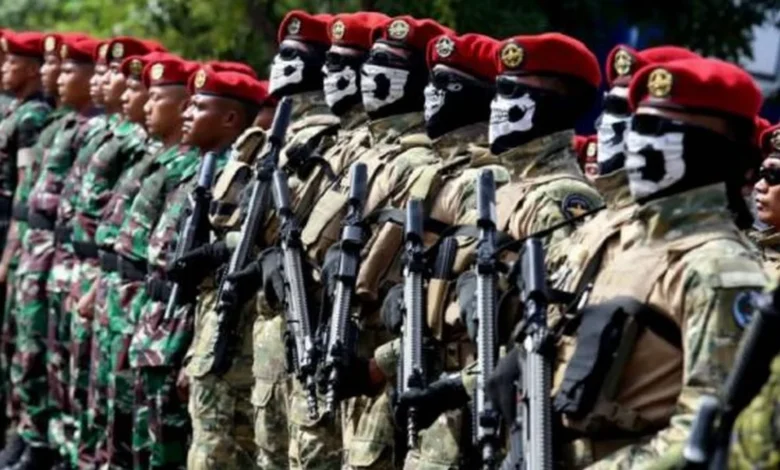
The moniker "Pasukan Tengkorak" is not merely a label but a deliberate component of the unit’s operational doctrine. The skull mask, often paired with dark-tinted tactical goggles and the signature red beret, serves a dual purpose. Tactically, the face covering provides protection against harsh elements and environmental debris. Psychologically, it serves as a powerful deterrent.
In the theater of special operations, anonymity is a weapon. By obscuring their identities behind the imagery of the skull, Kopaska operators strip away individual features, presenting an impersonal, relentless force to the adversary. This visual intimidation is intended to instill doubt and fear, complicating the enemy’s ability to identify or track specific operators during high-stress encounters. It reinforces the unit’s ethos: they are not individuals, but an unstoppable extension of the state’s maritime defense policy.
The Three-Dimensional Warrior: Capabilities and Scope
Kopaska is defined by its "three-dimensional" combat capability—the ability to operate seamlessly across sea, land, and air. This versatility makes them a unique asset in the Indonesian Armed Forces (TNI).
Underwater Demolition and Sabotage
The primary mission of the unit remains its namesake: "Frogmen" operations. This includes underwater demolition, the disabling of enemy vessels, and the destruction of harbor infrastructure. Their proficiency in handling explosives under extreme water pressure allows them to target the vital organs of an opposing naval force without ever being detected on the surface.
Amphibious Reconnaissance
Before a major naval landing can occur, the beachhead must be secured. Kopaska operators are tasked with covertly approaching enemy shores, surveying landing zones, and removing physical obstacles such as mines or anti-ship barriers. This reconnaissance mission is vital for the success of larger naval fleet movements.
Counter-Terrorism and Maritime Security
As global threats have shifted toward asymmetric warfare, Kopaska has adapted. Today, the unit plays a critical role in maritime counter-terrorism, including the boarding and reclaiming of hijacked vessels and the protection of offshore energy assets. Their training includes advanced close-quarters combat (CQC) and rapid insertion techniques via helicopter (fast-roping) or high-speed interceptor craft.
Semboyan: Tan Hana Wighna Tan Sirna
The unit’s motto, Tan Hana Wighna Tan Sirna, is derived from ancient Javanese literature and translates to "There is no obstacle that cannot be overcome." This philosophy is ingrained into every operator during the grueling selection process. The training pipeline for Kopaska is notoriously difficult, with a high attrition rate designed to ensure that only those with exceptional mental fortitude and physical endurance reach the elite ranks.
Training includes "hell weeks" that test the limits of human exhaustion, requiring candidates to remain submerged for extended periods, navigate complex underwater obstacles, and maintain operational focus under sensory deprivation. This rigorous preparation ensures that when a Kopaska operator enters a mission, they possess the resilience to withstand conditions that would incapacitate standard infantry.
Strategic Importance and Official Standing
Kopaska operates under the direct command of the Indonesian Navy’s Fleet Command (Koarmada) and reports to the Chief of Staff of the Indonesian Navy (KSAL). By maintaining this high-level command structure, the unit retains the agility to be deployed at a moment’s notice to any part of the Indonesian archipelago—a vast maritime territory that spans over 17,000 islands.
Defense analysts have noted that the existence of units like Kopaska serves as a significant deterrent against external maritime encroachment. Their ability to conduct "shadow" operations means that any hostile navy operating in or near Indonesian waters must contend with the constant threat of unseen, highly trained operators. The unit’s secrecy regarding its exact personnel numbers is another strategic layer; by refusing to disclose their strength, the Indonesian Navy keeps potential adversaries guessing about the extent of their capability.
Modernization and Future Implications
In the contemporary era, the focus of special operations has shifted toward technology and precision. Modern Kopaska operators are now equipped with advanced rebreather systems, encrypted communication suites, and high-fidelity thermal imaging, allowing them to operate in total darkness.
The integration of these technologies ensures that the "Skull Commandos" remain relevant in a world of drone surveillance and satellite reconnaissance. While the aesthetic of the skull remains a symbol of their heritage, the underlying reality is one of high-tech efficiency. The unit continues to collaborate with international special forces through joint exercises, further refining their techniques in boarding operations and underwater surveillance.
Conclusion: The Enduring Legacy of the Frogmen
The legacy of Kopaska is built upon more than six decades of service to the Republic of Indonesia. From their early days as a small group of divers trained in the United States to their current status as a pillar of Indonesia’s maritime sovereignty, they have remained a constant, silent presence in the defense of the nation.
The title "Pasukan Tengkorak" serves as a historical marker of their unique culture—a blend of fierce traditional pride and modern special warfare tactics. As Indonesia continues to assert its position as a global maritime power, the role of Kopaska will only grow in complexity. They represent the ultimate line of defense for a nation defined by its waters, proving time and again that whether on the surface, beneath the waves, or emerging from the shadows, they remain the unwavering guardians of the sea. Their story is a testament to the idea that true power often lies not in numbers, but in the resolve of a few, highly trained, and deeply disciplined individuals.