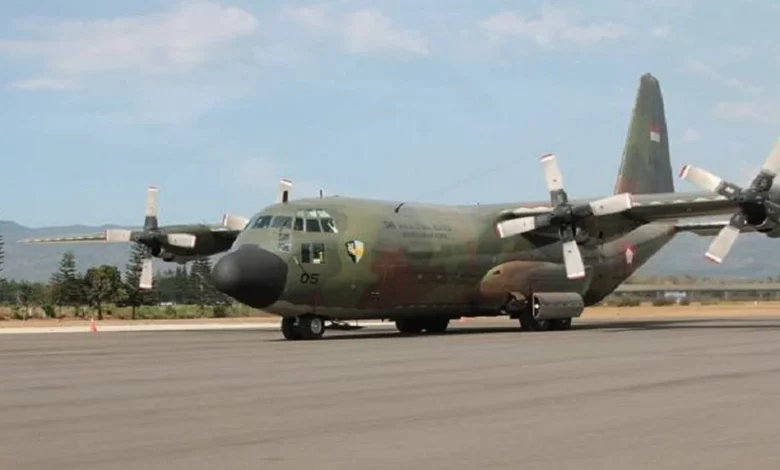
The Indonesian National Armed Forces (TNI) has intensified its commitment to mitigating the environmental crisis in Kalimantan by deploying an additional Hercules C-130 transport aircraft, identified as tail number A-1328, to the region. Departing from the Halim Perdanakusuma Air Force Base in East Jakarta on Saturday, October 24, 2026, the aircraft arrived at the Syamsudin Noor Air Force Base in Banjarmasin, South Kalimantan, marking a strategic escalation in the government’s efforts to combat widespread forest and land fires (karhutla) and the subsequent hazardous haze that has blanketed the area.
This reinforcement is part of a broader, multi-agency initiative aimed at scaling up Weather Modification Operations (WMO)—locally known as Operasi Modifikasi Cuaca (OMC)—to trigger artificial rain. The presence of the Hercules C-130 is expected to significantly increase the frequency and efficiency of cloud-seeding sorties, which remain the most effective tactical response to large-scale hotspots that are often inaccessible to ground-based firefighting units.
Strategic Deployment and Tactical Capabilities
The deployment of the Hercules C-130 is not merely a logistical movement; it is a tactical upgrade to the existing firefighting infrastructure in Kalimantan. The aircraft is equipped with two specialized seeding consoles, designed to facilitate the rapid dispersion of salt (NaCl) or dry ice into cloud formations. By inducing precipitation, the operation aims to saturate dry vegetation and peatlands, thereby neutralizing hotspots and reducing the concentration of smoke particles in the atmosphere.
Accompanying the flight crew is a specialized team of meteorologists and weather engineers from the National Research and Innovation Agency (BRIN). These experts are tasked with analyzing atmospheric data in real-time to identify suitable cloud clusters, ensuring that every drop of seeding material is utilized with maximum precision. The synergy between the TNI’s aviation prowess and BRIN’s technical expertise represents a sophisticated approach to disaster management, shifting the response from reactive firefighting to proactive climate intervention.
The Chronology of the Crisis
The decision to bolster air support follows a critical period in late October 2026, where satellite imagery and ground sensors indicated a dangerous surge in fire activity across several provinces in Kalimantan. The escalation began mid-month, as a prolonged dry spell—exacerbated by regional climatic anomalies—turned forest floors into tinderboxes.
- October 15, 2026: Initial spikes in hotspots are detected across Central and South Kalimantan.
- October 18, 2026: Local authorities issue an emergency alert as visibility drops significantly in major urban centers, including Palangkaraya and Banjarmasin.
- October 20, 2026: The National Disaster Management Agency (BNPB), in coordination with the TNI, initiates the first phase of WMO using smaller assets.
- October 23, 2026: High-level discussions conclude that existing aerial capacity is insufficient to combat the rapid spread of fires.
- October 24, 2026: The Hercules C-130 (A-1328) is deployed from Jakarta, signaling a high-priority intervention.
The timeline reflects a systematic response mechanism. While early suppression efforts focused on containment, the transition to a full-scale WMO operation signifies an acknowledgment that the scale of the fires has surpassed conventional manual suppression capabilities.
Environmental and Public Health Implications
The persistence of karhutla in Kalimantan presents a dual threat: ecological destruction and a public health crisis. Large-scale burning of peatlands, which are rich in carbon, not only destroys biodiversity but also releases massive quantities of greenhouse gases into the atmosphere, contributing to the global climate challenge.
Public health remains a primary concern for the Indonesian government. The hazardous haze, characterized by high concentrations of PM2.5 particles, poses severe risks to respiratory health. Hospitals in affected regions have reported an uptick in patients suffering from Acute Respiratory Infection (ARI). By deploying the Hercules C-130 to initiate cloud seeding, the government aims to suppress the smog, thereby improving air quality index (AQI) readings and reducing the burden on the local healthcare system.
Official Stance and Coordination
In a formal statement released on Sunday, October 25, 2026, the TNI Information Center (Puspen TNI) emphasized that the deployment is a collaborative mission. "The deployment of this additional aircraft is intended to strengthen the Weather Modification Operation, accelerating the handling of forest and land fires as well as the mitigation of haze," the statement read.
The operation involves a complex chain of command, integrating the Ministry of Environment and Forestry (KLHK), BRIN, the TNI, and local regional disaster management agencies (BPBD). This unified approach is essential for navigating the complexities of aerial operations, which require strict airspace management and real-time coordination between military pilots and meteorological scientists.
Fact-Based Analysis of the Aerial Strategy
The use of the C-130 Hercules is significant due to its payload capacity and endurance. Unlike smaller aircraft, which are limited in the amount of seeding material they can carry, the Hercules can conduct longer sorties and carry substantial loads of salt, allowing for multiple seeding passes in a single flight.
However, weather modification is not a panacea. Meteorological experts note that WMO is highly dependent on the presence of "seedable" clouds. In conditions of extreme atmospheric stability or a lack of humidity, even the most advanced aircraft cannot force precipitation. Therefore, the success of the mission hinges on the ability of BRIN’s scientists to interpret atmospheric conditions and strike at the precise moment that natural cloud development allows for enhancement.
Furthermore, the economic impact of the fires is substantial. Beyond the immediate costs of emergency response, the recurring nature of the haze affects aviation, maritime traffic, and agriculture. The decision to invest in heavy-lift assets like the Hercules reflects a shift toward more permanent, institutionalized disaster response frameworks, moving away from ad-hoc emergency measures toward sustained preparedness.
Looking Ahead: Sustainability and Prevention
While the current operation focuses on immediate suppression, the broader context of the 2026 crisis underscores the need for sustainable land management practices. The recurring nature of these fires highlights the challenges inherent in managing peatland ecosystems in a changing climate.
As the Hercules C-130 begins its sorties, the success of the mission will be measured by two metrics: the reduction in hotspot count and the subsequent improvement in air quality. Beyond the immediate term, policymakers are under pressure to evaluate the efficacy of these aerial interventions versus the long-term investment in ground-based prevention, such as water canal blocking and community-based fire patrols.
The TNI’s proactive stance in this instance—deploying one of its most reliable workhorses to the frontlines of the environmental crisis—serves as a clear indicator of the state’s resolve. By utilizing military assets for humanitarian and environmental protection, the government is reinforcing the dual role of the armed forces in both national defense and civil support.
In the coming days, the operations centered at Lanud Syamsudin Noor will likely serve as the hub for all aerial suppression activities. The deployment of the Hercules C-130 provides a much-needed morale boost to the ground crews working in the field, who can now rely on the certainty that the skies above them are being actively managed to bring the relief of rain to the scorched landscape of Kalimantan. As the situation evolves, the coordination between the aircrews and the ground teams will remain the deciding factor in the success of this critical mission.