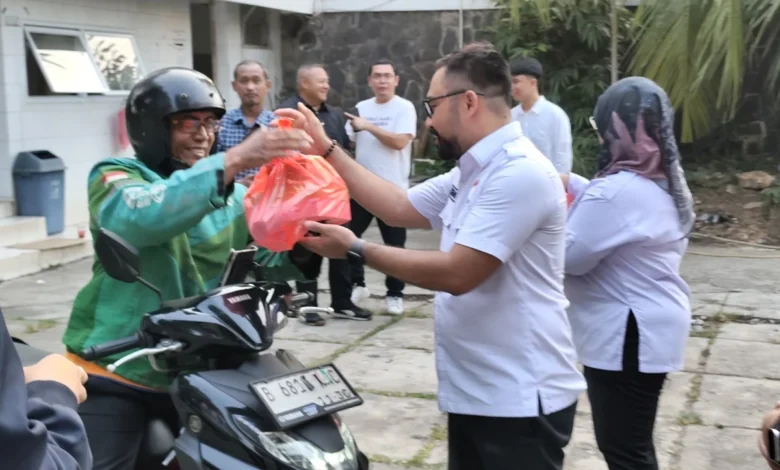
The Indonesian Unity Party (Perindo) marked its 12th anniversary on Thursday, October 8, 2026, by reinforcing its commitment to grassroots engagement through a series of humanitarian initiatives. At the party’s central executive board (DPP) office in Menteng, Central Jakarta, representatives organized a large-scale food distribution drive, providing meal packages and snacks to local residents and members of the city’s extensive online motorcycle taxi (ojol) workforce. This event serves as a focal point for the party’s ongoing efforts to transition from political campaigning toward consistent community service, a strategy aimed at maintaining public relevance and operational presence in the heart of the capital.
A Decisive Shift Toward Humanitarian Outreach
The anniversary event, which took place during the bustling late-afternoon hours, was strategically timed to coincide with the evening rush hour. By positioning the distribution point at the Menteng headquarters, the party was able to engage directly with hundreds of commuters, particularly ride-hailing drivers who serve as the backbone of Jakarta’s logistics and transportation sector. Firda Riwu Kore, the Head of the DPP for Legal and Advocacy Affairs at Perindo, underscored that the initiative was not merely a ceremonial gesture but a manifestation of the party’s long-term philosophy of "giving back."
According to the organizers, the distribution process was managed to ensure efficiency despite the high volume of traffic typically found in the Menteng area. The participation of various segments of society, from local residents to gig-economy workers, reflects a broader trend in Indonesian political party branding, where direct aid is increasingly used to mitigate the impacts of economic volatility on the urban poor and middle class.
Historical Context: Twelve Years of Political Evolution
Founded on February 7, 2015, the Indonesian Unity Party has spent the last 12 years navigating the complex landscape of Indonesian politics. From its inception, the party has positioned itself as an advocate for the "small people" (wong cilik), focusing on micro-entrepreneurship and social welfare programs. The 12th anniversary marks a significant milestone in the party’s history, signaling its survival through multiple election cycles and its adaptation to changing national priorities.
Over the past decade, Perindo has frequently utilized its media and economic resources to influence public opinion, often pairing policy proposals with visible social programs. The transition from its initial founding phase to its current status as an established political entity has been characterized by a push to professionalize its grassroots outreach. By institutionalizing these social welfare events, the party aims to create a sustainable feedback loop between the political elite and the constituents they represent.
Analyzing the Impact of Grassroots Political Initiatives
In the context of contemporary Indonesian politics, the use of food aid and direct social assistance—often referred to as "blusukan" or direct engagement—remains a critical tool for building electoral capital. Analysts note that while these actions provide immediate relief to those struggling with the rising cost of living, they also serve as a visible marker of party activity during non-election years.
Data from the Central Statistics Agency (BPS) regarding urban poverty in Jakarta indicates that a significant portion of the workforce remains vulnerable to fluctuations in the cost of essential goods. Initiatives like those organized by Perindo provide a tangible benefit to these workers. However, political scientists suggest that the long-term success of such strategies depends on whether these parties can pivot from temporary handouts to long-term legislative solutions that address the root causes of economic instability, such as access to healthcare, education, and fair labor protections for gig workers.
Official Responses and Strategic Messaging
During the event, Firda Riwu Kore emphasized that the party’s mandate is to ensure that its presence is felt beyond the legislative halls. "In this 12th year of the Perindo Party, this is our tangible manifestation of our commitment to continue having a positive impact on the community, providing the greatest possible benefit to the public," she stated.
The messaging from the party leadership suggests a concerted effort to move away from purely ideological discourse toward a focus on pragmatic, service-oriented politics. By highlighting their role in assisting the community during the 12th anniversary, the party is effectively signaling to its base that it remains a responsive political actor. This approach is intended to build brand loyalty among voters who prioritize parties that demonstrate "concrete work" (kerja nyata) over abstract political rhetoric.
The Role of the Gig Economy in Political Engagement
The inclusion of online motorcycle taxi drivers in the anniversary celebration is particularly noteworthy. As the gig economy continues to expand, this group has become a key demographic for political outreach. These workers operate in a precarious environment, often without the safety nets afforded to formal employees. By providing food packages to this group, the party is acknowledging the vital role they play in the economy while simultaneously securing visibility among a population that is highly mobile and deeply embedded in the social fabric of the city.
The logistics of the event, which utilized the DPP office as a distribution hub, allowed the party to maintain a high level of control over the narrative and the quality of the aid provided. This centralized approach contrasts with decentralized campaign efforts, suggesting that the party is focusing on building stronger institutional anchors within urban centers.
Future Projections and Party Trajectory
As the Perindo Party looks toward its next decade of operation, the focus on community-based welfare will likely continue to be a primary pillar of its strategy. Whether this translates into increased electoral support remains a subject of debate among political observers. In a competitive democratic environment like Indonesia, party loyalty is fluid, and voters are increasingly demanding evidence of policy efficacy.
To sustain its growth, the party will likely need to integrate these social welfare activities with a robust legislative agenda. If the party can successfully align its grassroots humanitarian efforts with effective advocacy for the workers it supports—such as pushing for better labor protections for gig workers in the House of Representatives—it may solidify its position as a representative for the lower-middle-class demographic.
Conclusion: A Milestone for Socially-Oriented Politics
The 12th-anniversary celebration of the Perindo Party represents more than just a celebratory event; it serves as a case study in how modern political organizations in Indonesia maintain visibility and relevance. By combining traditional social welfare practices with modern communication channels, the party continues to navigate the complexities of a democratic system that prizes direct, tangible interaction with the electorate.
As the country moves forward, the success of such initiatives will be measured not only by the quantity of food distributed but by the quality of the relationships formed between the party and the citizens it serves. For now, the events in Menteng serve as a clear indicator that for the Perindo Party, the path to long-term political viability is paved with consistent, community-focused engagement. As the party enters its 13th year, the challenge will be to scale these efforts, ensure they remain impactful, and translate the goodwill generated from such events into meaningful, sustainable policy change that addresses the fundamental needs of the Indonesian public.