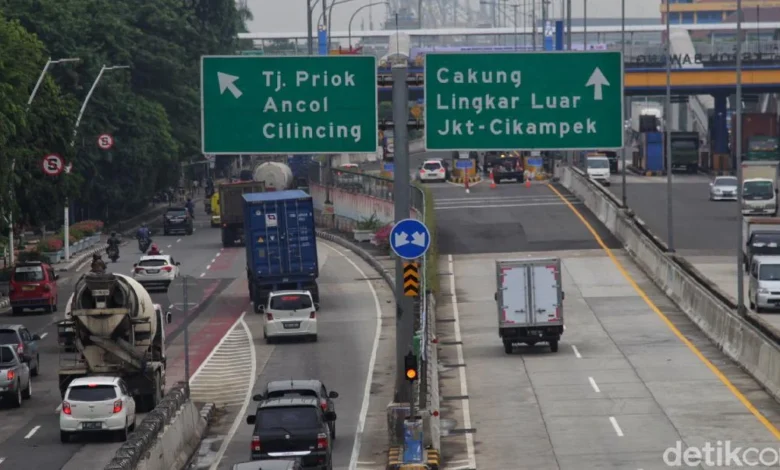
Jakarta — The possibility of implementing a unified toll tariff system across the Greater Jakarta (Jabodetabek) region has gained significant traction, driven by strong public and commercial demand for greater transportation efficiency, reduced logistics costs, and smoother daily commutes. A recent online survey conducted by the Indonesian Empowered Consumer Forum (FKBI) revealed that an overwhelming 74.1 percent of respondents strongly support the integration of toll tariffs in Jabodetabek. This backing predominantly originates from logistics operators and daily commuters who rely heavily on urban and inter-urban highway networks for their routine operations.
Despite the high public approval rating, the primary challenge moving forward lies in the meticulous design of a tariff scheme that simultaneously guarantees fluid traffic movement, maintains affordability for everyday citizens, and establishes highly efficient access corridors connecting major industrial estates to vital logistics hubs and ports. As congestion continues to threaten economic productivity across Indonesia’s bustling capital agglomeration, both government bodies and industry stakeholders are actively negotiating the practical parameters required to make regional toll integration a reality.
Current Regulatory Framework and Government Stance
The Indonesian government, through the Ministry of Public Works and the Toll Road Regulatory Agency (BPJT), is currently expediting the foundational regulatory frameworks necessary to accelerate the execution of nationwide and regional toll road integration.
Sony Sulaksono Wibowo, a representative of the BPJT under the Ministry of Public Works, expressed optimism regarding the impending completion of the necessary administrative and legislative adjustments.
"The expectation is that the harmonization process will be finalized shortly and that the ministerial regulation can be signed promptly so that toll road integration can be implemented immediately. The ultimate goal is to streamline traffic flow through a more balanced distribution of vehicles and to optimize interconnected road segments," Sony stated in an official release.
For the primary logistics corridors surrounding the capital, the integration of the Cibitung-Cilincing Toll Road, the Jakarta-Cikampek Toll Road, and the Tanjung Priok Access (ATP) Toll Road represents a critical strategic milestone. The alignment of toll tariffs across these three major segments is projected to significantly accelerate the flow of freight and heavy cargo moving directly from massive manufacturing and industrial centers toward the Port of Tanjung Priok, Indonesia’s busiest maritime gateway.
Sony further elaborated that the long-term development of Indonesia’s highway system has systematically been guided as a unified network under the National Toll Road Network General Plan for 2020–2040. However, historical discrepancies in the sequencing of construction projects, unexpected delays in completing supporting feeder routes, and noticeable tariff disparities have collectively led to severe congestion on certain specific stretches, while alternative parallel routes remain underutilized and fail to reach their maximum operational potential.
"The primary objective of integration is to enhance traffic fluidity through a more equitable distribution of vehicles. Interconnected corridors must mutually support one another as a single, cohesive network rather than operating as isolated commercial entities," Sony emphasized.
Economic Pressures and the Logistics Dilemma
While the integration of urban and regional toll networks promises substantial macro-level improvements in traffic management, logistics sector representatives have highlighted the intricate financial complexities governing commercial freight transport.
Ahmad Sugiono, a representative of the Indonesian Logistics and Forwarder Institute (ALFI) Jakarta chapter, pointed out that operational logistics costs are shaped by a multitude of intersecting variables. Toll tariffs constitute a sensitive component of overhead expenses that directly squeeze business profit margins in an intensely competitive market.
Within standard lump-sum trip allowance schemes, an estimated time savings of one to two hours does not automatically compel truck drivers or transport companies to abandon conventional arterial roads if the alternative incurs a heavier financial toll.
"The utilization of toll roads must be evaluated within the context of the entire logistics ecosystem. This includes evaluating the severity of traffic congestion encountered before entering the toll gate, the operational flexibility of transit routes, the frequency of trips, and the commercial probability of securing return cargo. Therefore, financial calculations cannot rely solely on travel time savings," Ahmad explained.
Strategic Differentiation in Tariff Policies
Addressing the structural nuances of urban highway usage, Gibran Sesunan, Executive Director of the Center for Strategic Infrastructure Studies (PUKIS), argued that the establishment of toll rates must carefully reflect the underlying functions and socioeconomic objectives for which each individual highway segment was originally constructed.
Simply applying a standardized tariff based strictly on vehicle classification categories is insufficient to accommodate the stark operational differences between highways primarily dedicated to heavy freight transport and those designed predominantly for private passenger vehicles. Consequently, tariff determinations must factor in the strategic utility, distinct traffic characteristics, and broader socioeconomic benefits associated with each specific road segment. Affordable pricing structures are viewed as a vital catalyst to encourage both everyday motorists and commercial transport operators to consistently utilize designated high-capacity networks.
"For road segments purposefully constructed as dedicated logistics corridors, freight transport vehicles should ideally be granted more affordable tariff rates to incentivize their usage. Policy frameworks regarding pricing must respect the specific service functions and core objectives of each respective road," Gibran noted.
Operational Realities for Freight Drivers
Echoing these operational concerns, Sugi Purnoto, Senior Consultant at Supply Chain Indonesia, stressed that route selection by heavy vehicle operators is fundamentally dictated by the adequacy of the travel allowance provided to drivers. This financial allocation must comprehensively cover a wide array of daily operational requirements, including driver remuneration, daily subsistence, fuel costs, toll fees, and loading-unloading expenses.
According to operational simulations conducted within the industry, toll fees currently account for approximately 7 to 14 percent of a standard travel allowance on conventional routes. However, if transport operators are forced to transition to specialized logistics toll routes without adequate tariff adjustments, that financial proportion could surge dramatically to between 28 and 40 percent of the total travel budget. Consequently, the remaining funds available for essential operational needs would be severely restricted.
"Physical connectivity must be underpinned by pricing structures that genuinely enable drivers to meet their daily operational requirements. If financial burdens escalate significantly, drivers will inevitably continue to choose existing non-toll arterial routes, despite enduring severe traffic congestion or exposing themselves to heightened safety risks," Sugi warned.
Broader Implications and Future Outlook
The initiative to integrate Jabodetabek’s toll tariffs represents a pivotal step in Indonesia’s ongoing modernization of its transportation infrastructure. By addressing historical tariff disparities and smoothing out administrative boundaries between different highway operators, the government aims to establish a seamless mobility network that benefits both individual commuters and large-scale industrial supply chains.
Nevertheless, the successful execution of this policy will depend heavily on the government’s ability to balance macroeconomic efficiency with the micro-level economic realities faced by logistics operators and truck drivers. As regulatory preparations near completion, industry observers will closely monitor whether the final ministerial decree can successfully harmonize tariffs without inadvertently placing an unsustainable financial burden on the transport sector. Ultimately, true integration will require a holistic approach that bridges infrastructure engineering with practical economic viability.
Related posts: