Telkom Indonesia and BRIN Forge Strategic Alliance to Accelerate National Digital Sovereignty Through AI, Satellite, and Quantum Computing


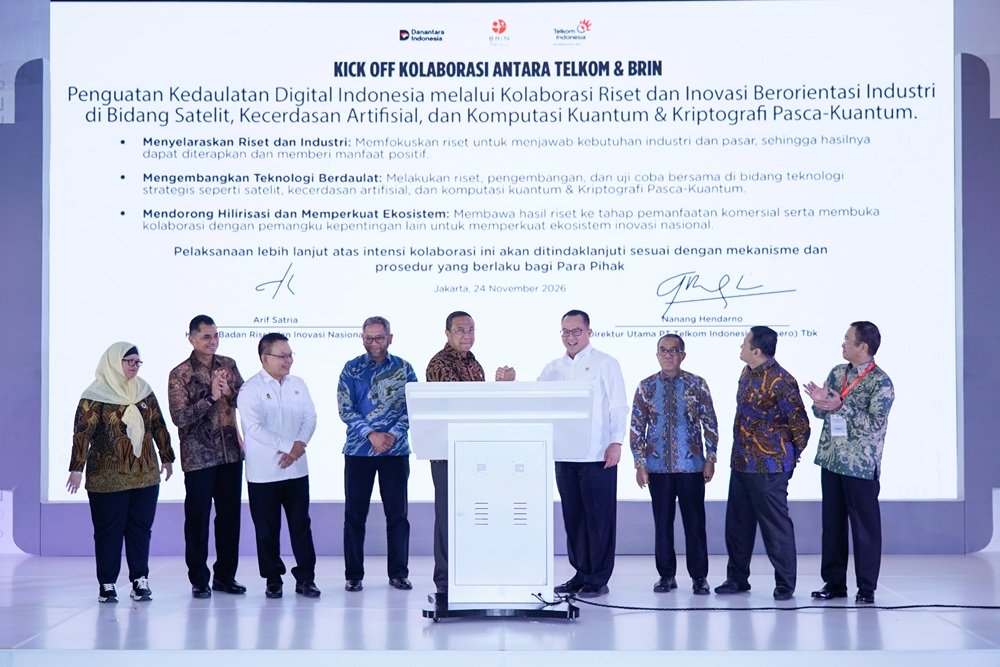
In a landmark development for Indonesia’s technological landscape, Telkom Indonesia and the National Research and Innovation Agency (BRIN) have officially entered into a strategic collaboration aimed at fortifying the nation’s digital sovereignty. The partnership, formalized through a signing ceremony in Jakarta on November 24, 2026, marks a pivotal shift in how the country bridges the gap between high-level academic research and commercial market application. By leveraging the research prowess of BRIN and the expansive industrial infrastructure of the TelkomGroup, the two organizations seek to catalyze local innovation in artificial intelligence, satellite communications, and quantum computing.
The agreement, signed by Telkom Indonesia President Director Nanang Hendarno and BRIN Head Arif Satria, represents a transition from traditional academic exploration toward a "joint innovation-to-commercialization" model. This framework is specifically designed to ensure that state-funded research does not remain confined to laboratory environments but instead evolves into viable, scalable products that address the pressing needs of the Indonesian industry and the general public.
The Strategic Imperative for Digital Sovereignty
The impetus behind this partnership is rooted in the growing global recognition that digital sovereignty is a matter of national security. As Indonesia’s digital economy continues to expand—a sector projected to reach a valuation of over $360 billion by 2030 according to various regional reports—the reliance on foreign-developed technologies has created a vulnerability in terms of data privacy, infrastructure control, and long-term economic independence.
"True digital sovereignty cannot be achieved merely by adopting foreign technologies," stated Nanang Hendarno during the event. "We must cultivate the capability to develop our own. By connecting BRIN’s robust research ecosystem with Telkom’s market reach, we are creating a pipeline that allows Indonesian ingenuity to meet industrial demand directly."
This sentiment is shared by BRIN, which has undergone significant structural shifts in recent years to centralize the nation’s scientific resources. With access to state-of-the-art facilities like High-Performance Computing (HPC) centers, BRIN is uniquely positioned to handle the data-intensive requirements of AI and quantum modeling. Arif Satria highlighted that the collaboration acts as a "fast-track" for researchers, providing them with a real-world testing ground where their work can be validated by enterprise-grade users.
AI Development: The ModelHub Initiative
One of the most ambitious components of this collaboration is the focus on Artificial Intelligence. The partnership centers on the creation of an indigenous AI ecosystem, specifically through the development of Large Language Models (LLM) and Small Language Models (SLM) tailored to the nuances of the Indonesian language and cultural context.
The strategy hinges on the deployment of "ModelHub," a centralized platform designed to host and refine these models. While LLMs offer the vast generative capabilities seen in global counterparts, the inclusion of SLMs is particularly strategic. SLMs provide the agility required for specific enterprise functions where computational resources are constrained, allowing for rapid deployment in sectors such as agriculture, maritime logistics, and public healthcare.
To ensure the commercial viability of these models, the collaboration has already secured pilot partnerships with key national entities, including Danantara Indonesia, MIND ID, Pertamina, and Garuda Indonesia. By deploying AI to solve operational challenges—such as predictive maintenance in mining, route optimization in aviation, and yield forecasting in agriculture—the partnership aims to demonstrate the tangible economic value of local AI development.
Advancing Satellite Connectivity and Infrastructure
The satellite sector, managed primarily through Telkom’s subsidiary, Telkomsat, is set for a massive technological upgrade under this agreement. The focus is split between immediate utility and future-proofing. In the short term, the partnership is working on increasing the accessibility of Geostationary Earth Orbit (GEO) services by developing more affordable, portable user terminals. This is crucial for bridging the digital divide in Indonesia’s 3T (frontier, outermost, and underdeveloped) regions.
Beyond GEO, the collaboration is setting its sights on the next generation of satellite constellations: Low Earth Orbit (LEO) satellites. LEO technology is critical for high-speed, low-latency internet and advanced Positioning, Navigation, and Timing (PNT) services. By building a sovereign LEO capability, Indonesia aims to reduce its reliance on international satellite providers, ensuring that domestic communications and critical national data remain under national oversight.
Quantum Readiness and Cybersecurity
Perhaps the most forward-looking aspect of the partnership is the joint venture into quantum computing and Post-Quantum Cryptography (PQC). As quantum computers approach the threshold of breaking conventional encryption, the threat to national cybersecurity is significant.
Telkom and BRIN are proactively developing PQC standards to protect three high-stakes areas: digital signatures, IoT networks, and Virtual Private Networks (VPNs). By integrating quantum-resistant encryption into these protocols, the partnership aims to secure the digital backbone of the country against future threats posed by advanced quantum processing power. This work is not merely theoretical; it is a defensive strategy intended to protect the integrity of electronic legal documents and the expanding network of connected industrial sensors.
The "Quick Win" Framework: A Three-Pronged Approach
To maintain momentum, the partnership has identified three "quick win" initiatives that are expected to yield results within the first phase of the collaboration:
- Ground Segment as a Service (GSaaS): Enhancing the ground-based infrastructure necessary to manage and communicate with satellite constellations efficiently.
- Indonesian-Centric LLM/SLM Development: Delivering functional language models that improve customer service, administrative automation, and information access for local users.
- PQC-Enabled Digital Signatures: Rolling out quantum-secure authentication for government and enterprise documents to ensure long-term data integrity.
Broader Implications and Future Outlook
The collaboration between Telkom and BRIN represents a shift in the philosophy of national innovation. Historically, the "valley of death"—the gap between successful research and commercial product—has been a hurdle for Indonesian innovation. By formalizing a pathway for research to be validated by market leaders like Pertamina or Garuda Indonesia, the project effectively mitigates the risk for both the researchers and the industrial end-users.
Furthermore, this alliance serves as a signal to the private sector and international investors that Indonesia is serious about cultivating a deep-tech ecosystem. The reliance on BRIN’s HPC infrastructure for AI and Big Data processing provides a competitive edge, ensuring that the country’s data remains within its borders, governed by domestic laws.
As the program progresses, the integration of these technologies is expected to have a ripple effect across the economy. Enhanced satellite connectivity will stimulate the digital economy in remote areas, AI adoption will drive efficiency in state-owned enterprises, and quantum-resistant security will build trust in the digital government services of tomorrow.
However, the road ahead is not without challenges. The success of this collaboration will depend on the sustained commitment to technical talent retention and the ability to scale these innovations beyond the pilot phase. Maintaining the agility of the ModelHub platform and ensuring that the PQC solutions are compatible with existing legacy systems will be technical hurdles that both Telkom and BRIN must navigate in the coming years.
Ultimately, the partnership signifies a mature phase in Indonesia’s digital journey. By moving beyond the role of a consumer of global technology and positioning itself as a developer of strategic intellectual property, Indonesia is taking a concrete step toward securing its place in the global digital economy. The collaborative spirit between the state’s scientific arm and its telecommunications giant serves as a blueprint for how nations can harness institutional knowledge to power long-term, sustainable economic growth. As the first results of these "quick wins" begin to manifest in early 2027, the success of this alliance will likely be measured by its ability to translate complex scientific breakthroughs into seamless, everyday digital utility for the Indonesian people.