The world of professional sports and ultra-luxury consumerism often intersect in extravagant ways, but few stories capture the volatile mix of ego, retail prejudice, and immense wealth quite like the infamous dealership encounter involving National Basketball Association icon Shaquille O’Neal. Long before multi-million-dollar vehicle fleets became standard social media fodder for professional athletes, a young O’Neal—then dominating the hardwood for the Los Angeles Lakers—walked into a high-end automotive showroom dressed in casual athletic wear. What followed was an impulsive retail transaction born from professional condescension, resulting in the immediate purchase of three bespoke Rolls-Royce motor cars, an unintended masterclass in sales psychology, and, decades later, the public auction of one of history’s most uniquely proportioned British luxury cruisers.
This incident, which has since entered sports and automotive folklore, sheds light not only on the purchasing behaviors of ultra-high-net-worth individuals but also on the persistent biases ingrained in luxury retail environments. As the automotive industry continues to evolve, the legacy of this purchase extends far beyond a simple celebrity anecdote, touching upon issues of customer profiling, bespoke automotive engineering, and the enduring market value of celebrity-owned memorabilia.
The Main Facts: An Impulsive Fleet Acquisition Rooted in Ego
The core narrative centers on an afternoon in the late 1990s or early 2000s when Shaquille O’Neal, standing at a towering 7 feet 1 inch and weighing well over 300 pounds, decided to visit a Rolls-Royce dealership in Southern California. At the time, O’Neal was the anchor of the Los Angeles Lakers franchise, commanding massive salaries and lucrative endorsement deals that afforded him almost limitless purchasing power. However, his personal philosophy regarding money was nuanced.
"I love spending money, but I do not like wasting money. I did not want to spend $400,000 for a car," O’Neal famously recounted during retrospective interviews regarding his spending habits during his prime athletic years.
Dressed down in casual training pants and a t-shirt—a standard off-court uniform for professional basketball players accustomed to grueling practices—O’Neal did not fit the traditional visual profile of a prospective buyer capable of acquiring multiple ultra-luxury vehicles without financing. As he browsed the showroom floor, inspecting various models and asking detailed questions about specifications and pricing, a floor salesman reportedly made a fatal error in customer service assessment.
Each time the salesperson quoted a price for a specific model, O’Neal simply waved his hand dismissively, evaluating the financial proposition rather than reacting with awe. Misinterpreting this gesture as a sign of financial limitation rather than analytical deliberation, the salesman confronted the four-time NBA champion with a blunt and condescending inquiry: "You are asking about all these cars, are you actually able to afford them?"
Stung by the insinuation and fueled by an ego that had been cultivated on the fiercely competitive basketball courts of the NBA, O’Neal’s demeanor shifted instantly from curious browser to aggressive consumer. Rather than walking out or demanding to speak with a manager, the center responded by purchasing three brand-new Rolls-Royce vehicles on the spot, paying for them outright. While the transaction served as an extraordinary display of financial retaliation and celebrity flex, it simultaneously transformed the skeptical salesman into a major beneficiary, netting him an unprecedented triple-commission on some of the most expensive passenger cars available on the global market.
Chronology and Context: The Lakers Dynasty and Automotive Customization
To fully understand the context of the purchase, one must examine O’Neal’s lifestyle during his tenure with the Los Angeles Lakers, spanning from 1996 to 2004. This era represented the zenith of his physical dominance, highlighted by a historic three-peat championship run alongside Kobe Bryant from 2000 to 2002. Financially, O’Neal was securing monumental contracts, including a historic seven-year, $120 million deal signed with the Lakers in 1996, followed by subsequent max-level extensions.
Vehicular acquisitions were a primary outlet for O’Neal’s wealth, though finding standard luxury cars that could accommodate his monumental frame presented a constant engineering challenge. Standard production vehicles required extensive aftermarket modifications just to allow the center to sit comfortably behind the wheel.
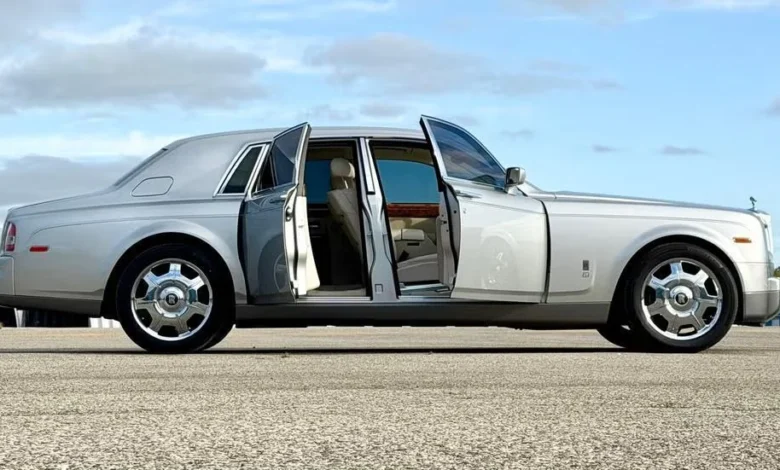
Among the trio of Rolls-Royces purchased during that fateful afternoon was a 2004 Rolls-Royce Phantom, a vehicle that would eventually find its way onto the collector market nearly two decades later. This specific automobile was not delivered in standard factory configuration; rather, it underwent bespoke alterations tailored explicitly to O’Neal’s physical specifications. Most notably, the driver’s seat compartment was re-engineered and pushed significantly further back into the cabin to provide adequate legroom for a driver standing over seven feet tall.
For approximately 14 years, O’Neal maintained ownership of the vehicle, integrating it into a rotating collection of customized exotic cars, oversized trucks, and performance vehicles. Despite its famous pedigree and specialized configuration, the car accumulated a relatively modest odometer reading of roughly 45,000 miles (approximately 72,400 kilometers) by the time it was consigned for public sale. This equates to an average utilization rate of roughly 3,600 kilometers per year, suggesting the Phantom was deployed selectively, likely reserved for high-profile public appearances, evening outings, or specific social engagements in the Southern California area.
Detailed Specifications of the Celebrity-Owned Phantom
When the 2004 Rolls-Royce Phantom was officially registered and listed for public acquisition on Bring a Trailer—a prominent digital auction platform specializing in enthusiast, classic, and unique vehicles—automotive purists and celebrity memorabilia collectors alike scrutinized its mechanical and aesthetic credentials.
The vehicle’s exterior was finished in a sophisticated silver paint scheme, complemented by a contrast silver upper section that accentuated the stately proportions of the British sedan. Inside, the cabin featured high-grade light-gray leather upholstery, maintaining the traditional aesthetic standards associated with the Goodwood-manufactured marque.
Beneath the elongated hood rested a formidable powertrain: a naturally aspirated 6.75-liter V12 engine capable of delivering effortless power and whisper-quiet operation. This engine was paired with a six-speed automatic transmission that routed power to the rear wheels, ensuring the smooth, gliding ride quality synonymous with the Phantom nameplate.
The equipment list on O’Neal’s custom Phantom reflected the peak of early-2000s automotive luxury:
- A factory glass sunroof allowing natural light into the expansive cabin.
- The iconic retractable "Spirit of Ecstasy" hood ornament, engineered to sink automatically into the radiator shell upon locking the vehicle or via cabin controls to prevent theft or vandalism.
- Rear-hinged coach doors (commonly referred to as suicide doors) designed to facilitate dignified entry and exit for rear passengers—though in this case, the primary user spent the majority of his time stretching out behind the steering wheel.
- Comprehensive front and rear parking sensors to navigate the vehicle’s massive footprint in tight urban environments.
- 21-inch silver-finished alloy wheels wrapped in high-profile luxury touring tires.
- An advanced self-leveling automatic air suspension system designed to isolate occupants from road imperfections.
Despite its initial multi-hundred-thousand-dollar MSRP and the celebrity provenance attached to its history, the market realities of aging ultra-luxury sedans proved unforgiving. When the hammer finally fell on the digital auction block, the vehicle realized a winning bid of $62,000—roughly equivalent to 1.1 billion Indonesian rupiahs at prevailing exchange rates. This final transaction price represented a staggering depreciation curve compared to the estimated $400,000 baseline cost per unit that O’Neal paid when he impulsively purchased the triad of luxury cruisers years prior.
Fact-Based Analysis of Market Implications and Consumer Psychology
The trajectory of Shaquille O’Neal’s Rolls-Royce—from a spontaneous retail retaliation to a heavily depreciated collector car—offers valuable insight into the economics of luxury depreciation and the real-world impact of celebrity ownership.
From an economic perspective, ultra-luxury sedans like the Rolls-Royce Phantom are notoriously prone to steep depreciation rates during their first two decades. Unlike rare hypercars or limited-production vintage sports cars, modern luxury flagships are heavily reliant on complex electronics, specialized hydraulic and pneumatic systems, and expensive proprietary components. As these vehicles age, the cost of deferred maintenance and mechanical upkeep often outpaces the vehicle’s residual market value, leading to plummeting secondary market prices regardless of who previously held the title.
Furthermore, the vehicle’s specific modifications—while necessary for O’Neal’s physical comfort—introduced a niche dynamic to the auction process. Alterations made to accommodate an exceptionally tall individual can sometimes narrow the pool of prospective buyers, as future drivers of standard height might find the customized seating position suboptimal. However, in this instance, the celebrity provenance served as a powerful counterweight, attracting bidders specifically interested in owning a tangible piece of NBA history and Hollywood lore.
From the perspective of retail psychology, the anecdote serves as a perennial cautionary tale for sales professionals within the luxury goods sector. The encounter underscores the commercial perils of profiling customers based on superficial appearances, attire, or demographic assumptions. In an era where extreme wealth is frequently accumulated by tech entrepreneurs, athletes, and entertainers who eschew traditional corporate dress codes in favor of casual streetwear, visual indicators of affluence have become increasingly unreliable.
Broader Impact and Cultural Legacy
The story of Shaq’s Rolls-Royce purchase has transcended automotive journalism to become a staple of modern pop culture, frequently recounted by O’Neal himself in talk show appearances, podcasts, and motivational speaking engagements. It highlights a recurring theme in the public persona of the Hall of Fame center: an individual acutely aware of his status, capable of leveraging his immense financial resources to turn slights into unforgettable public spectacles.
At the same time, the ultimate fate of the vehicle—sold at a fraction of its original cost—serves as an objective reminder of the ephemeral nature of automotive status symbols. While the salesman secured a lucrative commission on that afternoon in Southern California, and O’Neal found a momentary outlet for his competitive pride, the physical machinery itself was ultimately subjected to the relentless laws of automotive depreciation. Today, the 2004 Phantom lives on as a rolling museum piece, bridging the worlds of elite professional athletics, British automotive craftsmanship, and the unpredictable digital marketplace of modern collector cars.