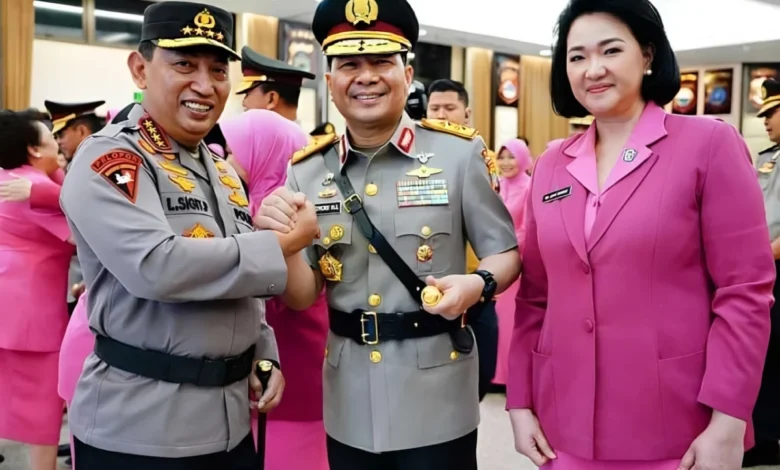
The Indonesian National Police (Polri) has officially elevated one of its most seasoned field commanders to the rank of Commissioner General (Komjen), marking a significant milestone in the career of Roycke Harry Langie. Following the latest organizational reshuffle stipulated in the Chief of Police’s Telegram Letter (ST) Number 1877/VIII/KEP./2026, Langie has been appointed as the Assistant to the Chief of Police for Operations (Astamaops). This promotion, which awards him the coveted third star, places him at the helm of the force’s most critical strategic operations unit, succeeding Commissioner General Mohammad Fadil Imran, who has entered his retirement phase.
The transition of leadership within the Astamaops division is viewed by security analysts as a move to strengthen the police’s strategic response capabilities, particularly in light of the ongoing security challenges in the eastern provinces of Indonesia. Langie, an alumnus of the 1994 Police Academy (Akpol), brings to the position a unique blend of urban law enforcement experience and rugged field command, forged largely through his extensive tenure in the challenging terrains of Papua.
A Career Defined by Field Experience
Roycke Harry Langie’s rise to the upper echelons of the police hierarchy was not an overnight success but the result of three decades of progressive service. His reputation as a "jungle hunter"—a moniker earned through his relentless pursuit of the Armed Criminal Group (KKB) in Papua—distinguishes him from many of his contemporaries who spent their careers primarily in bureaucratic or administrative roles.
His early career was characterized by a focus on criminal investigation (Reserse). Upon graduation from Akpol, he cut his teeth in the field, starting as the Head of Investigation Unit at the Indramayu Resort Police in 1995. This foundational experience in criminal intelligence proved vital when he was later deployed to the volatile regions of eastern Indonesia. Between 2012 and 2014, his command of the Kepulauan Yapen and Jayapura Resort Police departments put him at the forefront of operations against separatist insurgencies. During this period, he became intimately familiar with the complexities of counter-insurgency, hostage negotiation, and maintaining order in territories where government authority is often contested by armed non-state actors.
Chronology of Command and Advancement
The trajectory of Langie’s career reflects the evolution of the Indonesian National Police’s operational requirements. His resume reveals a strategic rotation between frontline tactical commands and high-level investigative roles in the nation’s capital.
- 1995–2004: Early career focused on criminal investigation, serving in Indramayu and later as the Commander of the Akpol Cadet Company.
- 2007–2010: Shifted to urban policing in Jakarta, serving as the Sector Police Chief (Kapolsek) in Jagakarsa and later as the Head of Criminal Investigation (Kasat Reskrim) for East Jakarta.
- 2012–2014: The "Papua Years." His leadership in Kepulauan Yapen and Jayapura marked him as a reliable commander capable of handling high-stakes security threats in remote, geographically difficult regions.
- 2014–2016: Returned to metropolitan security, commanding the Soekarno-Hatta Airport Police and later the West Jakarta Metropolitan Police.
- 2018: Graduated from the Sespimti Sespim Lemdiklat Polri, the highest-level command school for senior police officers, solidifying his path toward the general officer rank.
- 2026: Promoted to Commissioner General (Astamaops Kapolri), overseeing the entire operational strategy of the Indonesian police force.
Organizational Strategy and Modernization
The promotion of Langie comes at a time when the Indonesian National Police is undergoing a period of transformation to address modern security threats, ranging from cyber-crime and transnational narcotics trafficking to the perennial issue of armed conflict in Papua. According to the Head of the Public Relations Division of the National Police, Inspector General Johnny Eddizon Isir, the rotation is a routine administrative measure. However, internal sources suggest that the appointment of a battle-hardened commander like Langie as the Chief of Operations is a deliberate strategy to increase the tactical readiness of the force.
"The mutation of positions is an integral part of the organization’s dynamics and the professional development of our personnel," Isir stated in an official press release. "We select individuals based on their proven competence, their track record in previous assignments, and the specific strategic needs of the organization at this moment in time."
For the Astamaops role, the Chief of Police requires an individual who not only understands policy but also comprehends the logistical and psychological realities of personnel deployed in remote areas. Langie’s background as a "field general" is expected to bridge the gap between high-level policy-making in Jakarta and the execution of security operations on the ground.

Implications for Security Operations in Papua
The appointment of a commander with deep knowledge of the Papuan landscape is significant. The security situation in Papua has long been a focal point for the Indonesian government, involving a complex interplay of socioeconomic development, infrastructure expansion, and regional stability. Critics and supporters alike often debate the "security approach" versus the "prosperity approach."
By placing Langie in charge of national operations, the police force is signaling a commitment to maintaining a robust security posture while likely seeking to professionalize the methods used in the field. His experience suggests he will prioritize intelligence-led operations, reducing the reliance on blunt force and focusing instead on precision, surveillance, and the neutralisation of specific high-value threats within the KKB.
Furthermore, as Astamaops, Langie will now be responsible for the coordination of various police operations across the archipelago, including the maintenance of the "Operasi Damai Cartenz" in Papua. His ability to navigate the unique cultural and political sensitivities of the region will be tested as he transitions from a field commander to a strategic overseer.
The Standard of Professionalism
The elevation of Roycke Harry Langie serves as a case study for the current meritocracy within the Indonesian police force. In recent years, the institution has faced public scrutiny regarding internal discipline and accountability. By promoting officers whose records are grounded in tangible, field-tested achievements rather than solely through political appointments, the police leadership appears to be attempting to restore institutional morale and public trust.
The Sespimti Sespim (Senior Leadership School) education remains a prerequisite for such high-ranking positions, ensuring that candidates are not only tactical commanders but also trained in leadership, administration, and public policy. Langie’s successful navigation of these academic and professional hurdles reinforces his position as a standard-bearer for the next generation of police leadership.
Future Outlook and Challenges
As Komjen Pol Roycke Harry Langie assumes his new duties, he faces an array of immediate challenges. The national police are currently tasked with ensuring the security of various major national projects, responding to the rise in sophisticated financial crimes, and managing the delicate balance of public order in a politically active nation.
The Astamaops office is the nerve center for these activities. Langie will need to oversee the allocation of human and technical resources, coordinate with the Indonesian Armed Forces (TNI) for joint operations, and maintain a high level of readiness for emergency response scenarios. His performance in this role will likely dictate the next phase of his career, as the position of Assistant to the Chief of Police is often a stepping stone to the highest leadership roles within the institution.
Observers of the Indonesian security apparatus will be watching closely to see if Langie’s "field-first" philosophy translates into effective policy at the headquarters level. His career has been defined by his ability to remain calm and decisive under pressure; whether he can apply that same demeanor to the complex, multi-layered politics of the national police headquarters remains to be seen.
In conclusion, the promotion of Roycke Harry Langie is more than a routine personnel shuffle. It represents the elevation of a professional whose career path is inextricably linked to the most difficult security challenges the nation has faced in the last decade. As he takes his place at the center of the police operations command, his experience in the jungles of Papua will serve as the foundation for the strategic decisions that will shape the security landscape of Indonesia in the years to come. The "jungle hunter" has reached the stars, but his true test, and his most significant contributions, may only just be beginning.