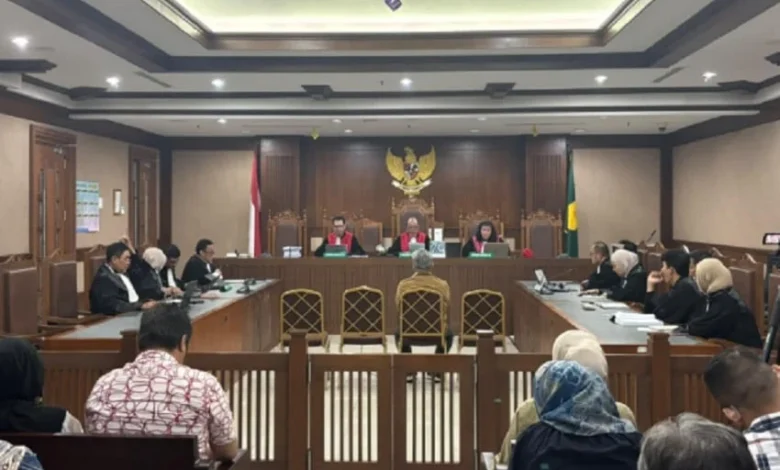
The Jakarta Corruption Court (Tipikor) delivered a significant verdict on Monday, September 21, 2026, sentencing four former high-ranking officials from the Indonesian Export Financing Agency (LPEI) to six years in prison each. The ruling concludes a high-profile legal battle centered on allegations of corruption linked to national export financing between 2015 and 2020, a period that saw the state-owned institution grapple with significant financial irregularities.
Presiding Judge Brelly Yuniar Dien Wardi Haskori, in a stern reading of the verdict, declared the four defendants guilty of collective, continuous corruption. In addition to the six-year custodial sentence, each individual has been ordered to pay a fine of Rp200 million. Failure to pay this penalty will result in an additional term of imprisonment, further underscoring the court’s commitment to penalizing white-collar crimes that undermine state financial integrity.
Profiles of the Convicted Officials
The defendants, who held critical roles in the Sharia Financing Division of LPEI, were found to have abused their authority during their respective tenures. The individuals convicted include:
- Andi Maulana Adjie: Served as the Head of the Sharia Financing Division Department from 2011 to 2017.
- Intan Apriadi: Served as the Head of the Sharia Financing Division from 2007 to 2016.
- Gamaginta: Served as the Head of Sharia Department I from 2017 to 2018.
- Komaruzzaman: Served as the Head of Sharia Financing Department II from 2011 to 2016.
The prosecution argued that these officials facilitated financing arrangements that bypassed standard prudential banking regulations. By failing to conduct adequate due diligence and ignoring internal risk management protocols, the defendants allowed funds to be disbursed to entities that were ultimately unable or unwilling to meet their export-related obligations.
Chronology of the Case
The investigation into LPEI’s financing practices was triggered by mounting concerns regarding the agency’s non-performing loans (NPLs). As the primary vehicle for the Indonesian government to boost national exports, LPEI is tasked with providing financing, guarantees, and insurance to domestic exporters. When reports of irregularities emerged, the Attorney General’s Office (AGO) and the High Prosecutor’s Office of Jakarta launched a series of investigations.
The timeline of the investigation can be summarized as follows:
- 2015–2020: The window of the alleged criminal activities, during which the defendants oversaw multiple financing facilities for various companies.
- Late 2023–2024: Following initial audits that revealed substantial gaps in the documentation of financed projects, the Attorney General’s Office initiated a full-scale corruption investigation.
- Mid-2025: Formal charges were brought against the four officials after investigators gathered sufficient evidence of illicit decision-making and administrative manipulation.
- September 2026: The Jakarta Corruption Court concluded the trial, resulting in the final verdict of six years imprisonment.
The case gained significant public attention due to the scale of the potential loss to the state. Throughout the trial, the prosecution presented a plethora of documents, including loan approval records, internal memoranda, and testimonies from former colleagues and industry experts, proving that the defendants knowingly deviated from established risk-mitigation policies.
The Mechanism of Corruption
The modus operandi of the corruption involved the approval of financing for export entities that did not meet the eligibility criteria. By circumventing the "Prudential Banking Principle," the officials allowed the disbursement of large capital injections to companies that lacked the necessary track record or collateral.
Experts in forensic accounting noted that the corruption was not merely an administrative error but a calculated circumvention of the agency’s internal controls. By systematically ignoring the red flags during the loan application process, the defendants effectively facilitated the misappropriation of state funds. This case highlights a recurring issue in state-owned financial institutions where the pressure to meet disbursement targets often overrides the necessity for rigorous risk assessment.
Institutional Implications and Official Responses
LPEI, as a Special Mission Vehicle (SMV) of the Ministry of Finance, has been under intense pressure to reform its governance structures. Following the revelation of the scandal, the agency has undergone internal restructuring, including the implementation of more stringent digital monitoring systems and the oversight of a new board of commissioners aimed at preventing similar incidents in the future.
The Attorney General’s Office has signaled that this conviction is only one part of a broader crackdown on financial malfeasance. The Jakarta High Prosecutor’s Office has recently announced the identification of four additional suspects related to wider allegations of corruption within LPEI’s export financing programs. These developments indicate that the investigation is far from over, as authorities continue to trace the flow of funds to private companies that benefited from these fraudulent arrangements.
"The verdict serves as a deterrent to those in positions of power who believe they can manipulate state funds for personal or external gain," a spokesperson for the prosecution noted following the trial. While the defendants’ legal teams have the right to appeal the decision, the court’s stance remains firm on the necessity of accountability for those managing state-owned resources.
Broader Economic Impact
The LPEI scandal has had a chilling effect on the Indonesian export sector. Reliable access to financing is the lifeblood of exporters, particularly Small and Medium Enterprises (SMEs) that depend on state support to compete in global markets. When corruption cripples an agency like LPEI, the negative ripple effects are felt throughout the economy:
- Reduced Confidence: International and domestic investors become more cautious when dealing with state-run financing entities, potentially increasing the cost of capital.
- Stagnation of Export Growth: If funds are diverted through corruption rather than being directed toward viable, productive export businesses, the nation misses critical opportunities for economic expansion.
- Governance Costs: The time and financial resources required to rectify the damage caused by these officials are substantial, diverting attention from the agency’s primary mission of supporting national growth.
The government’s response, led by the Ministry of Finance, has been to emphasize that LPEI must return to its mandate of professional, transparent, and sustainable financing. The ministry has committed to a comprehensive audit of all outstanding loans to ensure that the agency’s portfolio is healthy and that any further instances of fraud are identified early.
Conclusion: A Turning Point for Corporate Governance
The six-year prison sentences for the former LPEI officials represent a critical moment for financial governance in Indonesia. It underscores a shift toward holding individuals accountable for their administrative decisions, moving away from the culture of impunity that has historically plagued some state institutions.
As the legal process continues against other suspects, the Indonesian public and the international business community are watching closely to see if the reforms within LPEI will be sufficient to restore its credibility. The case serves as a stark reminder that in the realm of public finance, the responsibility to act with integrity is not merely a professional guideline, but a legal imperative that carries heavy consequences for those who choose to ignore it.
With the conclusion of this trial, the judicial system has sent a clear signal: the protection of state assets is paramount, and those entrusted with managing the nation’s wealth will be held to the highest standard of accountability. The challenge moving forward for LPEI and similar agencies will be to regain the trust of the business community while simultaneously enforcing the rigid controls necessary to prevent the recurrence of such systemic corruption.