
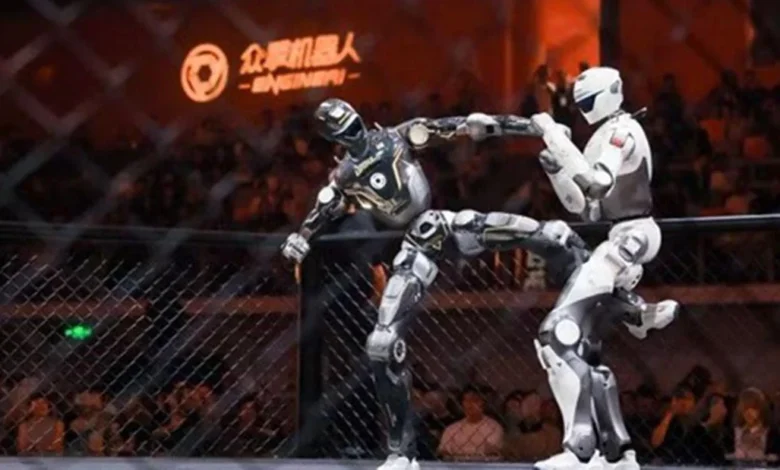
The realm of science fiction has once again blurred with reality, as China unveils its own "Real Steel"-esque spectacle: a league of humanoid robots engaging in fierce combat within a dedicated ring. What was once confined to the silver screen, epitomized by Hugh Jackman’s 2011 film where he masterfully controlled fighting robots, has now materialized in Shenzhen, China, fifteen years later. The Ultimate Robot Knock-out Legend (URKL) competition, launched with considerable fanfare, is ushering in a new era of robotic athletic prowess and commercialization.
The Dawn of a New Combat Sport: URKL Takes Center Stage
The inaugural event of the Ultimate Robot Knock-out Legend (URKL) took place at the Shenzhen Nanshan Cultural and Sports Center, commencing on a Thursday evening. This groundbreaking competition, organized by EngineAI, a prominent Shenzhen-based robotics firm, features an array of sophisticated humanoid robots locked in a free-for-all battle. The opening bout pitted White Eagle, a formidable white humanoid robot, against Matador, its black counterpart. The clash was met with thunderous applause from the captivated audience, a testament to the raw excitement generated by the mechanical gladiators. The fight culminated with White Eagle’s decisive victory, achieved by severing Matador’s head, a dramatic and visceral end to the first engagement.
The EngineAI T800: A New Breed of Warrior
At the heart of URKL’s inaugural matches are robots of a uniform model: the EngineAI T800. These towering machines stand at an impressive 1.73 meters tall, embodying a significant leap in humanoid robotics. Their combat capabilities are remarkably sophisticated, allowing for a diverse range of offensive and defensive maneuvers. The T800 is engineered to execute powerful uppercuts, agile spinning kicks, and even to recover from falls, demonstrating a degree of resilience and adaptability crucial for high-intensity combat. EngineAI proudly asserts that its robots possess advanced features such as sophisticated posture control, dynamic perception for real-time environmental awareness, and impact absorption mechanisms, all designed to withstand the rigors of intense robotic duels.
Celebrities and Visionaries Witness History in the Making
The significance of this event was not lost on prominent figures. Acclaimed actor Donnie Yen, known for his iconic roles in the "Ip Man" film series, was present to offer his insights and witness this historic occasion. Yen expressed his profound impression, stating, "Today is the first time I’ve seen real robots fight. Witnessing a historic breakthrough firsthand feels truly different. The precision of the machines and their movements is absolutely incredible." His endorsement underscores the cultural and technological impact of URKL, bridging the gap between cinematic fantasy and tangible innovation.
Zhao Tongyang, the CEO of EngineAI, articulated the broader commercial and developmental ambitions behind URKL. He explained that the competition is designed to foster the commercialization of robot fighting events, thereby providing a powerful impetus for robotics research and industrialization. "We want to leverage this competition to drive research and development in the industry. This event serves as input for technology, and technology will drive the industry," Tongyang stated. This vision highlights a strategic approach to advancing robotics, where competitive arenas act as catalysts for innovation and market growth.
A Global Stage for Robotic Competition
URKL has successfully attracted a diverse international contingent, with 32 teams from around the globe participating in the competition. All these teams are utilizing the standardized EngineAI T800 robot, ensuring a level playing field and focusing the competition on strategic programming, piloting skills, and the inherent capabilities of the machine. The URKL judging criteria are multifaceted, evaluating robots across four key categories: effective offense, body stability, defensive and evasive capabilities, and overall durability. This comprehensive assessment ensures that the winning robot is not only a powerful striker but also a resilient and strategically astute combatant.
The Genesis of Robot Combat: A Timeline of Inspiration and Development
The concept of robot combat, while dramatically popularized by films like "Real Steel," has roots in earlier technological explorations and competitive events. The idea of machines battling each other dates back to at least the late 20th century, with various forms of robotic competitions emerging in academic and hobbyist circles.
- Late 20th Century: Early forms of robot combat competitions, often focused on simpler wheeled robots, began to gain traction in academic settings and among enthusiasts. These events laid the groundwork for more complex robotic interactions.
- 2000s: The rise of more advanced robotics technology, including advancements in artificial intelligence, sensor technology, and material science, paved the way for more sophisticated robotic designs. This period saw an increase in the complexity and ambition of robot-building projects.
- 2011: The release of the film "Real Steel" significantly amplified public imagination regarding humanoid robot combat. The movie, while fictional, depicted a future where humans controlled lifelike robots in boxing matches, capturing the attention of a global audience and inspiring many to envision similar realities.
- Early 2010s – Present: Following the surge in interest, several companies and research institutions began to explore the feasibility of creating advanced humanoid robots capable of complex physical interactions, including combat. The development of advanced actuators, control systems, and AI algorithms became crucial.
- Mid-2010s: EngineAI, a Shenzhen-based robotics company, began to focus on developing humanoid robots with robust physical capabilities. Their research and development efforts were likely influenced by the growing accessibility of advanced robotic components and the burgeoning interest in the field.
- Late 2010s – Early 2020s: EngineAI likely conducted numerous internal tests and simulations, refining the T800 model for combat applications. This phase would have involved rigorous testing of its movement, balance, and durability under simulated combat conditions.
- 2020s (Specific Date not provided in source, but inferred as leading up to July 2026): The company likely made significant strides in miniaturizing and enhancing the power of the T800’s components, along with developing sophisticated control software and AI for autonomous or semi-autonomous combat. Partnerships and investments would have been crucial during this period.
- July 2026 (Launch of URKL): The official launch of the Ultimate Robot Knock-out Legend (URKL) in Shenzhen marks the culmination of years of research, development, and investment. The competition serves as a public debut for the EngineAI T800 and a platform to showcase the advancements in humanoid robotics.
Supporting Data and Technological Advancements
The EngineAI T800 represents a significant achievement in humanoid robotics, integrating several key technological advancements:
- Height: 1.73 meters (approximately 5 feet 8 inches) – comparable to an average human, making for visually engaging matches.
- Mobility: Capable of executing complex movements like uppercuts, spinning kicks, and recovering from falls, indicating advanced balance and locomotion systems.
- Control Systems: Sophisticated posture control and dynamic perception suggest advanced AI and sensor integration, allowing robots to react to their environment and opponents in real-time.
- Durability: The ability to withstand high-intensity combat implies robust structural design and materials, as well as effective impact absorption mechanisms.
- Standardization: The use of a uniform robot model (T800) for all competitors levels the playing field, emphasizing the skill of the programmers and pilots over superior hardware. This is a common strategy in competitive sports to ensure fairness and focus on strategy.
The global participation of 32 teams underscores the international interest and investment in this emerging field. The fact that these teams come from various parts of the world indicates a decentralized yet collaborative development of robot combat strategies and programming.
Broader Implications and Future Outlook
The advent of URKL and the EngineAI T800 signifies more than just an entertainment spectacle; it has profound implications for the future of robotics and artificial intelligence.
Driving Industrialization and Research:
As CEO Zhao Tongyang noted, URKL is envisioned as a catalyst for the commercialization of robot fighting. This can translate into increased investment in robotics research and development, accelerating advancements in areas such as:
- Actuator Technology: Developing more powerful, efficient, and precise motors and artificial muscles.
- Sensor Technology: Enhancing visual, tactile, and auditory sensing capabilities for robots.
- Artificial Intelligence: Improving AI for real-time decision-making, strategic planning, and adaptive learning in dynamic environments.
- Material Science: Developing lighter, stronger, and more resilient materials for robot construction.
Human-Robot Interaction and Training:
The skills honed in URKL, such as precise control, real-time reaction, and strategic engagement, have direct applications in other fields. This includes:
- Advanced Manufacturing: Robots capable of complex manipulation and interaction in assembly lines.
- Disaster Response: Humanoid robots that can navigate hazardous environments and perform rescue operations.
- Healthcare: Robotic assistants for surgery or patient care that require fine motor skills and situational awareness.
- Military and Security: Development of advanced robotic platforms for reconnaissance, defense, and potentially combat roles, though this aspect carries significant ethical considerations.
Ethical Considerations and Public Perception:
While the spectacle of robot combat is undeniably exciting, it also raises important ethical questions. The development of machines designed for destruction, even in a controlled sporting context, necessitates careful consideration of their potential misuse. Public perception will also play a crucial role; framing these advancements as tools for progress rather than solely for conflict will be vital for widespread acceptance and support. The safety of spectators and the ethical treatment of the robots themselves (as complex engineered systems) will also be ongoing considerations.
The success of URKL could pave the way for similar competitions globally, potentially evolving into a major esports or sporting league. The integration of advanced AI could lead to robots fighting autonomously in the future, further pushing the boundaries of machine intelligence. As China positions itself at the forefront of this technological frontier, URKL is more than just a competition; it is a bold declaration of intent in the global race for robotic supremacy and innovation. The echoes of "Real Steel" have indeed found their physical manifestation, and the world watches with anticipation to see where this new arena of combat will lead.