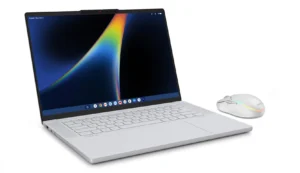

Hewlett-Packard (HP) has officially expanded its prominent OmniBook laptop portfolio with the introduction of the new HP OmniBook 3 17, a large-format productivity machine powered by Intel’s latest Wildcat Lake processor architecture. Designed to cater to enterprise users, students, and multimedia enthusiasts who require expansive screen real estate without sacrificing modern processing capabilities, the OmniBook 3 17 combines robust performance metrics with flexible configuration options. This release marks another strategic milestone in HP’s ongoing effort to integrate advanced artificial intelligence capabilities and high-efficiency silicon into its mainstream and productivity-focused device lineups.
The launch of the OmniBook 3 17 arrives at a time of significant transition within the personal computer industry. As manufacturers race to adopt processors equipped with dedicated Neural Processing Units (NPUs) to handle localized artificial intelligence workloads, HP has positioned its refreshed OmniBook series to meet these emerging demands. The incorporation of Intel Wildcat Lake processors signals a concerted industry push toward balancing traditional computing power with low-power AI acceleration, a feature increasingly vital for modern operating systems and productivity applications.
Main Facts and Hardware Specifications
At the core of the HP OmniBook 3 17 is a selection of Intel Wildcat Lake processors, specifically offering three distinct variants ranging from the entry-level Core 5 315 up to the more capable Core 7 350. All three available processor models share a unified core and thread architecture consisting of 6 cores and 6 threads. However, the higher-tier configurations deliver elevated turbo clock speeds and increased NPU performance to better handle computational tasks and light AI workloads. Notably, the baseline Core 5 315 features an integrated NPU capable of delivering up to 15 TOPS (Tera Operations Per Second), satisfying the baseline hardware requirements for modern AI-enhanced software environments.
Memory configurations for the OmniBook 3 17 are exceptionally versatile, accommodating a wide spectrum of user needs and budgets. HP offers the device with DDR5-5600 RAM options spanning 8GB, 12GB, 16GB, 24GB, and scaling all the way up to 32GB. For storage, users can choose between fast PCIe Gen 4 NVMe solid-state drives with capacities of 256GB, 512GB, and 1TB. Wireless connectivity options are similarly up-to-date, featuring support for either Wi-Fi 6 or the newer Wi-Fi 7 standard, alongside Bluetooth 5.4 or Bluetooth 6.0 compatibility depending on the selected configuration tier.
Display technology remains one of the defining characteristics of the 17-inch form factor. HP provides two distinct panel types for the OmniBook 3 17. The entry-level option utilizes a 17.3-inch Twisted Nematic (TN) panel with a resolution of 900p and a maximum brightness rating of 250 nits. Meanwhile, the higher-end alternative features a 17.3-inch In-Plane Switching (IPS) panel with a sharper 1080p resolution and an increased brightness output of 300 nits. To further accommodate diverse user preferences, both panel variations are available in either touch-sensitive or non-touch configurations.
Powering these components are two distinct battery capacity choices: a standard 41Wh variant and a larger 68Wh option designed for extended away-from-the-desk usage.
Pricing and Configuration Tiers
Pricing for the HP OmniBook 3 17 reflects its broad market positioning, starting at an accessible entry point in the United States before scaling upward for maximum specifications. The base model begins at USD 999, making it a competitive option for consumers seeking a large-screen laptop without crossing into premium workstation pricing territory.
Conversely, fully maxed-out configurations—featuring the Intel Core 7 350 processor, 32GB of DDR5-5600 RAM, a 1TB PCIe Gen 4 SSD, the larger 68Wh battery, and the 1080p IPS display panel—reach a retail price of USD 2,029. This tiered pricing structure allows enterprise deployment managers and retail consumers alike to tailor the hardware precisely to their performance requirements and financial constraints.

Background Context and Industry Evolution
The introduction of the OmniBook 3 17 occurs against a backdrop of rapid transformation in the global PC market. Following several years of fluctuating demand driven by pandemic-era purchasing cycles, the industry has stabilized around a new normal defined by replacement cycles and the necessity of hardware capable of running local AI models. Microsoft’s push for Copilot-certified hardware has placed immense pressure on original equipment manufacturers (OEMs) to ensure that even mid-range devices possess adequate NPU horsepower.
HP’s consolidation of its traditional consumer and commercial naming conventions under the unified "OmniBook" banner represents a strategic rebranding effort initiated over the past year. By streamlining its portfolio, HP aims to make product selection more intuitive for buyers, distinguishing devices by numerical tiers rather than convoluted alphabetical sub-brands. The OmniBook 3 series specifically targets value-conscious mainstream users who require reliability and modern processing capabilities without enterprise-grade price tags.
Chronology of the Release
The rollout of the Wildcat Lake-powered OmniBook lineup began following Intel’s strategic processor disclosures and subsequent OEM partnership announcements. Industry observers noted an acceleration in product announcements throughout the third quarter, with regional tech outlets highlighting concurrent releases across global markets.
In late September, simultaneous announcements from manufacturers such as HP and competing regional brands—such as the launch of the Advan Air Neo featuring similar Intel Core Series 3 Wildcat Lake silicon—underscored a coordinated industry-wide hardware refresh. HP officially detailed the specifications, configuration tiers, and regional pricing structures for the OmniBook 3 17 shortly thereafter, making the device immediately available for order through major retail channels and HP’s direct enterprise sales portals in the United States and select international markets.
Fact-Based Analysis of Market Implications
The launch of a 17-inch mainstream laptop with up to 32GB of RAM and modern Intel processing architecture addresses a specific niche that has seen relatively little hardware innovation in recent years: the desktop replacement market for budget-conscious users. While ultraportable 13-inch and 14-inch laptops dominate sales volume, a persistent segment of consumers—including remote workers, home-office professionals, and students—continues to prefer larger physical screens for multitasking and media consumption.
From a competitive standpoint, the inclusion of up to 32GB RAM options in a tier-3 OmniBook model democratizes high-memory configurations, which were historically restricted to expensive gaming rigs or professional workstations. Furthermore, the inclusion of a baseline NPU capable of 15 TOPS ensures that even the entry-level OmniBook 3 17 will not immediately face obsolescence as operating systems increasingly rely on hardware-accelerated machine learning features for everyday background tasks, security protocols, and productivity enhancements.
However, analysts note potential challenges regarding the base-tier display configuration. The inclusion of a 900p TN panel option at the starting price point may draw criticism from consumer advocates accustomed to Full HD IPS panels as an industry standard, even in budget categories. Buyers will need to carefully evaluate whether the base model meets their visual fidelity requirements or if upgrading to the 1080p IPS configuration is necessary.
Broader Industry Impact
As Intel continues to deploy its Wildcat Lake ecosystem across the global supply chain, devices like the HP OmniBook 3 17 serve as barometers for how quickly mid-range consumer technology can absorb advanced silicon advancements. By successfully scaling high-capacity memory options and AI-ready processors down to accessible price points, HP and its silicon partners are establishing a new baseline for what consumers can expect from productivity laptops in the sub-$1,000 to $2,000 price spectrum.
The market reception of the OmniBook 3 17 will likely influence future product development cycles, particularly regarding how manufacturers balance component costs—such as display quality and battery capacity—against processing power and memory density. As remote and hybrid work models remain firmly established globally, the demand for large-screen, versatile computing devices is expected to remain stable, ensuring that offerings like the OmniBook 3 17 will play a critical role in shaping OEM sales volumes over the coming fiscal periods.