Veluwemeer Aqueduct: The Engineering Marvel in the Netherlands That Allows Cars to Drive Beneath the Sea

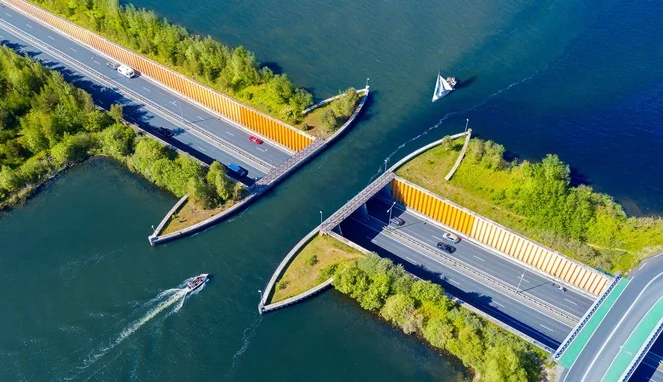
Bridges have traditionally served as the literal and figurative lifelines of human infrastructure, connecting fractured landscapes, spanning treacherous bodies of water, and facilitating the uninterrupted flow of commerce and daily commuters. Conventionally, civil engineers design these elevated structures to carry vehicular and pedestrian traffic high above rivers, lakes, and seas, leaving the fluid pathways below open to aquatic vessels. However, in the municipality of Harderwijk in eastern Netherlands, a profound departure from this conventional methodology exists. The Veluwemeer Aqueduct—often colloquially referred to as a water bridge—defies standard architectural expectations by routing a navigable waterway directly over a bustling vehicular highway, creating the mesmerizing optical illusion of automobiles driving right through the middle of the sea.
Architectural Overview and Core Mechanics
Opened to the public in 2002, the Veluwemeer Aqueduct is an extraordinary feat of hydro-engineering. Spanning approximately 25 meters in length and 19 meters in width, the aqueduct maintains a shallow water depth of roughly 3 meters. This specific depth is meticulously calculated to accommodate small boats, yachts, and regional water transport vessels safely as they traverse the route between the IJssel River and the Veluwemeer lake.
Rather than relying on massive suspension cables or towering concrete pillars typical of standard overpasses, the structure utilizes a robust reinforced concrete trough. The edges of this aquatic bridge are reinforced with heavy-duty steel sheet piles and barrier walls, ensuring that the water remains securely contained within its designated channel and preventing any overflow into the sunken highway running directly underneath it. Beneath this flowing body of water lies a 17-meter-long underwater roadway tunnel. This subterranean passage connects the historic mainland town of Harderwijk to Flevoland, a monumental artificial island created through land reclamation. Additionally, the flanks of the vehicle tunnel are flanked by dedicated lanes for pedestrians and cyclists, complete with high safety barriers to protect non-motorized commuters from vehicular traffic while offering them a uniquely surreal vantage point of the marine environment surrounding them.
Chronology and the Decision-Making Process
The genesis of the Veluwemeer Aqueduct project dates back to the late 20th century, during a period of rapid infrastructure expansion and regional planning in the Netherlands. As the artificial province of Flevoland continued to develop economically and experience population growth, transit connectivity between the mainland and the island became a critical priority for Dutch urban planners.

During the initial planning phases in the 1990s, civil engineers and government transportation committees evaluated multiple design concepts to handle the anticipated surge in regional traffic. Traditional options included constructing a high-level suspension bridge or engineering a conventional drawbridge system. However, each traditional alternative presented significant logistical disadvantages. A high-level suspension bridge would have required extensive, costly approach ramps that would permanently alter and disrupt the flat Dutch landscape, while also imposing severe aesthetic and environmental impacts on the surrounding wetlands. Conversely, a drawbridge system would have introduced inevitable traffic bottlenecks, severely compromising the efficiency of both maritime shipping and high-speed terrestrial commuting.
Following rigorous feasibility studies, the Dutch Directorate-General for Public Works and Water Management (Rijkswaterstaat) greenlit the aqueduct design. Construction commenced in the late 1990s and culminated in its successful inauguration in 2002. Total construction expenditures reached approximately $61 million USD. Despite this substantial initial capital investment, transportation economists and infrastructure analysts widely agree that the project yielded long-term cost efficiencies. Compared to the massive ongoing maintenance expenses and structural complexities associated with a major drawbridge network or an elevated highway over a dynamic aquatic ecosystem, the aqueduct presented a permanent, low-maintenance solution.
Economic, Social, and Environmental Implications
In the decades since its completion, the Veluwemeer Aqueduct has transitioned from a localized engineering solution into an internationally recognized Dutch landmark. From an operational standpoint, the infrastructure successfully balances the competing demands of land and water transit. Today, the sunken highway beneath the aqueduct accommodates an average of approximately 8,000 vehicles daily, ranging from private commuter cars to heavy freight transport, ensuring seamless economic integration between Harderwijk and Flevoland. Simultaneously, recreational boaters and commercial watercraft utilize the upper water channel without experiencing delays from traffic signals or bridge openings.
Beyond its primary function as a transportation nexus, the Veluwemeer Aqueduct and its surrounding geography hold substantial ecological and recreational value. The Veluwemeer lake functions not only as a hub for leisure activities such as sailing, windsurfing, and recreational boating for local residents and international tourists alike, but it also serves as a protected cultural and environmental sanctuary for diverse regional fauna. Flevoland itself—representing one of the largest man-made land reclamation projects in human history—adds a unique historical and geographical dimension to the region. The integration of pedestrian and cyclist pathways alongside the vehicular tunnel encourages eco-friendly, active mobility, allowing the public to interact intimately with an extraordinary synthesis of nature and civil engineering.
Conclusion and Future Outlook
The Veluwemeer Aqueduct stands as a testament to the ingenuity of modern Dutch water management, a discipline historically shaped by the nation’s continuous battle against and coexistence with the sea. By rejecting conventional design paradigms and implementing a structure where water flows safely over land, the engineers of Harderwijk solved a complex transportation dilemma while creating an enduring architectural icon. As global urban centers grapple with rising population densities, environmental preservation, and the need for efficient multi-modal transit corridors, the Veluwemeer Aqueduct remains a compelling case study in innovative, harmonious infrastructure design.