From Spooky Legend to Culinary Hotspot: How Bandung’s Iconic Roemah Kentang 1908 Reinvented Itself

Bandung, the capital of West Java and a renowned destination for culinary tourism, has long been a canvas for architectural preservation intertwined with urban folklore. Among its most storied structures is the legendary "Rumah Kentang" (Potato House), a Dutch colonial-era building that once evoked shivers among locals due to decades-old ghost stories and urban legends. Today, however, the eerie atmosphere of the past has been completely dispelled, making way for a vibrant, highly photogenic dining establishment known as Roemah Kentang 1908. This transformation reflects a broader architectural trend in heritage cities across Indonesia, where neglected historical assets are repurposed into economically productive lifestyle hubs rather than remaining abandoned liabilities.
Historical Roots and the Genesis of an Urban Legend
Constructed in 1908 during the Dutch colonial administration, the sprawling estate on Jalan Banda originally served as a private residence before functioning as a gathering place historically referred to as Lochea Hermes. For generations, the building fell into a state of severe neglect. Over decades, thick, overgrown vegetation enveloped the property, plunging the facade into deep shadows and fostering an oppressive, dark ambiance that naturally catalyzed local folklore.
The moniker "Rumah Kentang" (Potato House) emerged from persistent local whispers claiming that passersby would frequently detect a strong, distinct aroma of roasting potatoes emanating from the empty grounds after dark. This sensory illusion became the cornerstone of numerous ghost stories, cementing the property’s reputation as one of Bandung’s premier haunted sites. Despite its grim reputation in popular culture, the structure possessed undeniable underlying assets: it sat on a prestigious heritage land grant in one of the city’s most strategic commercial districts, directly facing the bustling Saparua Gymnasium (GOR Saparua).
The Strategic Pivot: From Abandonment to Gastronomic Hub
In December 2020, amidst a challenging economic landscape defined by shifting consumer behaviors during the global pandemic, visionary management teams recognized the unrealized commercial potential of the heritage site. Instead of demolishing the historic edifice or allowing it to decay further, investors spearheaded a meticulous adaptive reuse project. The core objective was to strip away the decades of stigma while rigorously preserving the building’s irreplaceable architectural integrity.
While necessary interior modernizations were executed to accommodate a commercial kitchen and comfortable dining spaces, the building’s exterior remained entirely untouched. The vintage aesthetic was deliberately retained to honor the structure’s 1908 heritage. Today, the venue operates as Roemah Kentang 1908, a warm, inviting, and fiercely instagenic destination. Patrons no longer visit to test their courage against the supernatural; instead, they frequent the establishment for its carefully curated ambiance, marked by prominent vintage backdrops—such as the original heavy-set entry doors and a classic upright piano positioned thoughtfully in the corner—that consistently draw photography enthusiasts and social media content creators.

Culinary Philosophy and Menu Architecture
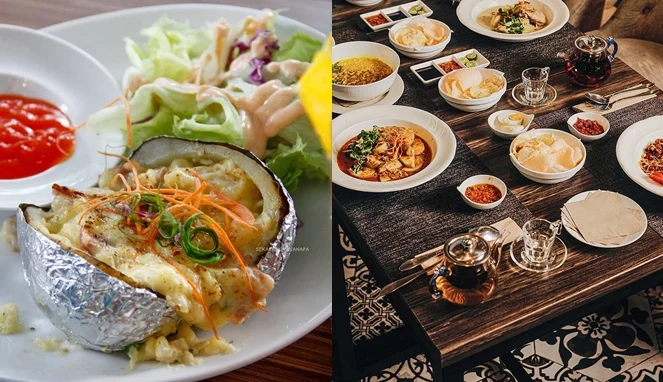
The culinary identity of Roemah Kentang 1908 is anchored in a concept broadly defined as Peranakan fusion, bridging culinary traditions from Indonesia, Western Europe, Oriental influences, and the Middle East. This diverse menu structure is designed to appeal to both local gourmands and international tourists seeking dynamic flavor profiles within a historical setting.
Nodding directly to the building’s infamous historical moniker, the restaurant’s signature offerings heavily feature specialized potato dishes. Among the most popular is the Moza Beef Baked Potato, a hearty dish that marries European baking techniques with local palate preferences. For breakfast and brunch crowds, the establishment offers Bubur Bakar Roeken, an innovative take on traditional Indonesian porridge. Traditional comfort foods have also been given gourmet elevations, highlighted by the crispy Pisang Goreng 1908 and a selection of classic Western staples, including artisanal burgers and fusion dishes like the Ayah Karuhun menu, which blends traditional Indonesian spices with Western culinary presentation.
Operational Framework and Location Metrics
Strategically situated at Jalan Banda No. 18, right in front of GOR Saparua in the heart of Bandung, West Java, Roemah Kentang 1908 occupies a prime geographic advantage. The facility operates on an extended schedule to capture both the morning exercise crowd and the evening nightlife demographic. From Monday through Friday, the restaurant opens its doors from 10:00 AM to 10:00 PM WIB, while weekend hours are extended to begin earlier at 08:00 AM and run through 10:00 PM WIB to accommodate family brunch gatherings.
Urban Implications and the Future of Heritage Preservation
The successful metamorphosis of Roemah Kentang 1908 offers significant insight into urban planning and commercial real estate management in heritage-rich Indonesian cities like Bandung, Yogyakarta, and Jakarta. By transforming stigmatized or derelict colonial properties into functioning commercial enterprises, investors demonstrate that historical preservation can be financially self-sustaining without relying entirely on government subsidies or public tourism boards.
Urban development analysts note that adaptive reuse projects of this nature stimulate local economic activity, generate employment opportunities in the hospitality sector, and revitalize surrounding neighborhoods. In Bandung’s fiercely competitive cafe and restaurant ecosystem—where hundreds of new establishments vie for consumer attention annually—Roemah Kentang 1908 has successfully carved out a distinct niche. By weaponizing its own controversial history as a marketing narrative rather than a deterrent, the establishment has permanently rewritten its cultural footprint, shifting from a feared neighborhood phantom into a celebrated monument of modern Indonesian culinary culture.