Leo Rolly Carnando and Daniel Marthin Secure Historic Thirtieth Badminton Gold for Indonesia at the 2026 Asian Games

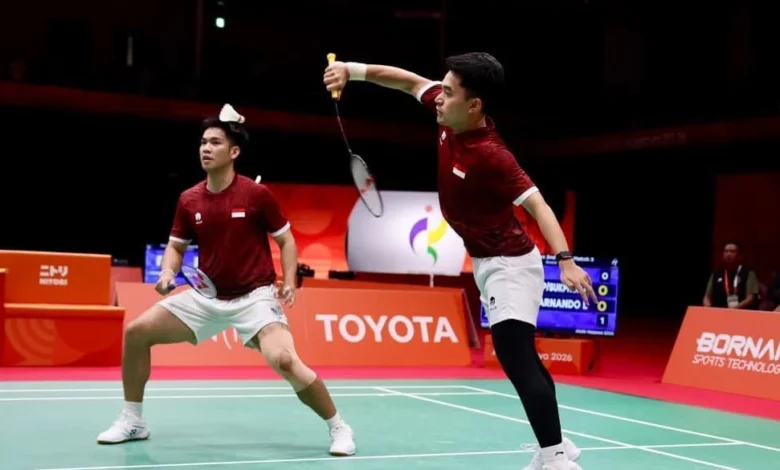
The Indonesian contingent competing at the 2026 Asian Games has etched another remarkable chapter in the nation’s rich sporting history, courtesy of the men’s doubles pair Leo Rolly Carnando and Daniel Marthin. Competing at a packed and electric venue on Tuesday, September 29, 2026, the dynamic duo claimed the coveted gold medal after overcoming a formidable challenge from China’s top-tier pairing, Liang Weikeng and Wang Chang. This triumph did more than simply reward the Indonesian athletes for years of rigorous training and tactical discipline; it served as a monumental milestone for the sport of badminton in Indonesia, pushing the cumulative gold medal count for the discipline to an unprecedented 30 in the history of the Asian Games.
The path to the ultimate step of the podium was fraught with intense competition, requiring immense mental resilience and physical stamina. Badminton has historically been the crown jewel of Indonesia’s multi-event sports campaigns, bearing the immense weight of national expectations every four years. The victory by Carnando and Marthin not only capped off a brilliant campaign at the 2026 Games but also reinforced the country’s status as a traditional powerhouse in Asian badminton, holding off fierce challenges from continental rivals such as China, Japan, South Korea, and Chinese Taipei.
Chronology of a Golden Campaign
The journey toward this historic milestone in Aichi-Nagoya began days prior with the highly anticipated team events. The Indonesian men’s team entered the tournament with a well-balanced squad combining experienced campaigners and explosive young talents. In the men’s team final, Indonesia faced a powerhouse Chinese squad in a tie that kept spectators on the edge of their seats from the first match to the last.
In that dramatic team showdown, which ultimately ended in a razor-thin 3-2 victory for Indonesia, Leo Rolly Carnando and Daniel Marthin played a pivotal role. Tasked with facing the robust Chinese pair of He Ji Ting and Liu Yi, Carnando and Marthin delivered a masterclass in aggressive doubles play, securing a crucial point that paved the way for the ultimate team triumph. That initial team gold set the tone for the rest of the contingent, lifting the psychological morale of the entire badminton squad as they transitioned into the individual categories.
Entering the individual men’s doubles draw, Carnando and Marthin faced a grueling schedule. Navigating through the early rounds demanded absolute focus, as the world-class depth of Asian badminton meant no match could be taken lightly. By the time they reached the final on Tuesday, September 29, 2026, they were battle-tested. Pitting their speed and deceptive net play against the raw power of Liang Weikeng and Wang Chang, the Indonesians orchestrated a tactical masterclass. They absorbed the heavy smashes of the Chinese pair, capitalized on transitional opportunities, and maintained their composure during high-pressure baseline exchanges to seal the victory in straight, thrilling games.
Expanding an Unmatched Legacy
Before the commencement of the 2026 Asian Games, official historical records indicated that Indonesian badminton had accumulated 28 gold medals across previous editions of the continental multisport quadrennial event. The sport has consistently served as the most reliable producer of top-tier international success for the Southeast Asian archipelago, frequently saving national campaigns from medal droughts on the global stage.
With the addition of the men’s team gold and the subsequent individual men’s doubles gold secured by Carnando and Marthin, the total tally has officially risen to 30 gold medals. This achievement widens the gap between badminton and the rest of Indonesia’s sporting disciplines at the Asian Games, cementing its position at the pinnacle of the nation’s athletic achievements.
To contextualize the monumental scale of badminton’s dominance, a review of Indonesia’s top five gold-producing sports at the Asian Games reveals a stark disparity:
- Badminton – 30 golds
- Tennis – 15 golds
- Pencak Silat – 14 golds
- Cycling – 6 golds
- Athletics – 4 golds
This statistical hierarchy underscores how heavily the nation’s international sporting prestige in premier multi-sport events has relied on the shuttlecock. While disciplines like tennis and the traditional martial art of pencak silat have delivered commendable historical contributions, badminton stands alone as a global export of excellence for Indonesia.
Official Responses and National Pride
Following the conclusion of the final match, the coaching staff, team officials, and leadership from the Badminton Association of Indonesia (PBSI) expressed immense pride in the achievements of the athletes. While elite sport is inherently results-oriented, the psychological significance of reaching the 30-gold milestone was not lost on the delegation’s leadership.
"This achievement is a testament to the systematic development programs that have been continuously refined over decades," noted a senior PBSI representative speaking from the venue. "Reaching 30 gold medals in the history of the Asian Games is not just about Leo and Daniel; it is a tribute to every legend who has worn the Garuda on their chest in the past, from the eras of Rudy Hartono and Liem Swie King to the modern champions. Leo and Daniel showed incredible grit, especially after a demanding team event earlier in the week."
Athletes and coaches alike emphasized that the victory was born from collective synergy. The support staff, including physiotherapists, strength and conditioning coaches, and tactical analysts, worked tirelessly behind the scenes to keep the players in peak physical condition amid the demanding logistical and competitive environment of the 2026 Games. For Carnando and Marthin, standing on the podium while the Indonesian national anthem echoed through the arena represented the realization of a lifelong ambition. In post-match remarks, the pair dedicated their victory to their families, the coaching staff, and the millions of passionate badminton fans back home who tuned in across television and digital streaming platforms.
Broader Impact and Strategic Implications
The ripple effects of this historic gold medal extend far beyond the immediate celebrations in the arena. In a country where badminton is treated not merely as a sport but as a matter of national identity, milestone achievements of this magnitude carry significant socio-cultural and institutional weight.
First, the success at the 2026 Asian Games provides a vital morale boost for the Indonesian sports ecosystem, which constantly faces pressure to diversify its medal sources at major global events like the Olympic Games and the Asian Games. While sports administrators continue to push for improved performances in foundational sports like weightlifting, athletics, and aquatics, the continued dominance of badminton proves that elite high-performance models can be successfully sustained over generations through targeted talent identification and structured club-to-national-team pipelines.
Second, the victory by a relatively younger generation of players like Carnando and Marthin signals a successful generational transition within the national squad. As senior legends gradually step away from active competition, the ability of emerging pairs to step into the spotlight and deliver under the immense pressure of a multi-sport continental games ensures that Indonesia’s competitive edge in world badminton remains intact.
Finally, the milestone of 30 Asian Games gold medals sets a towering benchmark for future generations of shuttlers. As the sport continues to evolve globally—with nations across Europe and Asia heavily investing in sports science, analytics, and infrastructure—maintaining this legacy will require unrelenting innovation from national governing bodies. For now, however, the immediate chapter belongs to Leo Rolly Carnando and Daniel Marthin, whose exploits in 2026 have permanently etched their names into the storied annals of Indonesian sports history.