The National Search and Rescue Agency (Basarnas) has provided a comprehensive update regarding the ongoing search and rescue operations for the ill-fated motor vessel KM Virgo Transport 8, which capsized and sank in the waters of the Java Sea. According to the agency’s leadership, the wreckage has been located resting upside down at a depth of approximately 30 meters. However, shifting underwater currents and complex structural hazards are presenting significant tactical challenges for the deployment of elite diving teams aiming to locate missing crew members.
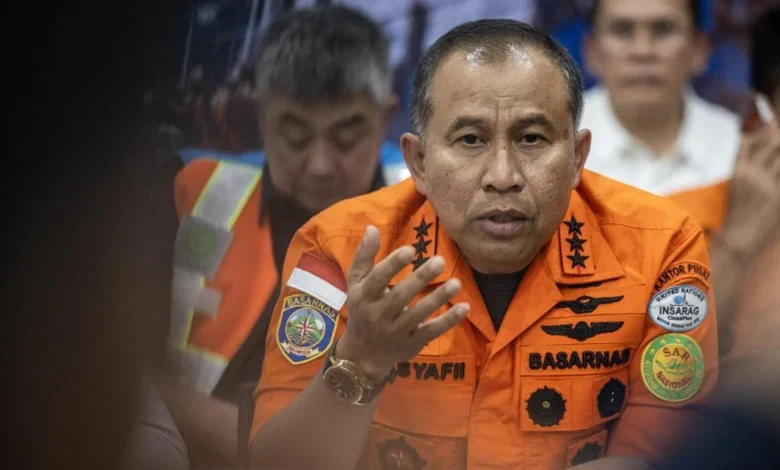
During a formal press briefing, Basarnas Head Mohammad Syafii detailed the exact parameters of the sunken vessel’s current location and the intricate safety calculations governing the ongoing multi-agency operation. While the relatively shallow depth of 30 meters might initially suggest favorable conditions for recovery efforts, maritime dynamics and the vessel’s inverted posture have necessitated a highly cautious approach to safeguard the lives of rescue personnel.
Current Location and Subsurface Dynamics
The search and rescue operation, now moving past its initial critical phases, has revealed that KM Virgo Transport 8 is no longer stationary at the exact coordinate where it initially went under. Syafii noted that hydrographic surveys conducted on the second day of the SAR operation confirmed a notable displacement of the vessel’s datum point.
Driven by persistent underwater currents characteristic of the Java Sea, the inverted hull has drifted approximately 1.6 nautical miles in a westerly direction. This continuous movement, coupled with the vessel’s upside-down orientation, has introduced severe complications for underwater navigation and structural penetration.
"The position of the datum or the location point of the Virgo Transport 8 has shifted. From what I conveyed previously, it has now moved approximately 1.6 nautical miles to the west while remaining in an inverted condition," Syafii stated.
Maritime experts and naval tacticians advising the operation have emphasized that stationary wrecks in deep or semi-deep environments are generally preferable for stabilization before complex intervention begins. In alignment with input received from the Indonesian Navy (TNI AL), Basarnas has evaluated whether leaving the hull undisturbed at the seabed could mitigate secondary risks, though the imperative to locate potential survivors trapped in air pockets remains the overarching priority.
Operational Hazards and Diving Safety Constraints
Operating on the principle of absolute safety—famously prioritized as "safety first" in professional rescue protocols—Basarnas has deliberately withheld authorization for divers to forcefully penetrate the submerged hull. The structural integrity of the upside-down vessel, combined with internal compartmentalization, creates an environment rife with lethal hazards.
Modern commercial and cargo vessels feature numerous watertight compartments, void spaces, and internal corridors. When such a ship capsizes and sinks, these enclosed areas can trap pockets of air, creating localized buoyancy and pressure differentials. Syafii highlighted that attempting to force entry or arbitrarily breaching internal bulkheads could trigger violent shifts in pressure or sudden structural collapses, endangering the lives of the rescue divers.
"If the position is inverted when the diving team enters, it certainly carries its own risks, and operations can only be carried out if they meet regulations and safety first standards," Syafii explained. "Moreover, when there are empty spaces in the ship, if we force entry and happen to open one of the bulkheads of these empty spaces, there will be an extraordinary pressure change. This would certainly be extremely dangerous."
Because human physiological limits under compressed air or mixed-gas diving protocols are strictly regulated, maritime rescue operations of this scale require specialized education, deep-sea salvage experience, and meticulous planning. Basarnas is coordinating closely with specialized technical personnel to assess whether stabilizing the vessel or employing mechanical lifting systems to roll the hull back into an upright position is feasible without compromising the structural evidence or risking further loss of life.
Chronology and Evolution of the SAR Operation
The maritime disaster involving KM Virgo Transport 8 unfolded rapidly, prompting an immediate mobilization of national assets. While comprehensive historical data and continuous chronology logs are actively compiled by the Basarnas Command Center, the operation has entered a critical phase by its third operational day.
On the second day of the SAR mission, surface operations were scaled across six distinct geographical sectors defined within the official Search and Rescue Map (SAR Map). These sectors were established to maximize the probability of containment and visual detection along the drift trajectory. However, due to the dynamic nature of wind patterns, wave action, and subsurface currents in the Java Sea, these search sectors are scheduled for recalibration.
Basarnas announced that the updated operational sectors for subsequent days will be dynamically adjusted based on drift modeling generated by the command center’s predictive software. While underwater teams tackle the complexities of the 30-meter-deep wreckage, surface vessels and aerial surveillance units continue to comb the surrounding maritime expanse, holding firm to the hope of recovering survivors.
"We are still very much hoping that victims can be found alive soon," Syafii affirmed, reiterating the human-centric focus of the mission despite the mechanical hurdles presented by the sunken infrastructure.
Coordination and Strategic Outlook for Phase Three
As the operation transitions into its next critical window, inter-agency collaboration remains the backbone of the mission. Basarnas is actively consulting with naval engineering specialists, salvage experts, and veteran divers from the Indonesian Navy to formulate a comprehensive strategy for the third day and beyond.
The evaluation process includes assessing the utility of remotely operated vehicles (ROVs) equipped with sonar and high-definition optical cameras to inspect the exterior and accessible entry points of the hull safely. By deploying technology prior to human intervention, Basarnas aims to map internal pathways, identify potential air pockets where crew members might have sheltered, and calculate the precise buoyancy forces acting upon the displaced vessel.
Furthermore, logistical preparations are underway to determine whether heavy salvage barges equipped with crane systems can be brought to the site. Righting a vessel of this size at a 30-meter depth is a monumental engineering task that requires precise tidal calculations, seabed soil analysis, and specialized rigging. Any decision to alter the position of KM Virgo Transport 8 will be weighed strictly against the primary objective of search and rescue versus long-term salvage and environmental clearance.
Implications for Maritime Safety and Regional Navigation
The capsizing and subsequent drift of KM Virgo Transport 8 serve as a stark reminder of the unpredictable and unforgiving nature of maritime transport within Indonesian archipelagic waters. Incidents of this magnitude not only trigger immediate emergency responses but also prompt broader industry-wide scrutiny regarding cargo load distribution, stability management, and adherence to safety protocols prior to departure.
While official investigations into the root cause of the capsizing will be spearheaded by the National Transportation Safety Committee (KNKT) once the immediate rescue phase concludes, the current operational focus remains squarely on human life and tactical precision. Navigational warnings have been broadcasted to all commercial and artisanal vessels operating in the vicinity of the Java Sea datum zone to ensure maritime traffic avoids the drifting wreckage area and remains clear of active SAR vessels.
As the operation pushes forward, Basarnas continues to provide transparent updates to the public and victim families, balancing urgency with rigorous adherence to international maritime safety standards. The coming days will prove decisive as specialized diving teams and technical planners determine the safest and most effective pathway to resolve the complex challenges posed by the submerged hulk of KM Virgo Transport 8.