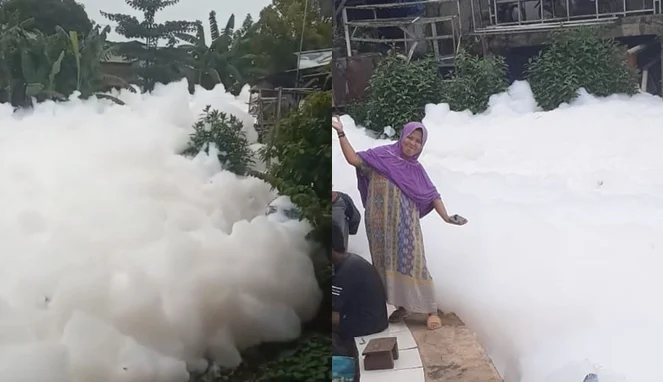
A viral video depicting severe environmental degradation has captured public attention after thick, towering layers of white foam completely blanketed a river in Depok, West Java. The alarming footage, which circulated widely across social media platforms starting late Monday afternoon, November 27, 2023, showcased a portion of the Kali Baru river in Tugu Village, Cimanggis Subdistrict, where the water surface was entirely obscured by dense synthetic froth that billowed high enough to spill over the riverbanks and encroach upon nearby residential properties.
The incident has triggered widespread concern among local residents and online communities, drawing sharp scrutiny toward industrial and domestic waste management practices in the densely populated urban center. Environmental authorities have since launched an investigation to trace the exact origins of the pollutant, while experts warn of the multifaceted hazards such severe chemical contamination poses to both public health and the surrounding ecosystem.
Chronology of the Incident and Visual Impact
The phenomenon first drew alarm on November 27, 2023, when local residents noticed strange white formations accumulating along the Kali Baru waterway. According to eyewitness accounts gathered from the location, the foam did not appear instantaneously in its maximum volume. Instead, it began as a subtle accumulation before rapidly expanding into towering masses of white suds that defied normal water flow characteristics.
By late afternoon, the volume of the foam had escalated to such a degree that the underlying river water was completely invisible. Video recordings shared on platforms like TikTok and Instagram captured the sheer scale of the pollution, with onlookers expressing shock at the towering buildup. In several clips, the foam was documented rising high enough to affect at least five residential homes situated along the riparian zone. The person recording the video could be heard exclaiming in distress over the unprecedented scale of the contamination, describing it simply as toxic industrial-style waste overtaking a local waterway.
Local residents reported that the foam emitted a pungent, chemical odor that sharply contrasted with the scent of standard perfumed detergents, suggesting a concentrated influx of cleaning agents or industrial byproducts. True to the transient nature of many surfactant-driven pollution events, the massive blanket of foam eventually dissipated by the night of the same day, leaving behind lingering questions regarding the chemical composition of the water and the safety of the local environment.
Public Reaction and Social Media Outcry
The viral dissemination of the footage prompted an immediate wave of commentary and concern across various social media networks. Because the foam was so dense and voluminous, many internet users initially mistook the phenomenon for a freak weather occurrence, suggesting the footage captured localized cloud formations touching the ground or heavy accumulations of winter snow—an impossibility in Indonesia’s tropical climate.
Once the reality of the environmental hazard set in, public sentiment quickly shifted toward outrage and demands for immediate administrative intervention. Commentators flooded local government channels and news pages, urging the City Government of Depok and the relevant environmental agencies to take swift punitive and corrective action against polluters. The incident magnified existing anxieties among urban residents regarding the systematic neglect of municipal waterways, which frequently bear the brunt of unregulated waste disposal.
Government Response and Investigation
In response to the public outcry and the viral spread of the footage, the Environmental and Hygiene Service (Dinas Lingkungan Hidup dan Kebersihan—DLHK) of Depok City mobilized a field team to investigate the root cause of the contamination. Preliminary assessments conducted by local officials suggest that the towering foam was likely generated by a massive influx of domestic wastewater—specifically high concentrations of surfactants originating from soap, shampoo, or commercial laundry detergents—that had accumulated in the drainage network upstream.
Investigators noted that the sudden surge and surface eruption of the foam were heavily influenced by environmental triggers, notably the seasonal transition period from the dry season to the rainy season. As intermittent rains began to elevate water volume and flow rates, accumulated sediments and chemical residues within the drainage basins were churned and aerated, creating ideal conditions for massive foam generation.
To establish definitive accountability, the DLHK announced plans to conduct comprehensive water quality testing and inspections across local commercial establishments, industrial workshops, and residential clusters situated along the Kali Baru watershed. Officials aim to determine whether specific commercial enterprises failed to properly treat their wastewater before discharging it into public drainage systems.
Broader Environmental and Health Implications
River contamination of this magnitude carries severe ecological and public health ramifications. Environmental science experts emphasize that dense foam blankets on urban rivers are often indicative of high concentrations of non-biodegradable surfactants, which reduce surface tension and severely limit oxygen transfer at the air-water interface. This oxygen depletion asphyxiates aquatic life, threatening the survival of remaining fish and macroinvertebrates in the urban watershed.
From a public health perspective, exposure to heavily polluted surface water poses direct risks to nearby communities. Direct contact with contaminated foam and water can lead to acute skin irritations, dermatological infections, and respiratory issues, particularly given the pungent chemical odors reported by residents. Furthermore, many urban communities rely indirectly on river ecosystems for regional water tables, while agricultural sectors downstream frequently utilize river water for crop irrigation. The presence of high levels of synthetic detergents and potential heavy metals in irrigation water threatens crop safety and long-term soil fertility.
The incident at Kali Baru serves as a stark reminder of the fragile state of urban river management in rapidly developing Indonesian metropolitan areas. As the DLHK continues its forensic audit of the watershed’s discharge points, environmental advocates are calling for stricter enforcement of wastewater regulations, routine water quality monitoring, and enhanced community participation in safeguarding local water resources from unregulated chemical dumping.
Related posts: