Viral Candid Photo of Chinese Model Zi Lang With Sculpted Abs in South Korea Sparks Global Conversation on Evolving Beauty Standards

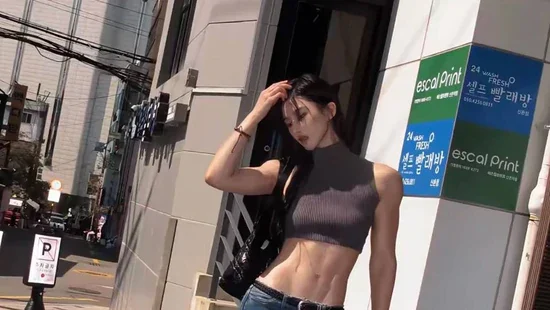
The intersection of fashion, fitness, and international travel frequently produces moments that capture the public imagination, but few have resonated across digital platforms quite like the recent viral phenomenon involving Chinese fashion model Zi Lang. Captured in a candid photograph while walking down a bustling street in South Korea, Zi Lang immediately drew the attention of pedestrians and online commentators alike. What began as a spontaneous snapshot shared on the social media platform Weibo quickly transformed into a cross-border viral sensation, accumulating millions of views, shares, and discussions. The focal point of this widespread public fascination is not merely her striking facial features, but her exceptionally toned physique—specifically, her sharply defined abdominal muscles, or "abs," and athletic upper body, which sharply contrast with traditional, hyper-slender beauty paradigms historically prevalent in East Asian media markets.
As the imagery circulated across various platforms, including Instagram, X (formerly Twitter), and regional blog networks, it ignited a broader discourse regarding the shifting definitions of physical attractiveness for women in the twenty-first century. Zi Lang’s public appearance in Seoul has become a case study in how contemporary modeling is evolving to embrace strength, athleticism, and muscular definition. This comprehensive report examines the chronology of the viral event, the background of the model, the physiological implications of her conditioning, and the socio-cultural ramifications of her growing international appeal.
Chronology of a Viral Sensation
The sequence of events leading to Zi Lang’s international digital footprint unfolded organically over a brief period in late autumn. The timeline underscores the rapid velocity at which modern social media can elevate local sightings into global news stories.
The initial incident occurred on a Tuesday afternoon in a high-traffic commercial and fashion district in South Korea—a country globally recognized for its vibrant street style culture and stringent aesthetic standards. Zi Lang, visiting the country for professional and leisure purposes, was navigating the pedestrian corridors dressed in a contemporary ensemble featuring a crop top paired with low-rise trousers, a styling choice that intentionally highlighted her midsection.
According to eyewitness accounts and subsequent video footage uploaded by bystanders, Zi Lang’s physical presence commanded immediate attention. Several pedestrians reportedly paused to observe her, with some approaching her directly to request photographs after being struck by her commanding posture and physical conditioning. One such candid photograph, capturing her mid-stride with natural lighting accentuating her muscular arms and chiseled abdominal definition, was uploaded to Weibo by a local observer.
Within forty-eight hours of its initial publication, the photograph transcended domestic Chinese networks. By Thursday, content aggregators in South Korea and Southeast Asia had picked up the image, noting the juxtaposition of her delicate, defined facial structure with a physique typically associated with professional fitness competitors rather than runway models. By the weekend, major digital lifestyle publications had identified the subject as Zi Lang, a rising figure within the Chinese modeling industry. The narrative shifted from a simple "street spot" curiosity to an in-depth exploration of her lifestyle, dietary discipline, and professional portfolio.
Background and Professional Profile of Zi Lang
To understand the public reaction to Zi Lang, it is essential to examine her background within the competitive landscape of the fashion and modeling industry. Zi Lang operates primarily out of China, a market undergoing a gradual but noticeable transition regarding the representation of female bodies in advertising, editorial spreads, and runway shows.
Historically, the dominant beauty standard for female models in East Asia has centered around the "Ji Lao Rou" or extreme thinness—often referred to colloquially as the "A4 waist" or "paper-thin" aesthetic, where minimal body fat and a slender, fragile frame were prized above all else. Models were rarely encouraged to display visible musculature, as traditional cultural expectations often associated heavy muscle mass exclusively with male athleticism.
Zi Lang’s entry into and success within the industry challenge these archaic constraints. Standing at a statuesque height with exceptionally balanced proportions, she has cultivated a unique personal brand that bridges high fashion with athletic empowerment. Her portfolio frequently showcases her ability to carry avant-garde, streetwear, and minimalist collections, all while maintaining a physique built on rigorous functional training. Industry insiders note that Zi Lang’s dedication to fitness extends far beyond basic weight maintenance; her conditioning requires a disciplined regimen of resistance training, core stability work, and cardiovascular endurance, paired with a meticulously managed nutritional intake designed to preserve lean muscle tissue while maintaining a remarkably low body fat percentage.
The Anatomy of the "Handsome Girl" Aesthetic
One of the most recurring themes in the commentary surrounding Zi Lang’s viral moment is the embrace of the "handsome girl" or "shuai ge" aesthetic—a term that, in contemporary Chinese digital culture, is increasingly applied to women who exude charisma, physical strength, confidence, and a departure from hyper-feminine tropes.
Sociologists and cultural analysts tracking Asian media trends have pointed out that younger generations are redefining gender expression. The traditional dichotomy dividing hyper-masculine strength and passive femininity is steadily dissolving. Zi Lang embodies this modern archetype. Her physical presentation—characterized by broad, defined shoulders, well-muscled arms, a tightly corseted waist with virtually no subcutaneous fat, and abdominal muscles commonly described as "block-shaped"—projects an aura of autonomy and physical capability.
Fashion psychologists suggest that when women project physical strength in public spaces, it communicates a subconscious message of self-reliance and empowerment. This partly explains why her choice of attire in Seoul—deliberately exposing her toned midriff—resonated so deeply. It was not merely a fashion statement; it was an unapologetic display of the physical fruits of intensive labor and personal dedication.
Industry Implications and the Evolution of Beauty Standards
The viral traction of Zi Lang’s candid photographs carries broader implications for the global fashion, advertising, and fitness industries. For decades, the modeling sector has faced intense criticism for promoting unhealthy, unattainable, and fragile body standards that frequently correlated with eating disorders and poor mental health among young consumers.
In recent years, however, consumer demand has shifted decisively toward wellness, strength-training, and functional health. Brands are increasingly recognizing that modern consumers—particularly Gen Z and millennial demographics—respond more favorably to models who represent vitality, health, and active lifestyles.
- Shifting Advertising Demands: Commercial brands in China and South Korea are slowly moving away from frail, passive archetypes. Athletic models who can authentically market sportswear, outdoor gear, and lifestyle brands are seeing a surge in demand. Zi Lang’s marketability is expected to rise significantly as mainstream brands seek out ambassadors who symbolize empowerment and health.
- Impact on Public Health and Fitness Culture: The viral spread of images showcasing strong female physiques has a tangible, positive influence on public health discourse. When fitness is visibly normalized and celebrated in mainstream media, it encourages broader demographic segments—particularly young women—to engage in resistance training, weightlifting, and sports, moving away from restrictive, starvation-based dieting cultures.
- Cross-Cultural Aesthetic Appreciation: The fact that a Chinese model captured the public imagination so intensely on the streets of South Korea highlights the growing integration of East Asian pop culture and aesthetic trends. Both nations share massive digital infrastructures where fashion and fitness trends cross borders almost instantaneously, creating a unified regional market that increasingly values physical vigor.
Public and Professional Reactions
While the overwhelming majority of responses to Zi Lang’s viral photos have been celebratory, the commentary provides a fascinating window into contemporary societal attitudes toward fitness and the female form.
On Chinese platforms like Weibo and Xiaohongshu, thousands of users expressed admiration for her discipline. Comments frequently highlighted the sheer amount of effort required to sculpt an abdominal wall defined by deep, clear-cut lines while maintaining a slender waistline. Many female users noted that Zi Lang serves as an inspiration to step away from cardio-centric weight loss programs and embrace weight training.
Similarly, South Korean netizens—known for their discerning eye regarding fashion and physical presentation—praised her effortless fusion of high-fashion elegance and athletic rigor. Online forums featured discussions comparing her physique favorably to professional fitness athletes, while noting that her ability to maintain such conditioning while working as a commercial and editorial model is a testament to extraordinary professional commitment.
At the same time, cultural commentators have emphasized that while models like Zi Lang are breaking barriers, the broader industry still has significant ground to cover. True inclusivity in fashion requires not only celebrating exceptionally fit and genetically fortunate models like Zi Lang, but also expanding representation to encompass a wide spectrum of body types, heights, and physical abilities.
Conclusion
The viral moment of Zi Lang navigating the streets of Seoul is more than a fleeting social media curiosity; it is a visible marker of cultural transition. By proudly displaying a body sculpted through rigorous athleticism, uninhibited by outdated cultural scripts that demand female physical fragility, Zi Lang has captured the zeitgeist of a new era.
As the boundaries between fashion, health, and physical capability continue to blur, figures like Zi Lang serve as pioneers of a modern aesthetic where strength is synonymous with beauty. Whether this viral attention translates into long-term systemic changes across the global modeling industry remains to be observed, but the directional shift is unmistakable: the future of fashion belongs to those who embody health, vitality, and unapologetic physical strength.
Related posts: