The legal web surrounding corruption within Indonesia’s financial and regulatory institutions has tightened significantly following a series of high-profile developments involving senior government officials. Ahmad Dedi, an official within the Directorate General of Customs and Excise under the Ministry of Finance—commonly referred to in public discourse by his moniker Dedi Congor—now finds himself at the center of a sprawling multi-agency corruption scandal. Having garnered widespread notoriety earlier this year for sprinting away from investigative journalists at the Anti-Corruption Commission (KPK) headquarters, Dedi now carries the heavy burden of holding dual suspect statuses issued by both national law enforcement bodies: the Indonesian National Police (Polri) and the KPK itself.
The case underscores systemic vulnerabilities within customs regulation, import facilitation, and enforcement oversight, highlighting the challenges faced by Indonesian authorities in rooting out entrenched graft. As investigators piece together years of alleged illicit transactions, the unfolding legal saga provides a sobering look at how regulatory authority can be manipulated for private enrichment, triggering sweeping institutional repercussions and high-stakes courtroom battles.
A Viral Exit and the Rising Tide of Suspicion
The public obsession with the case arguably began not inside a courtroom, but in the glaring lights of media cameras outside the KPK building in May 2026. Dedi, having just concluded a routine examination as a witness before anti-corruption investigators, took the media by surprise when he bolted from the lobby at high speed, desperately attempting to avoid microphones and pointed questions regarding his alleged involvement in corrupt practices. The dramatic sprint instantly captured the public imagination, transforming him into a viral symbol of administrative evasion and cementing the nickname "Dedi Congor" across digital platforms.
However, the drama surrounding his evasive maneuver was merely the tip of the iceberg. In the months that followed, Dedi’s name surfaced repeatedly during corruption trials involving high-ranking customs officials and corporate executives. Most notably, his name appeared prominently in court verdicts concerning the leadership of several cargo companies accused of bribing customs officials to smooth over import operations. According to official judicial findings read during these trials, Dedi was explicitly accused of receiving a staggering Rp 30 billion in illicit kickbacks.
Dedi’s legal counsel has vigorously denied these allegations, asserting that their client never received the purported Rp 30 billion. Furthermore, Dedi has privately and publicly expressed frustration over his ubiquitous moniker, maintaining that friends and family know him strictly by his given name, Ahmad Dedi. Despite these denials, the weight of accumulating documentary evidence and witness testimonies has proven insurmountable, paving the way for formal criminal charges from two separate investigative authorities.
The Polri Investigation: Gratuities from a Past Era
While the KPK’s recent focus has dominated media headlines, Dedi’s legal troubles actually trace back years through an extensive investigation conducted by the Corruption Crime Eradication Corps (Kortas Tipikor) of the Indonesian National Police. According to law enforcement records, Polri formally established Dedi’s suspect status in connection with alleged acceptance of gratifications during his tenure as the Head of Enforcement Section at the Directorate of Enforcement and Investigation (P2) within the Directorate General of Customs and Excise.
The alleged offenses span a significant historical window, occurring between 2008 and 2016. Kortas Tipikor initiated preliminary inquiries into these suspect gratuities as early as 2017, methodically building a case file that tracked suspicious financial movements tied to his regulatory decisions.
Providing official confirmation of the police’s ongoing legal measures, the Head of Operations for Kortas Tipikor Polri, Senior Commissioner Ahmad Yusuf Afandi, addressed the matter in an interview with reporters.
"Correct, he is a suspect regarding alleged gratification," Yusuf confirmed via telephone.
As the investigative phase reaches maturity, law enforcement agencies are coordinating closely with the judicial system. Yusuf noted that investigators are currently focused on completing administrative requirements and fulfilling the prosecution’s feedback files, known locally as the P19 directive from prosecuting attorneys, ensuring that the Polri dossier is robust enough to withstand judicial scrutiny in an open court.
The KPK Inquiry: Import Bribery and the Net Widens
Compounding his legal jeopardy, the Corruption Eradication Commission (KPK) formally designated Dedi as a suspect in September 2026, making him the ninth individual to be implicated in an expansive investigation into bribery related to import facilitation and customs clearance procedures.
Detailing the commission’s actions, KPK Spokesperson Budi Prasetyo briefed reporters on the timeline and scope of the indictment.
"Individual AD, who is an employee of the Directorate General of Customs and Excise, has also been designated as a suspect," Budi stated.
Budi clarified that Dedi’s official transition from witness to suspect occurred concurrently with actions taken against Gatot Heroe, who served as the Head of Sub-directorate for Enforcement at the P2 Directorate of Customs and Excise. The synchronization of these suspect designations points to a coordinated prosecutorial strategy aimed at dismantling what investigators believe was a structured network of extortion and bribery operating within the regulatory apparatus of international trade.
In tandem with these criminal charges, the KPK has imposed strict travel restrictions on Dedi, placing him on an official exit ban list to prevent him from fleeing the jurisdiction while pre-trial investigations and asset tracing operations are underway.
"It is true that investigators have implemented a travel ban abroad for the individual in question," Budi confirmed, though he declined to specify the exact duration for which the preventative measure has been authorized.
Broader Legal Landscape: Convictions and Ongoing Trials
The criminal proceedings against Ahmad Dedi do not exist in a vacuum; they form a critical node in a massive judicial crackdown on corrupt practices within the customs and excise ecosystem. Prior to Dedi’s formal indictment, the KPK had already secured multiple high-profile convictions against corporate actors who funneled bribes through cargo logistics firms to bypass regulatory roadblocks.
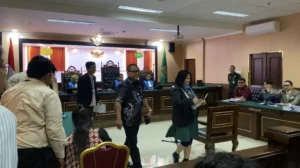
Notably, three representatives from Blueray Cargo have already faced the full force of the judiciary, receiving prison sentences and substantial financial penalties for their roles as corporate paymasters:
- John Field was sentenced to 3 years in prison, accompanied by a fine of Rp 300 million with a subsidiary provision of 100 days of confinement.
- Deddy Kurniawan Sukolo received a 2.5-year prison sentence alongside a Rp 200 million fine, backed by a subsidiary penalty of 80 days.
- Andri was similarly sentenced to 2.5 years behind bars and ordered to pay a Rp 200 million fine, with an 80-day subsidiary confinement term.
Beyond the corporate bribers, the judicial net has also captured several high-ranking internal figures from the Directorate General of Customs and Excise, who are currently navigating various stages of prosecution and trial. Prosecutors have pursued heavy prison terms and asset recovery measures, reflecting the severe financial loss inflicted on the state. The ongoing cases involving customs officials include:
- Rizal, who faces a demanding prosecution request of 11.5 years in prison, a Rp 1 billion fine (or 190 days subsidiary), and a staggering restitution payment of Rp 15.7 billion, backed by an additional 4-year subsidiary sentence.
- Sisprian Subiaksono, who is facing a 10-year prison sentence, a Rp 1 billion fine, and direct asset restitution amounting to Rp 7.4 billion, alongside foreign currency restitutions of SGD 150,000 and USD 10,000.
- Orlando Hamonangan, who has been handed a prosecution demand of 7.5 years imprisonment, a Rp 1 billion fine, and asset replacement obligations exceeding Rp 5.5 billion.
Meanwhile, collateral proceedings continue to move through the courts. Budiman Bayu Prasojo, serving as the Head of Excise Intelligence at the P2 DJBC, remains deep in the witness examination phase of his trial. Simultaneously, the separate case file concerning Gatot Heroe continues to wind its way through the KPK’s investigative pipeline, suggesting that the ultimate tally of indicted state officials may continue to rise.
Systemic Implications and Institutional Reform
The dual-suspect status of Ahmad Dedi serves as a watershed moment for the Indonesian Ministry of Finance, particularly concerning internal oversight within the Directorate General of Customs and Excise. As the nation’s primary gatekeeper for international trade, logistics, and border revenue collection, the agency has historically grappled with perceptions of vulnerability to rent-seeking behaviors and administrative capture.
The convergence of investigations by both the National Police and the anti-corruption commission illustrates a rare inter-agency synergy, yet it simultaneously raises questions regarding institutional accountability and internal vetting mechanisms. Analysts note that the systemic nature of the bribery schemes—involving coordinated actors across multiple sub-directorates and external cargo enterprises—points to deep-seated structural flaws that allowed illicit arrangements to persist unchecked for years.
For the Ministry of Finance, the fallout demands an aggressive acceleration of bureaucratic reforms, digital automation of customs clearance to minimize human discretion, and stricter asset declaration audits for officials holding high-risk regulatory portfolios. As Dedi prepares to face trial across multiple jurisdictions for both historical gratuities and recent import bribery allegations, the ultimate outcome of these proceedings will serve as a crucial barometer of Indonesia’s broader capacity to cleanse its vital economic institutions of systemic corruption.