The legal and administrative controversy surrounding the high school educational background of Vice President Gibran Rakabuming Raka has entered a new phase, moving beyond the constitutional arena and into the State Administrative Court (PTUN) in Jakarta. Despite prior scrutiny and a previous ruling by the Constitutional Court (MK), the legitimacy of the educational equivalency documents utilized by the Vice President continues to be contested by external parties, culminating in dramatic courtroom proceedings marked by a sudden walkout and the presentation of academic records.
This ongoing judicial saga highlights the intricate intersection of administrative law, political accountability, and educational verification standards in contemporary Indonesian governance. As the litigation unfolds, it brings to the forefront procedural debates concerning transparency, the burden of proof in administrative disputes, and the rigorous standards applied to the credentials of high-ranking state officials.
Background and Context of the Educational Equivalency Dispute
The controversy stems from the administrative process undertaken to validate Gibran Rakabuming Raka’s secondary education credentials, which were obtained abroad before he registered as a vice-presidential candidate. Under Indonesian electoral regulations, candidates running for high national office must present verified proof of educational attainment equivalent to a senior high school (SMA) diploma.
In August 2019, the Directorate General of Secondary and Special Education—then operating under the Ministry of Education and Culture—issued Ministerial Decree Number 9149/D.D1/KS/2019 concerning the equivalency of educational credentials. This decree served as the legal basis recognizing Gibran’s foreign studies as meeting the domestic high school requirement. However, critics and opposing entities have persistently questioned the evidentiary foundation upon which this equivalency was granted, arguing that it relied on alternative attendance records rather than a traditional high school graduation certificate.
The issue previously came under review by the Constitutional Court (MK) during broader electoral dispute proceedings. The MK noted in its findings that the educational equivalency certificate used by Gibran for his candidate registration was issued based on a certificate of attendance and supporting documents rather than a conventional high-level secondary diploma. Nevertheless, the Constitutional Court ultimately dismissed the disqualification petitions brought before it, ruling that the plaintiffs lacked the requisite legal standing (legal standing) to challenge the presidential election results under those specific statutory provisions.
Chronology of the PTUN Jakarta Proceedings
Following the conclusion of the electoral disputes at the Constitutional Court, the controversy transitioned into the administrative jurisdiction. A formal lawsuit was lodged at the Jakarta State Administrative Court (PTUN Jakarta) and registered under case number 255/G/2026/PTUN.JKT. The plaintiff in this matter is PT Mercy Toga Kirana, a corporate entity challenging the legality of the administrative decision, with the Director-General of Secondary and Special Education of the Ministry of Primary and Secondary Education (Kemendikdasmen) named as the primary defendant.
The lawsuit requests the court to nullify Ministerial Decree No. 9149/D.D1/KS/2019, alleging severe substantive and procedural flaws. The plaintiffs contend that the decree was issued without primary foundational documents, suffered from procedural defects by being issued by an unauthorized official without adhering to mandatory electronic formats, and violated the General Principles of Good Governance (AAUPB)—specifically principles of prudence, openness, legal certainty, and equal treatment. Furthermore, the plaintiffs sought a court order compelling the defendant to permanently revoke and register the cancellation of the decree within sixty working days, as well as to formally respond to an administrative clarification request filed earlier in February 2026.
Throughout the months following its initial filing in August 2026, the case proceeded through standard administrative litigation stages, including electronic submissions of answers by intervenor defendants and the conventional filing of additional documentary evidence.
Dramatic Courtroom Developments and the Walkout
The litigation took an unexpected turn during a recent evidentiary hearing when the legal counsel for the plaintiffs, Denny Indrayana, announced the sudden withdrawal of the lawsuit. The decision to pull back from the proceedings was framed by the plaintiff’s legal team as a response to the alleged failure of the defendant—the Ministry of Primary and Secondary Education—to present crucial administrative documents substantiating the issuance of the equivalency decree.
During the session, the plaintiff’s counsel emphasized that essential evidentiary items previously discussed during the Constitutional Court hearings—namely, the certificate of attendance at UTS Insearch, grade transcripts reflecting attendance across multiple distinct academic semesters spanning from 2004 to 2007, and enrollment documentation—were not sufficiently produced in the PTUN proceedings. Arguing that these foundational records were indispensable for evaluating the legality of the disputed equivalency letter and asserting that the absence of such documentation undermined procedural fairness, the plaintiffs chose to withdraw their claim.
However, under administrative court procedural rules, the unilateral withdrawal of a lawsuit after a certain stage of examination requires the consent of the opposing parties. Both the representatives of the Ministry of Primary and Secondary Education and the legal team representing Vice President Gibran Rakabuming Raka—who participated as an interested party—formally objected to the withdrawal request.
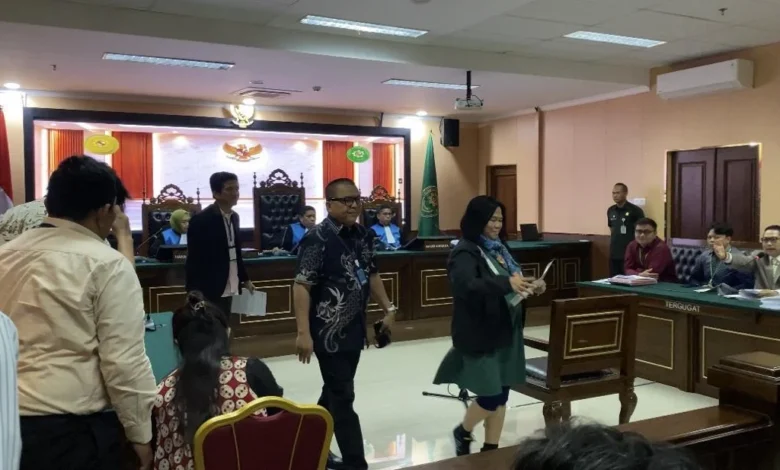
Muhammad Rullyandi, legal counsel for Gibran, argued that the attempt to withdraw the suit after extensive examination demonstrated a lack of seriousness on the part of the plaintiffs. Following the court’s acknowledgment of the objections and the refusal to grant an immediate unilateral dismissal, Denny Indrayana and his team executed a walkout, formally leaving the courtroom while maintaining their stance on the withdrawal of the case. The presiding judges, while noting the departure, underscored the importance of maintaining verifiable administrative records within judicial forums to preserve institutional trust.
Defense Presentation and Scrutiny of Academic Credentials
Amidst the procedural friction regarding the plaintiff’s withdrawal, the legal team representing Vice President Gibran Rakabuming Raka seized the opportunity to present extensive documentation directly to the bench and the public. In an effort to dispel ongoing rumors and demonstrate transparency, attorney Muhammad Rullyandi displayed digital scans of a complete portfolio of academic credentials spanning from elementary school through undergraduate higher education.
The documentation presented in court and made available to media observers included records ranging from elementary and junior high school completion certificates to the UTS Insearch certificate of attendance, a diploma from The Management Development Institute of Singapore (MDIS), and a bachelor’s degree from the University of Bradford. Rullyandi stated that a comprehensive dossier containing these verified scans had been formally submitted to the presiding judges as part of a 69-page formal legal response, which was also uploaded to the electronic court system (e-court) and shared with the opposing parties.
The defense emphasized that physical, original copies of the educational certificates will be formally introduced into evidence at the appropriate procedural juncture, adhering strictly to evidentiary requirements mandated by Indonesian procedural law. This public display was designed to counter persistent public skepticism and reinforce the legal validity of the Vice President’s educational pathway.
Broader Implications and Institutional Impact
The ongoing legal maneuverings at PTUN Jakarta carry notable implications for the broader political and administrative landscape of Indonesia. While the immediate courtroom battle involves technical questions of administrative law and the evidentiary standards required for foreign degree equivalency, the case resonates within the wider sphere of public accountability.
From a legal perspective, the dispute underscores the complex challenges courts face when adjudicating administrative decisions that intersect with high-profile political figures. Administrative litigation requires strict adherence to procedural timelines, statutory evidentiary rules, and the precise interpretation of ministerial decrees. The reluctance of plaintiffs to proceed without specific primary records, contrasted with the defense’s strategy of proactive document disclosure, illustrates the high stakes involved in validating official state records.
Furthermore, the controversy highlights the growing role of digital court systems (e-court) and public transparency in modern Indonesian litigation. As both sides leverage digital evidence and public briefings to articulate their positions, the proceedings serve as a test case for how administrative courts handle politically sensitive credential disputes.
Ultimately, whether the PTUN Jakarta proceedings reach a definitive judicial conclusion or conclude through procedural dismissals, the case cements the necessity of robust, transparent, and legally sound administrative record-keeping within government ministries. As state institutions continue to navigate challenges to official decrees, the judiciary remains the ultimate arbiter in balancing administrative compliance with the rights of citizens and state officials alike.